Schloss
Raudondvaris Castle
🇱🇹 Litauen · 14. Jahrhundert
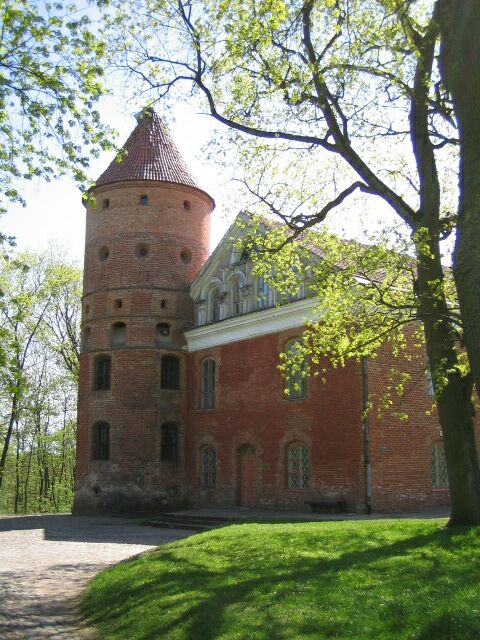
Raudondvaris Castle (litauisch Raudondvario pilis, polnisch Czerwony Dwór, wörtlich „Rotes Gutshaus“), auch als Gutshaus Raudondvaris bezeichnet, ist eine gotisch-renaissancezeitliche Adelsresidenz in dem gleichnamigen Ort Raudondvaris in Litauen.
Erstmals 1392 von Chronisten des Deutschen Ordens als heidnische Wehranlage erwähnt. Als Samogitien an den Orden überging, errichteten die Ordensritter an dieser Stelle eine kleine Burg namens Koenigsburg, in der 80 Ritter und 400 Soldaten Unterkunft fanden. Nach der Schlacht bei Tannenberg (Grunwald) wurde die Burg weiter verstärkt und erweitert. Seither war sie bis 1549 persönliches Eigentum der Könige Polens und Großfürsten Litauens, als Sigismund II. August sie (samt der umliegenden Stadt) seiner Frau, Königin Barbara Radziwiłł, schenkte. Nach ihrem Tod fiel das aus rotem Backstein erbaute Gutshaus, das dem umliegenden Dorf Czerwony Dwór, dem heutigen Raudondvaris, seinen Namen gab, in Verfall und wurde an die Familie Gintowt-Dziewałtowski verkauft, die es bald darauf wieder an die mächtige Familie Radziwiłł verkaufte.
Zwischen 1653 und 1664 ließ Fürst Janusz Radziwiłł es umbauen und renovieren, wodurch es seine heutige Gestalt erhielt. Nach seinem Tod ging das Gut von einer Adelsfamilie zur nächsten über, zunächst an die Worłowski, dann an die Familie Zabiełło, und schließlich wurde es in den 1820er Jahren von Benedykt Tyszkiewicz erworben. Nach dem Novemberaufstand 1831 wurde die Burg von der russischen Armee verwüstet, jedoch bald darauf wiederaufgebaut. Die Renovierung von 1832 bis 1855 verlieh ihr die neugotische Gestalt, wobei einige Spuren früherer Renaissance- und Gotikelemente noch sichtbar sind (insbesondere der Rundturm, der als Teil der ursprünglichen Ordensburg gilt). Um diese Zeit wurde das Gutshaus von einem großen englischen Garten mit einer großen Orangerie voller Zitronenbäume umgeben.
Maschinell übersetzt aus „Raudondvaris Castle“ in der englischsprachigen Wikipedia, CC BY-SA 4.0.
Raudondvaris Castle steht weltweit auf Platz 4.464 von 8.134 im Burgen-Bekanntheitsranking des Atlas und Nr. 28 der 32 in Litauen verzeichneten. Die Gründung fällt auf 1392 — früher als bei 55% der datierten Objekte des Atlas — eines von 604 Atlas-Objekten, die im 14. Jahrhundert gegründet wurden. Im Umkreis von 25 km stehen 3 weitere Objekte des Atlas. Der nächste Ausflugs-Guide ist Kaunas, 11 km entfernt. Sehen Sie in der Burgen-Statistik, wie Litauen abschneidet.
Auf der interaktiven Burgenkarte ansehen →Häufige Fragen
Wo liegt Raudondvaris Castle?
Raudondvaris Castle liegt in Litauen, bei 54.94306°, 23.78333°.
Wann wurde Raudondvaris Castle erbaut?
Der Atlas nennt als Gründungsjahr 1392. Frühere Anlagen mögen an dieser Stelle bestanden haben; dies ist das älteste dokumentierte Gründungsjahr.
Wie bekannt ist Raudondvaris Castle?
Im Bekanntheitsranking dieses Atlas: Platz 4.464 von 8.134 weltweit, Platz 28 in Litauen. Bekanntheit misst hier, in wie vielen Wikipedia-Sprachversionen ein Denkmal steht und wie oft diese gelesen werden.
Welche Burg liegt in der Nähe von Raudondvaris Castle?
Eighth Fort, rund 7 km entfernt.
Weitere Burgen in Litauen
- Rokantiškės Castle Litauen · 12. Jahrhundert
- Pac Palace (Vilnius) Litauen · 16. Jahrhundert
- Chodkevičiai Palace Litauen · 15. Jahrhundert
- Kernavė Litauen · 13. Jahrhundert
Weitere Schlösser
- Schloss von Bornem Belgien · 10. Jahrhundert
- Charlottenlund Castle Schweden · 19. Jahrhundert
- Viderup Castle Schweden · 17. Jahrhundert
- Björnstorp Castle Schweden · 18. Jahrhundert