 Spain · 11th century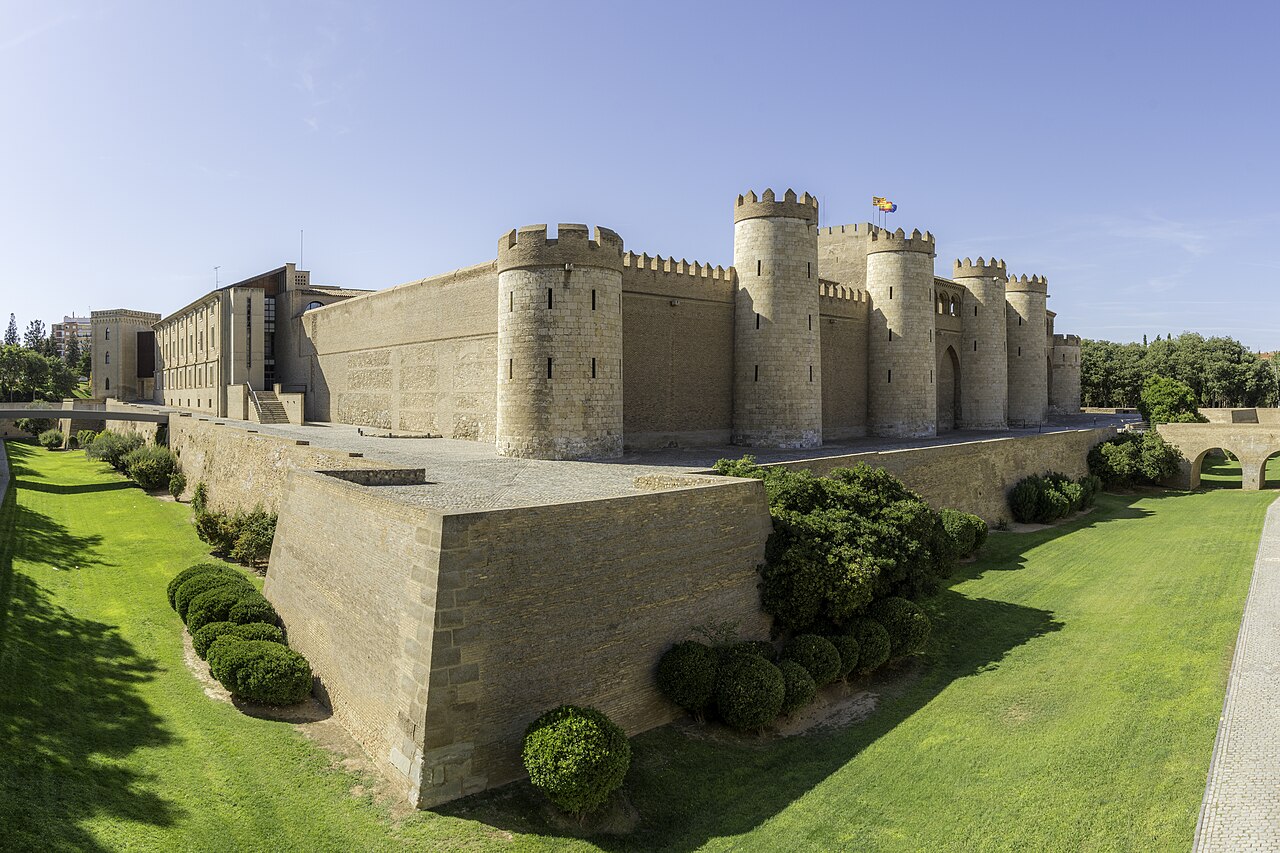
The Aljafería Palace (Spanish: Palacio de la Aljafería; Arabic: قصر الجعفرية, tr. Qaṣr al-Jaʿfariyah) is a fortified medieval palace built during the second half of the 11th century in the Taifa of Zaragoza in Al-Andalus, present day Zaragoza, Aragon, Spain. It was the residence of the Arab Banu Hud dynasty during the era of Abu Jaffar Al-Muqtadir. The palace reflects the splendor attained by the Taifa of Zaragoza at its height. It currently houses the Cortes (regional parliament) of the autonomous community of Aragon.
The structure is the only conserved large example of Spanish Islamic architecture from the era of the taifas (independent kingdoms). The Aljafería, along with the Mosque–Cathedral of Córdoba and the Alhambra, are the three best examples of Hispano-Muslim architecture and have special legal protection. In 2001, the original restored structures of the Aljafería were included in the Mudéjar Architecture of Aragon, a World Heritage Site.
The style of ornamentation of the Aljafería, such as the use of mixtilinear arches and springers, the extension of arabesques over a large area, and the schematisation and progressive abstraction of the yeserias of a vegetal nature, strongly influenced Almoravid and Almohad art in the Iberian Peninsula. The shift in decoration towards more geometric motifs is at the basis of Nasrid art.
After the reconquest of Zaragoza in 1118 by Alfonso I of Aragón, it became the residence of the Christian kings of the Kingdom of Aragón. It was used as a royal residence by Peter IV of Aragón (1319–1387) and, in 1492, it was converted into the palace of the Catholic Monarchs. In 1593 it underwent another restructuring that would turn it into a military fortress, first according to Renaissance designs (which today can be seen in its surroundings, moat, and gardens) and later for quartering military regiments.
Text adapted from “Aljafería” on Wikipedia, CC BY-SA 4.0.
Aljafería ranks #240 of 9,079 worldwide in the atlas's castle fame ranking, and #10 of the 607 mapped in Spain. Founded c. 1075, it is older than 87% of the atlas's dated landmarks — one of 436 atlas entries founded in the 11th century. Its Wikipedia articles were opened 15,035 times in the last 60 days, more than 96% of the atlas. 1 more atlas landmarks stand within 25 km. See how Spain compares in the castle statistics.
View on the interactive castle map →