 France · 2nd century BC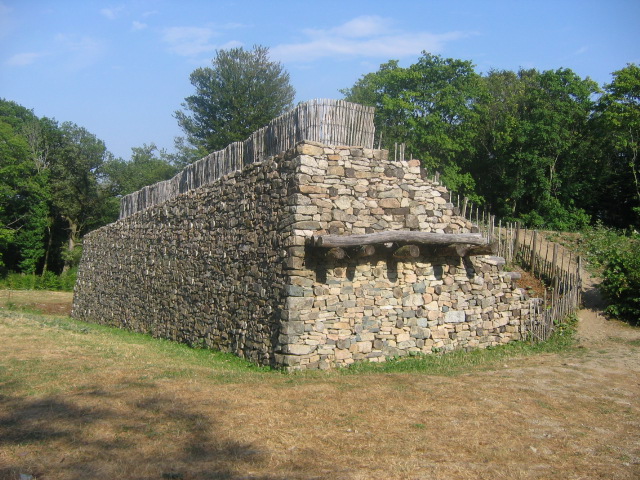
Bibracte, a Gallic oppidum (fortified settlement), was the capital of the Aedui and one of the most important hillforts in Gaul. It was located near modern Autun in Burgundy, France. The material culture of the Aedui corresponded to the Late Iron Age La Tène culture.
In 58 BC, at the Battle of Bibracte, Julius Caesar's armies defeated the Helvetii 26 km (16 mi) south of the fort. In 52 BC, Vercingetorix was proclaimed head of the Gaulish coalition at Bibracte. A few decades after the Roman conquest of Gaul, Bibracte was abandoned in favour of Autun, another 25 km (16 mi) away. Once abandoned, Bibracte remained undisturbed and unexamined until discovered by modern archaeology.
Jacques-Gabriel Bulliot initiated the first excavations at the site between 1867 and 1895. His nephew Joseph Déchelette, author of a famous Manuel d'Archéologie, continued the excavations between 1897 and 1907.
The modern site, known as Mont Beuvray, is generally identified as ancient Bibracte. The site straddles the borders of the French départements of Nièvre and Saône-et-Loire in Burgundy. The site is an archaeological park at the centre of a protected forest. It is the focus of cooperative European archaeological efforts, a training ground for young archaeologists, and a centre for interpreting Gaulish culture for a popular audience. Important international excavations have been undertaken at Mont Beuvray by teams from the universities of Brno, Sheffield, Kiel, Budapest, Vienna and Leipzig.
Before the Roman conquest in 52 BC the great Celtic city of Bibracte had more than thirty thousand inhabitants, protected by a huge stone wall of the Murus Gallicus type which enclosed an area of 135 hectares.
On 12 December 2007 the site of Bibracte received the "Great Site of France" designation.
Text adapted from “Bibracte” on Wikipedia, CC BY-SA 4.0.
Bibracte ranks #280 of 9,079 worldwide in the atlas's castle fame ranking, and #31 of the 793 mapped in France. Founded c. 200 BC, it is older than 99% of the atlas's dated landmarks — one of 12 atlas entries founded in the 2nd century BC. Its Wikipedia articles were opened 13,551 times in the last 60 days, more than 96% of the atlas. See how France compares in the castle statistics.
View on the interactive castle map →