


Palace
Carondelet Palace
 Ecuador · 16th century
- Fame
- Hidden gem
- Founded
- c. 1570
- Style
- Spanish Colonial architecture
- Location
- Quito
- Coordinates
- -0.21972°, -78.5125°
- Open data
- Wikidata Q3288157
- Links
- Wikimedia Commons

Description
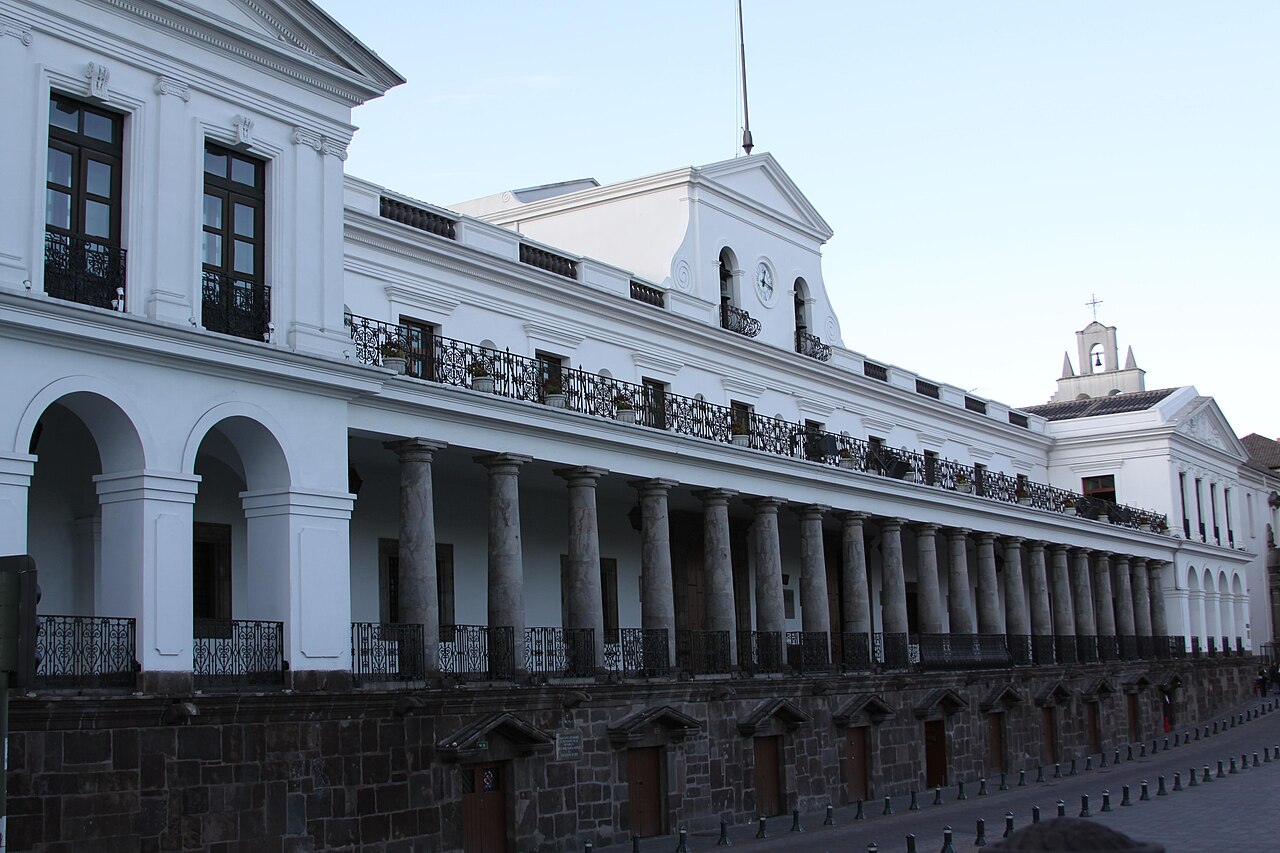
Carondelet Palace (Spanish: Palacio de Carondelet) is the seat of government of the Republic of Ecuador, located in Quito. Access is by the public space known as Independence Square or Plaza Grande (colloquial name), around which are also the Archbishop's Palace, Municipal Palace, Hotel Plaza Grande, and Metropolitan Cathedral.
The history of this emblematic building dates back to colonial times, around 1570, with the acquisition of the former royal houses located in the city of Quito.
The first seat of the Spanish Crown in the Royal Audience of Quito functioned near the convent of La Merced (current Cuenca and Chile streets). After Diego Suarez de Figueroa, secretary of the audience, died in 1611, the government took over his small palace, built in the central square (Plaza Grande).
Juan Fernandez de Recalde, president of the Audience, informed the king that the building was available. It was purchased by the Crown as a larger building to house the Spanish administration in Quito.
Some time later, Recalde's successor, President Antonio de Morga, informed the king that the royal houses needed to be replaced, as they were very old. He proposed buying the adjacent houses. The earthquake of 1627 caused damage and the government was forced to buy the neighboring buildings to restore them. They were rebuilt in stone and brick. Thereafter, the seat of the audience was settled in the front of the Plaza Grande.
In 1799, the Barón Francisco Luis Héctor de Carondelet was appointed chairman of the Audience. In 1801, the Spanish hired Antonio Garcia, to perform the work of rehabilitation and improvements, both of the Audience Palace and the cathedral. He also led the work on the arches of the sewers and the renovation of the Prison building.
After the independence of Ecuador ended with the Battle of Pichincha in 1822, the palace became the headquarters of the South Department of Gran Colombia, welcoming the liberator Simón Bolívar sometimes. He wondered at the elegance and austerity of the building and was delighted with the taste of the Baron of Carondelet (main person in charge of the work); thus, Bolivar gave the building the name of Carondelet Palace.
During the Republican era, almost all the presidents (constitutional, internees and dictators) have worked in this building, which is the seat of Government of the Republic of Ecuador.
Text adapted from “Palacio de Carondelet” on Wikipedia, CC BY-SA 4.0.
In the rankings
Carondelet Palace ranks #1,456 of 9,902 worldwide in the atlas's castle fame ranking. Founded c. 1570, it is older than 35% of the atlas's dated landmarks, one of 933 atlas entries founded in the 16th century. Its Wikipedia articles were opened 2,800 times in the last 60 days, more than 80% of the atlas. See how Ecuador compares in the castle statistics.