 Portugal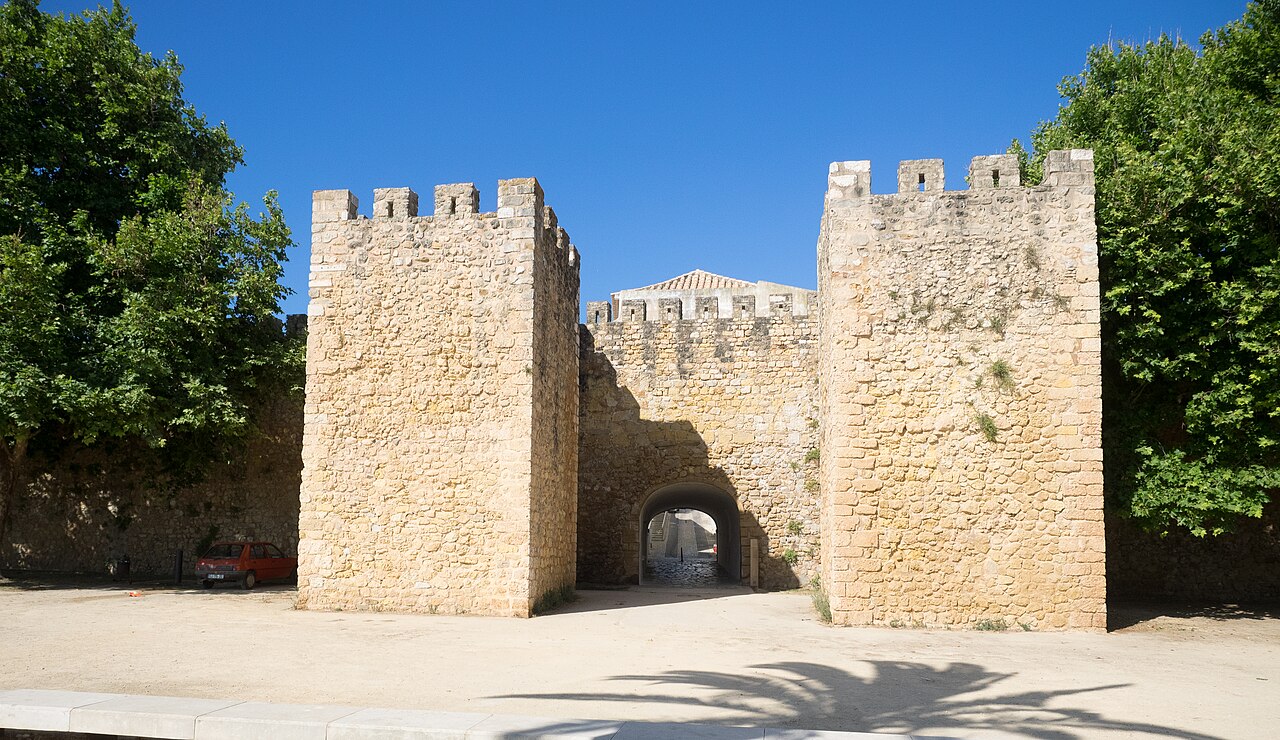
The Castle of Lagos is a medieval castle located in the municipality of Lagos, Portugal. Its walls surrounded the entire city of Lagos, providing the town its main means of defence.
Due to its strategic location, this stretch of coastline has been successively occupied since prehistoric times. In antiquity, the region was visited by Greek navigators, Phoenicians and Carthaginians. When the Romans arrived in the Iberian Peninsula, the primitive village had the Latinized name of Lacóbriga (also written Laccobriga). The new settlement received a quadrangular wall for its defence. The town of Lagos was occupied by Visigoths and later on, in the eight century, by Muslim Moors from North Africa, who renamed the town as 'Zawiya'.
Abd-ar-Rahman III, Caliph of Cordoba, conquered the town in 929 and provided it with towers. The size of these works reflected the economic and strategic importance the town enjoyed, which had a privileged access to Muslim Silves.
During the Christian reconquest of the Iberian peninsula, Lagos was surrendered to King Sancho I in 1189 after the fall of Silves. Almohad Caliph Abu Yusuf Yaqub al-Mansur reconquered the place in 1191, only to be retaken in 1241 by Paio Peres Correia.
From this time there is little reliable information regarding the town's defences under Muslim rule. King Afonso III (1248–1279) began works on the city's walls, which were continued by King Denis (1279–1325) and his successor Afonso IV (1325–1357).
From 1361 onwards, the town of Lagos was separated from the jurisdiction of Silves, reaching administrative independence.
In the context of the Portuguese discoveries, Lagos played an important role. Nearby Sagres was one of the support bases for the conquest of North Africa and the operations of Henry the Navigator (1394–1460), in the first phases of the Age of Discoveries. Due to its harbour, as well as facilities where Caravels and other vessels were built, Lagos played a crucial role in the rise of the Portuguese Empire. From Lagos left:
1415 - Portuguese expeditions to conquer Ceuta in North of Africa; 1419 - Vessels for the discovery of Madeira; 1427 - Vessels for the discovery of the Azores; 1434 - Gil Eanes vessel that crossed Cape Bojador on the West African coast; 1458 and 1472 - The expeditions of King Afonso V (1438–1481) to conquer Ksar es-Seghir, Asilah and Tangier in the North of Africa.
Text adapted from “Castle of Lagos” on Wikipedia, CC BY-SA 4.0.
Castelo de Lagos ranks #6,155 of 9,079 worldwide in the atlas's castle fame ranking, and #104 of the 212 mapped in Portugal. Its Wikipedia articles were opened 1,007 times in the last 60 days, more than 50% of the atlas. 5 more atlas landmarks stand within 25 km. See how Portugal compares in the castle statistics.
View on the interactive castle map →