 France · 12th century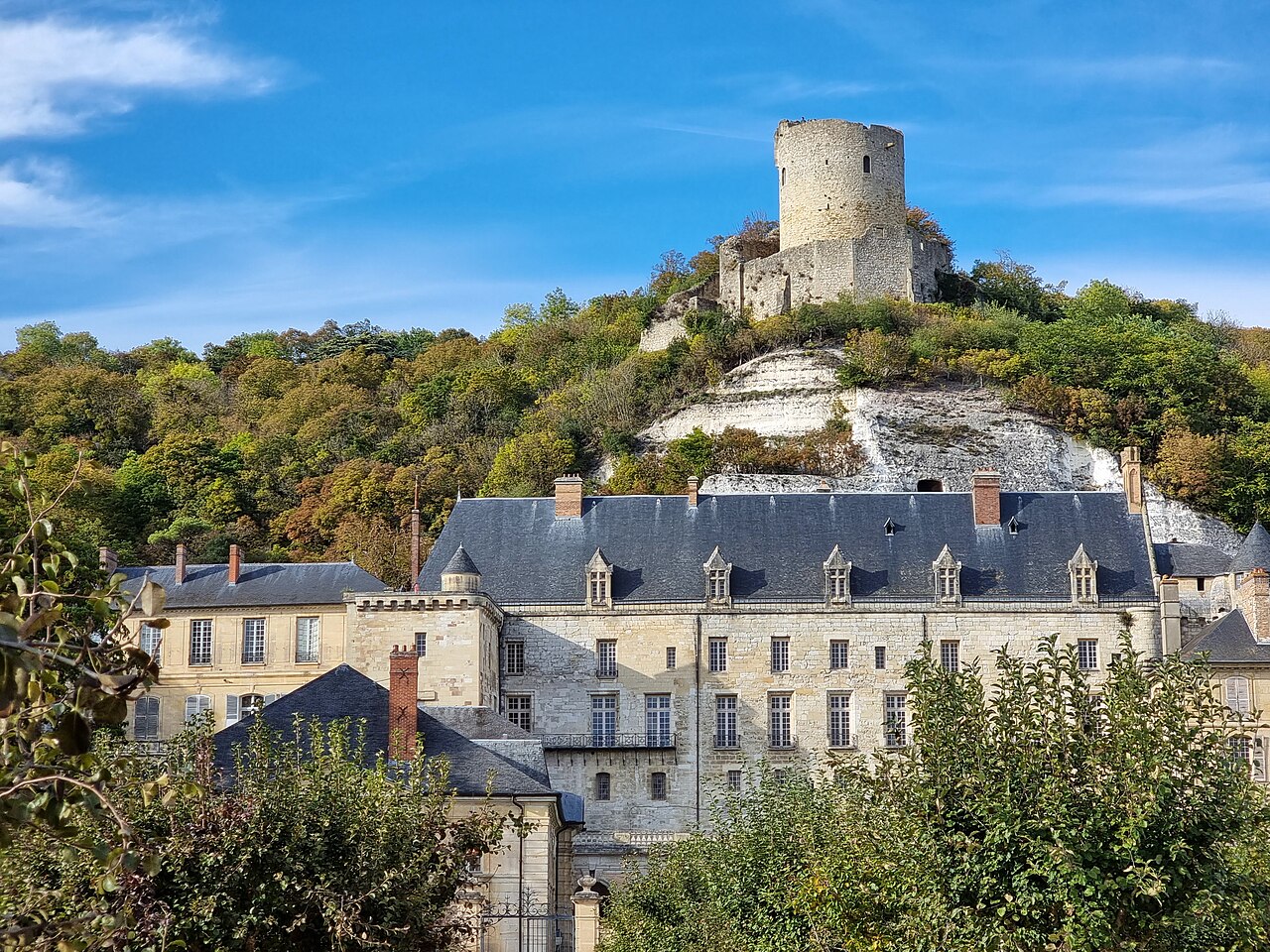
The Castle of La Roche-Guyon is the successor building of a medieval castle which had been built on a limestone rock in a bend of the Seine above the village of La Roche-Guyon, about 65 km northwest of Paris in the present-day département of Val-d'Oise.
Since the 10th century the castle was part of the border fortifications in the wars against the Normans and at times possessed considerable strategic value. The structures are partly dug into the mountain. In the course of the conflicts of the following period they were further strengthened.
The castle belonged to the lords of La Roche (French roche = rock), who traditionally bore the first name Guy and thus gave the place its name. The noble family of La Roche-Guyon descended from Guy de la Roche (early 12th century), existed until the end of the 15th century and was succeeded by the Silly family. The latter were raised to the rank of count in 1515 and were succeeded by the La Rochefoucauld family, which received the ducal title for La Roche-Guyon in 1622. Its most important representative was the writer François de La Rochefoucauld.
In the 14th century a manor house was built at the foot of the rock and a secret passage dug to the upper castle. In the age of the Renaissance the military significance receded into the background. The manor house now served as a hunting lodge, and a vegetable garden was laid out. A wall was to protect against flooding of the Seine.
In the 18th century extensive building works took place under the Duke of La Rochefoucauld: a representative entrance, terraces, a large salon, a library and a small theatre were built. In the southeast tower an observatory was installed.
Machine-translated from “Schloss La Roche-Guyon” on the German Wikipedia, CC BY-SA 4.0.
Castle of La Roche-Guyon ranks #3,809 of 9,079 worldwide in the atlas's castle fame ranking, and #304 of the 793 mapped in France. Founded 1190, it is older than 78% of the atlas's dated landmarks — one of 756 atlas entries founded in the 12th century. Its Wikipedia articles were opened 4,608 times in the last 60 days, more than 85% of the atlas. 9 more atlas landmarks stand within 25 km. The nearest day-trip guide is Évreux, 35 km away. See how France compares in the castle statistics.
View on the interactive castle map →