 France · 13th century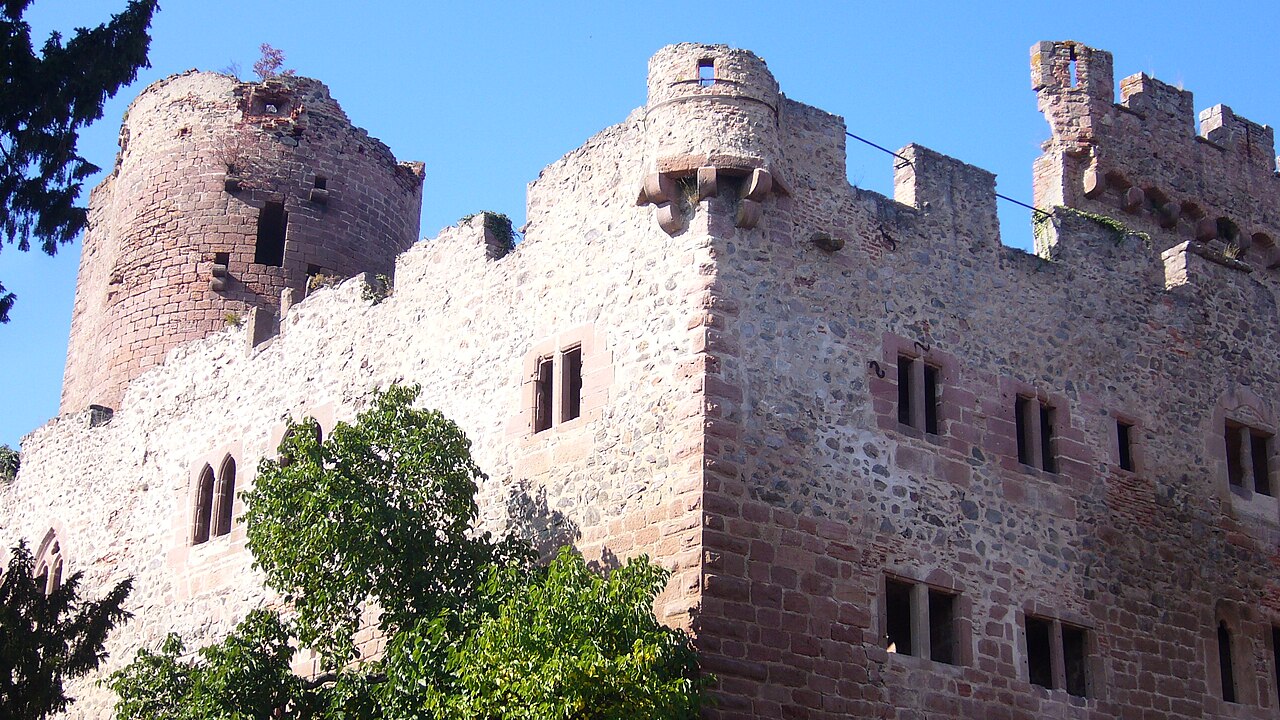
The Château de Kintzheim is a castle in the commune of Kintzheim in the Bas-Rhin département of France dating from the 12th century. The ruin of the castle dominate the village of Kintzheim.
Kintzheim was known in the 6th century under the name of Regis Villa. The Merovingian kings had made it into the center of a vast domain including the valley of the Liepvre River and the forests of Haut-Koenigsbourg.
In 774, the emperor Charlemagne made a gift to the Abbey of Liepvre of one part of his forests at Gunigesheim (the former name of Kintzheim).
In 775, Charlemagne spent the Christmas holidays in the Palatium selestatis, probably located at Kintzheim.
In 843, the Emperor Lothair I, the grandson of Charlemagne, gave Kintzheim to Erchangar, the Count of Nordgau and father of Richarde, the future abbess of Andlau.
The construction of the castle began around 1250 on the order of Emperor Frederick II of Hohenstaufen. The keep and the rampart which belongs to it were finished at the end of the 13th century. The residential structures were built during the 14th and the 15th centuries. In 1341, Emperor Louis IV, known as "The Bavarian", gave the village of "Kinsen" to the town of Sélestat.
In 1492, on the order of Emperor Frederick III of Habsburg, the landvogt of Alsace, Gaspard de Morimont, sold the castle to the town of Sélestat.
In 1633, the castle was partly destroyed by the Swedes during the Thirty Years' War.
In 1649, the town of Sélestat sold the castle for 3,000 florins to J. G. de Gollen, a former mayor of the town, who had been the minister of Ferdinand III of Habsburg to the Peace of Westphalia, which ended the Thirty Years' War.
Between 1650 and 1670, J. G. de Gollen restored the residential buildings and the chapel, but never actually lived in there.
Between 1760 and 1780, the last resident of the castle was a hermit monk who took care of the chapel.
Taken care of during the 18th century by J. G. de Gollen, then by the marquis de Broc, his heir, the castle was abandoned following the French Revolution of 1789. The roofs disappeared around 1830. In 1801, the marquis de Broc put it up for sale. The town of Sélestat tried to regain possession of the property. In 1807, a decree of Emperor Napoleon I gave the Château de Kintzheim to Mathieu de Favier, who was obliged to pay 2,000 silver marks to the town of Sélestat to settle their claim.
Text adapted from “Château de Kintzheim” on Wikipedia, CC BY-SA 4.0.
Château de Kintzheim ranks #6,573 of 9,079 worldwide in the atlas's castle fame ranking, and #593 of the 793 mapped in France. Founded c. 1300, it is older than 61% of the atlas's dated landmarks — one of 1080 atlas entries founded in the 13th century. 23 more atlas landmarks stand within 25 km. The nearest day-trip guide is Colmar, 20 km away. It is one of the 63 landmarks on the atlas's regional map of Alsace. It is stop 23 of 32 on the Alsace castle route, Wissembourg to Mulhouse. See how France compares in the castle statistics.
View on the interactive castle map →