 Italy
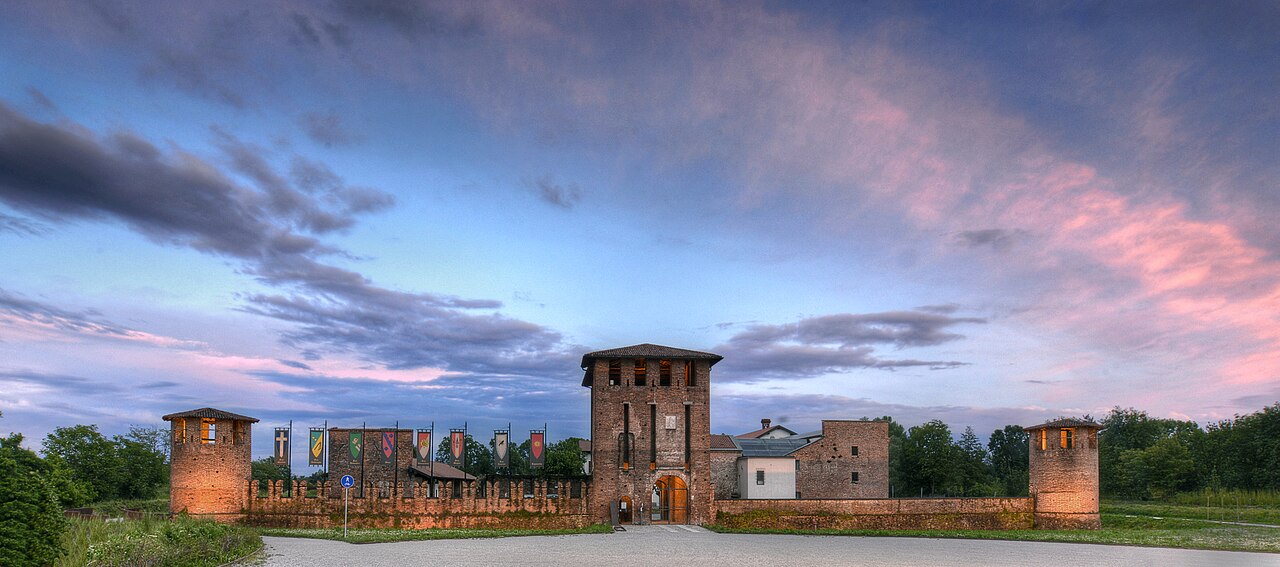
Castle of Legnano ranks #5,184 of 9,040 worldwide in the atlas's castle fame ranking, and #374 of the 555 mapped in Italy. 15 more atlas landmarks stand within 25 km. The nearest day-trip guide is Milan, 25 km away. See how Italy compares in the castle statistics.
The Visconti Castle is a medieval fortification that stands south of Legnano on a natural island in the Olona River. It has also been known as the castle of San Giorgio (lat. Castrum Sancti Georgi) since the 13th century. The architectural complex is located on Viale Toselli, between Castello Park and Piazza I Maggio.
The presence of a castle in Legnano is linked to the strategic function the city of Carroccio had from the Middle Ages to the 16th century. Legnano was located along an important medieval communication route that ran along the Olona River and connected Mediolanum (modern Milan) with the Verbannus Lacus (Lake Verbano, i.e., Lake Maggiore), the Via Severiana Augusta, which existed since Roman times. The modern Simplon road, built during the Napoleonic era, echoes in its layout the ancient road in use in Roman and medieval times.
The defense of Legnano was important because its eventual conquest could allow Milan's enemies easy access to the northwestern Milanese countryside due to the fact that it was located at the outlet of the Olona Valley, which ends at Castellanza and to aim, through this road, at the Milanese capital. In the Middle Ages Legnano, although formally belonging to Seprio, gravitated around Milan. The link between Milan and the city of the Carroccio was not only military, but also economic: Legnano and the other contadi that gravitated around the capital of Milan also supplied Milan with part of the foodstuffs produced.
When it belonged to the Viscontis, the castle of Legnano was part of a larger defensive system of the belt that enclosed Milan. In particular, fortifications were located in places where the Visconti owned a greater amount of real estate. The castles located around Milan served their function both for military purposes, mainly for external attacks and internal civil wars within the Milanese lordship, and for other purposes. They were also used as summer vacation spots, which allowed the lords to leave the city during the hottest months, during which water was scarce and heat prevailed, aided by the proximity of city buildings: at the time, dwellings in Milan were divided by narrow streets.
Another use was the organization of hunting parties in the woods located near the castles, a sport that was very common in the 12th and 13th centuries. In the Upper Milanese area, castles were numerous.
Text adapted from “Visconti Castle (Legnano)” on Wikipedia, CC BY-SA 4.0.
View on the interactive castle map →