Castle
Centum Cellas
🇵🇹 Portugal · 1st century
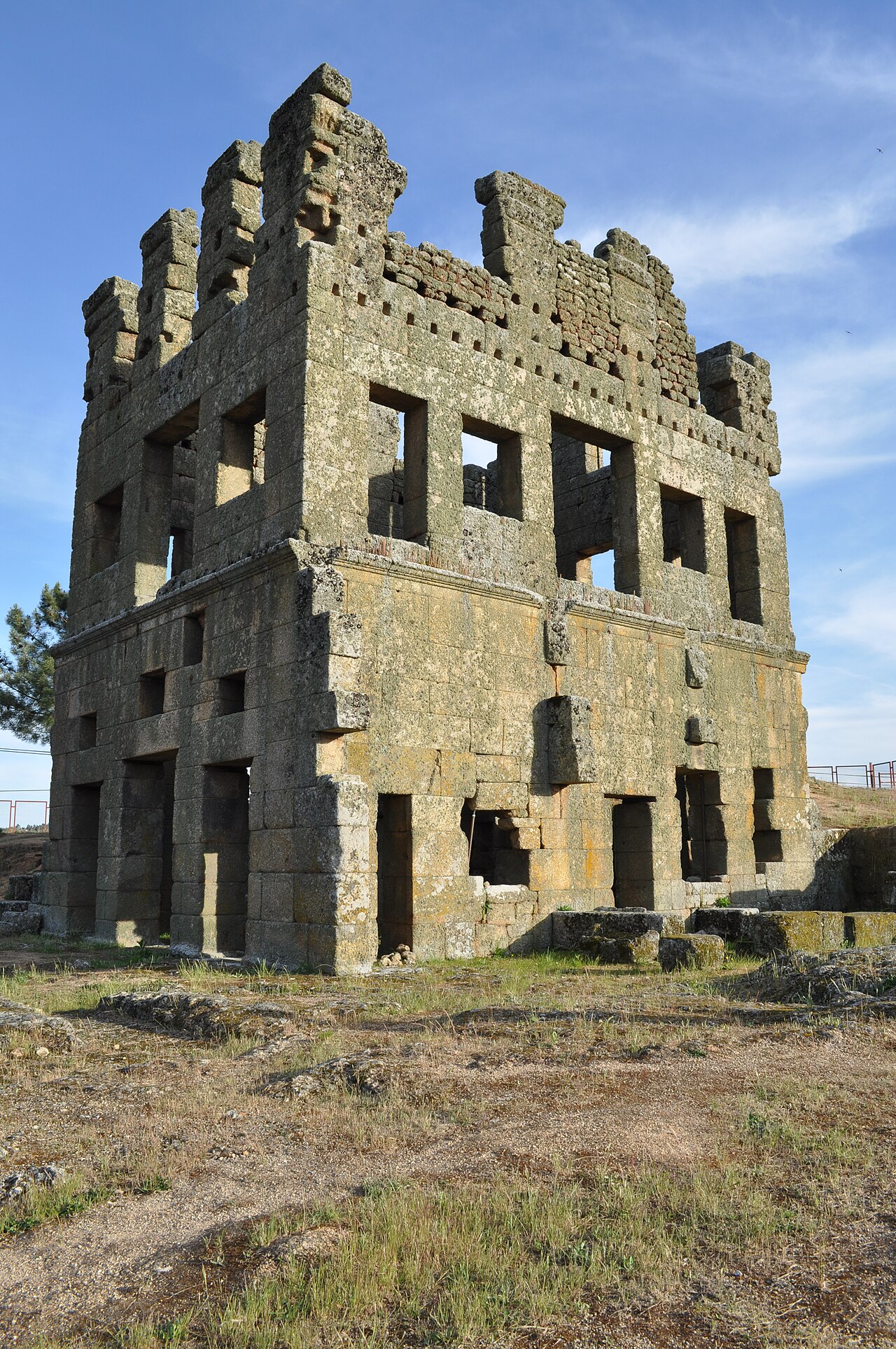
Centum Cellas, also referred to as Centum Cellæ, Centum Celli, or Centum Cœli (and in Portuguese: Centocelas), is a Roman villa rustica that dates back to the 1st century AD, located in the Mount of Santo Antão in Belmonte, Castelo Branco District, Portugal.
In the context of the Roman invasion of the Iberian Peninsula, the Villa was supposedly the property of a Lúcio Cecílio (in Latin: LVCIVS CÆCILIVS), a wealthy Roman citizen, a tradesman of tin (an abundant metal in the Iberian Peninsula) who ordered its construction in the 1st century AD. Hispania (modern Spain and Portugal) was one of if not the richest Roman province in the case of mineral ore from around the first century BC. Containing deposits of the metals (gold, silver, copper, tin, lead, iron, and mercury), it was very rich in resources. The Romans realised this, and there is evidence of large-scale mining and processing in the region.
From its acquisition during the Punic Wars to the Fall of Rome, Iberia continued to produce a significant amount of Roman metals. Tin was especially important being mined only in Iberia, Persia and Britannia. According to certain archeological sources, it was partially destroyed in the 3rd century AD but rebuilt right after. In the Middle Ages, over the remnant parts, a chapel was built in homage to Pope Cornelius. However, there are no traces of it today. It is also possible that during this time, due to its proximity with the Kingdom of León, the tower was used as a military outpost.
In 1188, the place, then named Centuncelli, received a foral by king Sancho I of Portugal. 19th century Portuguese historian Pinho Leal wrote that the tower was renovated in order to be used as a watchtower in either the 13th or 14th centuries.
The tower-like structure is one of the best preserved Roman monuments in the country. The core building has a rectangular floor plan (13.3 m × 15.5 m) and was two-storey; the second floor is probably a medieval addition. It has multiple entrances with different sizes. Two friezes separate the floors. The tower is 12 m high and originally stood in a building complex (the villa rustica). On three sides it was surrounded by extensions, of which only the foundations are visible. The sides were surrounded by rows of three chambers. At the front was the pillared portico of an open courtyard.
Text adapted from “Centum Cellas” on Wikipedia, CC BY-SA 4.0.
Centum Cellas ranks #4,160 of 8,764 worldwide in the atlas's castle fame ranking, and #52 of the 211 mapped in Portugal. Founded c. 50, it is older than 98% of the atlas's dated landmarks — one of 22 atlas entries founded in the 1st century. Its Wikipedia articles were opened 1,666 times in the last 60 days, more than 63% of the atlas. 5 more atlas landmarks stand within 25 km. The nearest day-trip guide is Viseu, 57 km away. See how Portugal compares in the castle statistics.
View on the interactive castle map →Frequently asked questions
Where is Centum Cellas?
Centum Cellas stands in Portugal, at 40.37767°, -7.34273°.
When was Centum Cellas built?
The atlas dates its founding to c. 50. Earlier structures may have stood on the site; this is the earliest documented founding year.
How famous is Centum Cellas?
In this atlas's fame ranking: #4,160 of 8,764 worldwide, and #52 in Portugal. Fame here combines how many Wikipedia language editions cover a landmark with how many people read them.
What is the nearest castle to Centum Cellas?
Castle of Belmonte, about 2 km away.
More castles in Portugal
- Citadel of Cascais Portugal · 15th century
- Palácio de Estói Portugal
- Fort of Sacavém Portugal · 19th century
- Castle of Melgaço Portugal · 12th century
More castles
- Zolotyy Potik Castle Ukraine · 16th century
- Armathwaite Castle England · 15th century
- Barnbougle Castle Scotland · 13th century
- Burleigh Castle Scotland · 15th century