 France · 12th century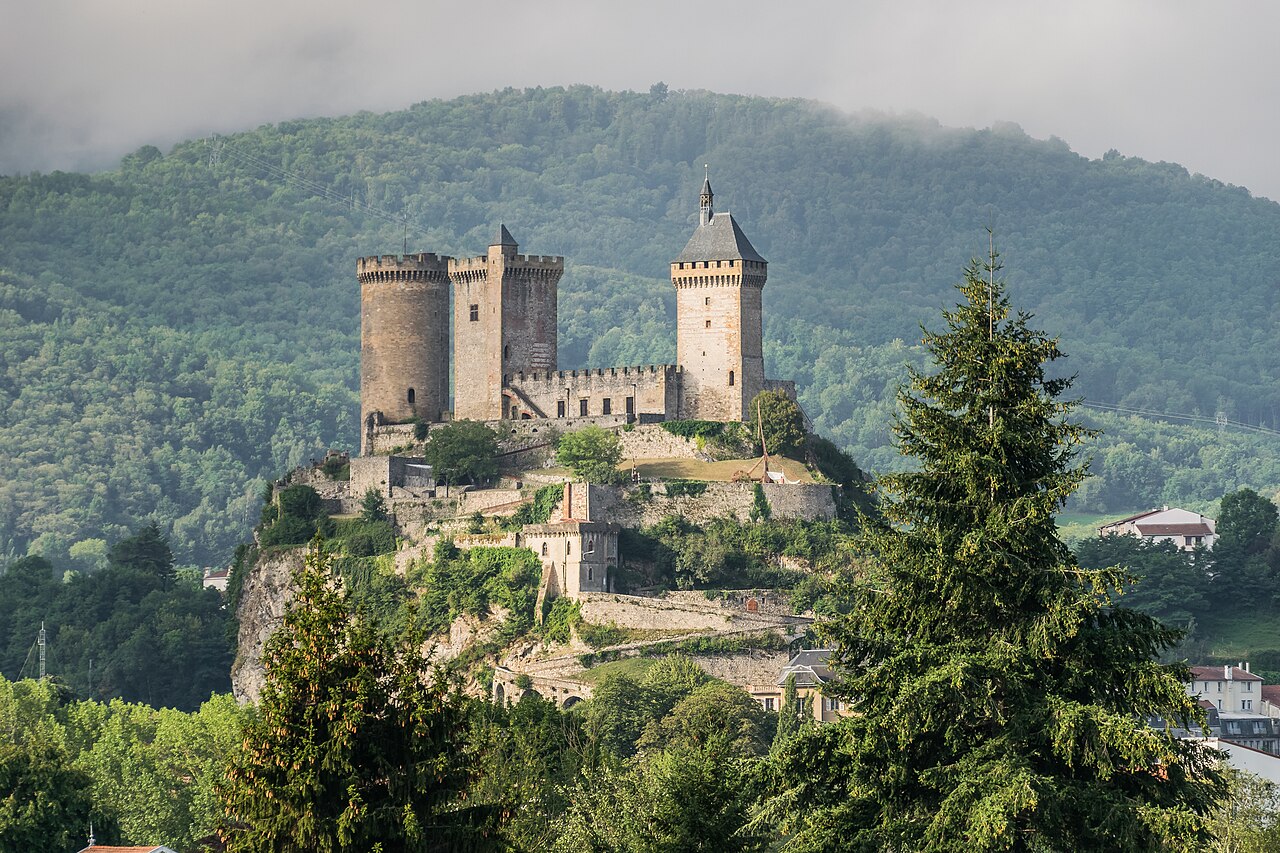
The Château de Foix (Languedocien: Castèl de Fois) is a castle which dominates the town of Foix in the French département of Ariège. An important tourist site, it is known as a centre of the Cathars. It has been listed since 1840 as a monument historique by the French Ministry of Culture.
Built on an older 7th-century fortification, the castle is known from 987. In 1002, it was mentioned in the will of Roger I, Count of Carcassonne, who bequeathed the fortress to his youngest child, Bernard. In effect, the family ruling over the region were installed here which allowed them to control access to the upper Ariège valley and to keep surveillance from this strategic point over the lower land, protected behind impregnable walls.
In 1034, the castle became capital of the County of Foix and played a decisive role in medieval military history. During the two following centuries, the castle was home to Counts with shining personalities who became the soul of the Occitan resistance during the crusade against the Albigensians. The county became a privileged refuge for persecuted Cathars.
The castle, often besieged (notably by Simon de Montfort in 1211 and 1212), resisted assault and was only taken once, in 1486, thanks to treachery during the war between two branches of the Foix family.
From the 14th century, the Counts of Foix spent less and less time in the uncomfortable castle, preferring the Governors' Palace (Palais des gouverneurs). From 1479, the Counts of Foix became Kings of Navarre and the last of them, made Henri IV of France, annexed his Pyrrenean lands to France.
As seat of the Governor of the Foix region from the 15th century, the castle continued to ensure the defence of the area, notably during the Wars of Religion. Alone of all the castles in the region, it was exempted from the destruction orders of Cardinal Richelieu (1632–1638).
Until the Revolution, the fortress remained a garrison. Its life was brightened with grand receptions for its governors, including the Count of Tréville, captain of musketeers under Louis XIII and Marshal Philippe Henri de Ségur, one of Louis XVI's ministers. The Round Tower, built in the 15th century, is the most recent, the two square towers having been built before the 11th century. They served as a political and civil prison for four centuries until 1862.
Text adapted from “Château de Foix” on Wikipedia, CC BY-SA 4.0.
Château de Foix ranks #695 of 9,079 worldwide in the atlas's castle fame ranking, and #62 of the 793 mapped in France. Founded c. 1101, it is older than 85% of the atlas's dated landmarks — one of 756 atlas entries founded in the 12th century. Its Wikipedia articles were opened 6,431 times in the last 60 days, more than 89% of the atlas. Wikidata records about 88,000 visitors in 2016. 4 more atlas landmarks stand within 25 km. It is one of the 23 landmarks on the atlas's regional map of Cathar Country. See how France compares in the castle statistics.
View on the interactive castle map →