Palace & château
Château de la Guignardière
🇫🇷 France · 16th century
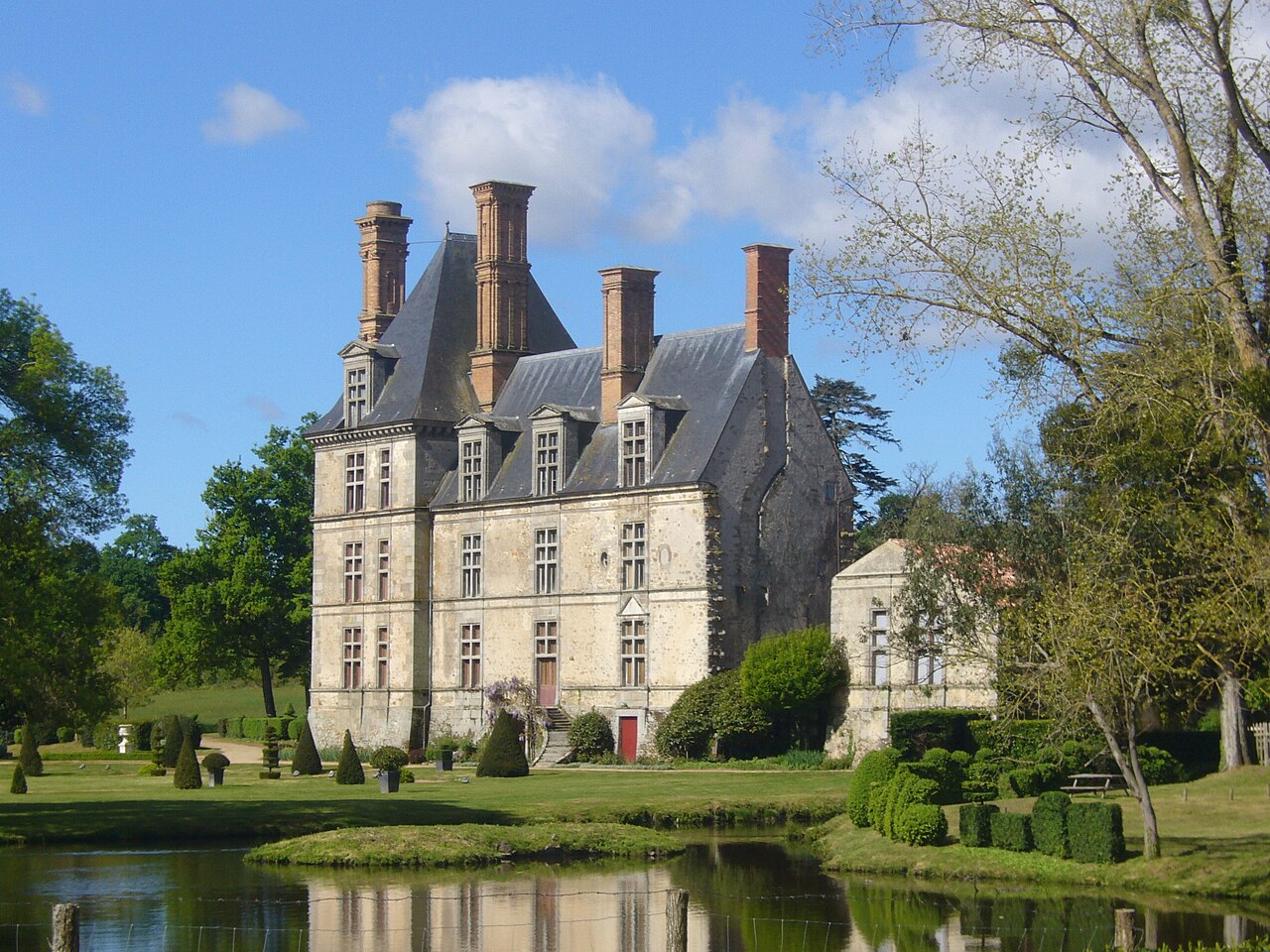
The Château de la Guignardière (French pronunciation: [ʃato də la ɡiɲaʁdjɛʁ]) is a 16th-century château located outside Avrillé, in the Vendée department, western France. It was begun in 1555, but was never completed. The building and park are open to the public.
The château was begun in around 1555 for Jean Girard, panetier, or breadmaster, to King Henri II. It was planned as a symmetrical building, flanked by tall wings. However, in 1563, Girard was assassinated, and the building site was abandoned. The master masons, who had been imported from Paris by Girard, dispersed across the local area, influencing the designs of several buildings in the area.
Further building was not carried out until the 18th century, when Sylvestre, Count of Chaffault, attempted to complete it. Ionic pilasters were added to the principal windows, surmounted by a pediment inscribed with the Count's armorial bearings and the date 1773. Gardens were laid out, and the large pond excavated. However, the Count, a royalist, was forced to flee the country following the arrest of Louis XVI during the French Revolution. During his absence, a republican mob plundered the château, defacing the armorial bearings, and killing the Count's children.
By the early 19th century the château was owned by the Marquis de Saint Denis, a keen agricultural improver. He transformed the gardens, and planted numerous exotic trees, including Magnolia, Swamp Cypress, Zelkova and California Redwood. His successor Henri Luce de Tremont also hoped to complete the château, but instead he chose to move the curved perron stair from the proposed central bay of the garden facade, to the actual central bay. From 1920, the statesman Georges Clemenceau rented a house, known as la bicoque, ("the shack") on the estate. He became friends with the owner, Amedée Luce de Tremont, and was regularly entertained in the dining room of the château. La bicoque is now a state property, and is open to the public as the Maison de Georges Clemenceau. The château remains privately owned, and is now open to the public. It has been classed as a monument historique since 1978.
The château is an example of French Renaissance architecture. It comprises a three-bay section of three storeys, the proposed central block, and a tall wing of four storeys.
Text adapted from “Château de la Guignardière” on Wikipedia, CC BY-SA 4.0.
Château de la Guignardière ranks #6,520 of 8,764 worldwide in the atlas's castle fame ranking, and #558 of the 675 mapped in France. Founded 1555, it is older than 39% of the atlas's dated landmarks — one of 827 atlas entries founded in the 16th century. See how France compares in the castle statistics.
View on the interactive castle map →Frequently asked questions
Where is Château de la Guignardière?
Château de la Guignardière stands in France, at 46.474°, -1.51°.
When was Château de la Guignardière built?
The atlas dates its founding to 1555. Earlier structures may have stood on the site; this is the earliest documented founding year.
How famous is Château de la Guignardière?
In this atlas's fame ranking: #6,520 of 8,764 worldwide, and #558 in France. Fame here combines how many Wikipedia language editions cover a landmark with how many people read them.
What is the nearest castle to Château de la Guignardière?
Château d'Apremont, about 35 km away.
More castles in France
- Château de la Madeleine France · 11th century
- Château de la Napoule France · 14th century
- Château de la Pommerie France
- Château des Ravalet France · 16th century
More palaces & châteaux
- Château du Vert-Bois France · 18th century
- Château of Thoiry France · 20th century
- Chateau d'Asnières France
- Château de Vascœuil France