 France · 13th century
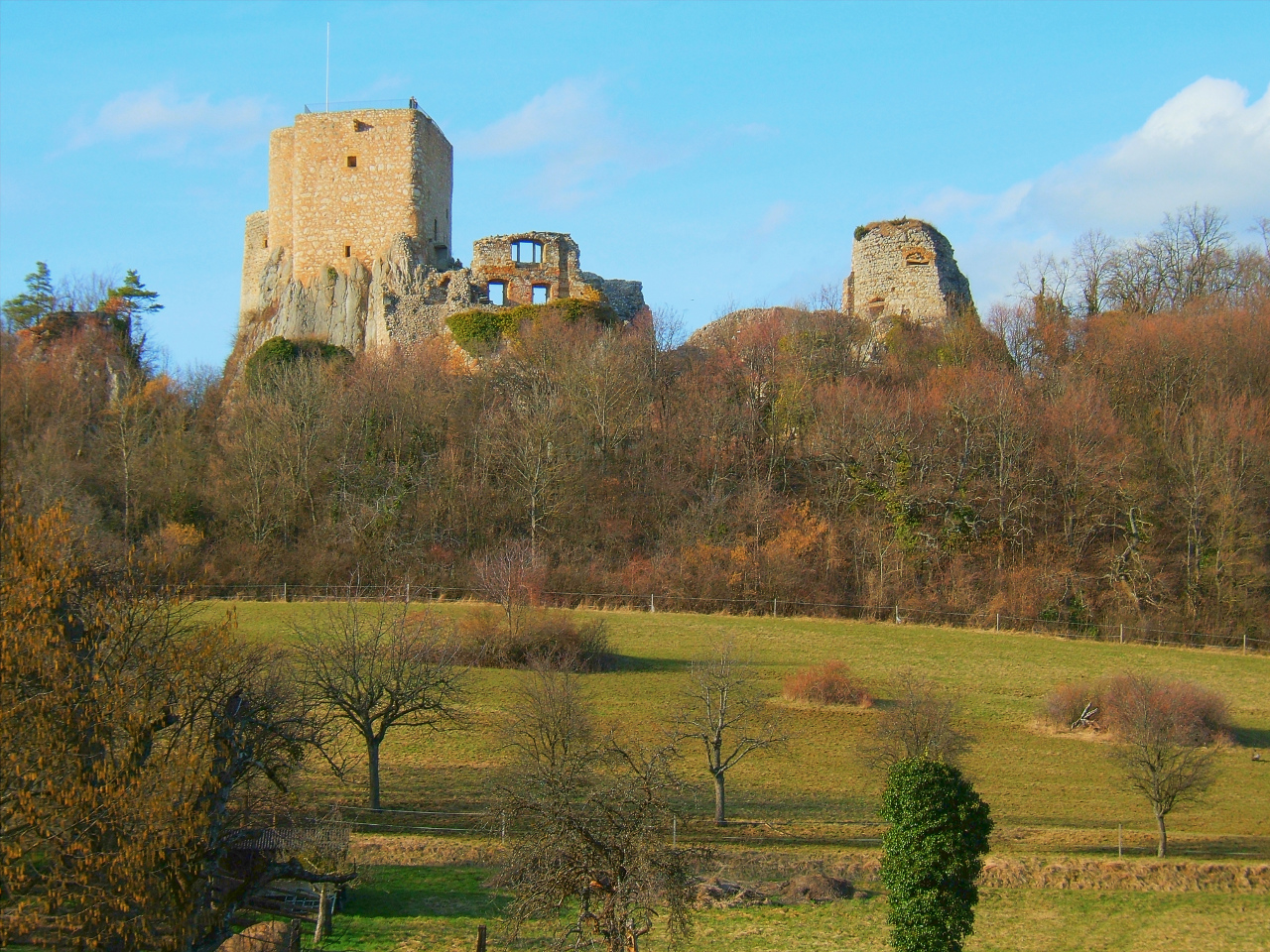
The Château de Landskron (or Landskron Castle) is situated in the southern part of Alsace, in the east of France, mere footsteps away from Switzerland, in the commune of Leymen. The village situated at the north of the ruin, Leymen, in the département of Haut-Rhin, lies in France while Flüh, at the south east foot of the ruin, is in Switzerland.
The castle was built before 1297. It had a very important strategic position in that it allowed the control of the Eastern Sundgau, the elbow of the Rhine and the city of Basel. Several disputes concerning the ownership have been reported. Like the Château de Ferrette and Château de Morimont, the Château de Landskron was owned by Habsburg for a time. In 1462, the castle was given to the Lord of the Bailiwick of Lupfen, Sébastien de Reichenstein, who later enlarged and transformed the castle to adapt it to firearms in 1516. In 1648, by the Peace of Westphalia which ended the Thirty Years' War, the lands and lordships of the Habsburgs in Alsace, including the Château de Landskron, passed into the hands of the King of France.
After 1665, Vauban was responsible for rebuilding the castle into a military garrison, while many other Alsatian castles were abandoned and gradually destroyed. In the 1690s, it was used as a state prison. The few prisoners who were imprisoned there until the French Revolution were predominantly political prisoners and the mentally ill. Bernard Duvergez, a courtier at the French court, was held there from 1769 until 1790 when he was discovered by revolutionaries looking for political prisoners. He died while waiting for them to find him a better place. He is the subject of a local novel, The Prisoner of Landskron The castle survived the Revolution, whereas the houses of the wealthy in Leyman were burned. The castle was destroyed in 1813 by the Austrian and the Bavarian armies fighting Napoléon Bonaparte.
Text adapted from “Château de Landskron” on Wikipedia, CC BY-SA 4.0.
Château de Landskron ranks #4,235 of 9,035 worldwide in the atlas's castle fame ranking, and #343 of the 787 mapped in France. Founded 1297, it is older than 63% of the atlas's dated landmarks, one of 1090 atlas entries founded in the 13th century. Its Wikipedia articles were opened 975 times in the last 60 days, more than 50% of the atlas. 17 more atlas landmarks stand within 25 km. The nearest day-trip guide is Basel, 11 km away. See how France compares in the castle statistics.
View on the interactive castle map →