 France · 10th century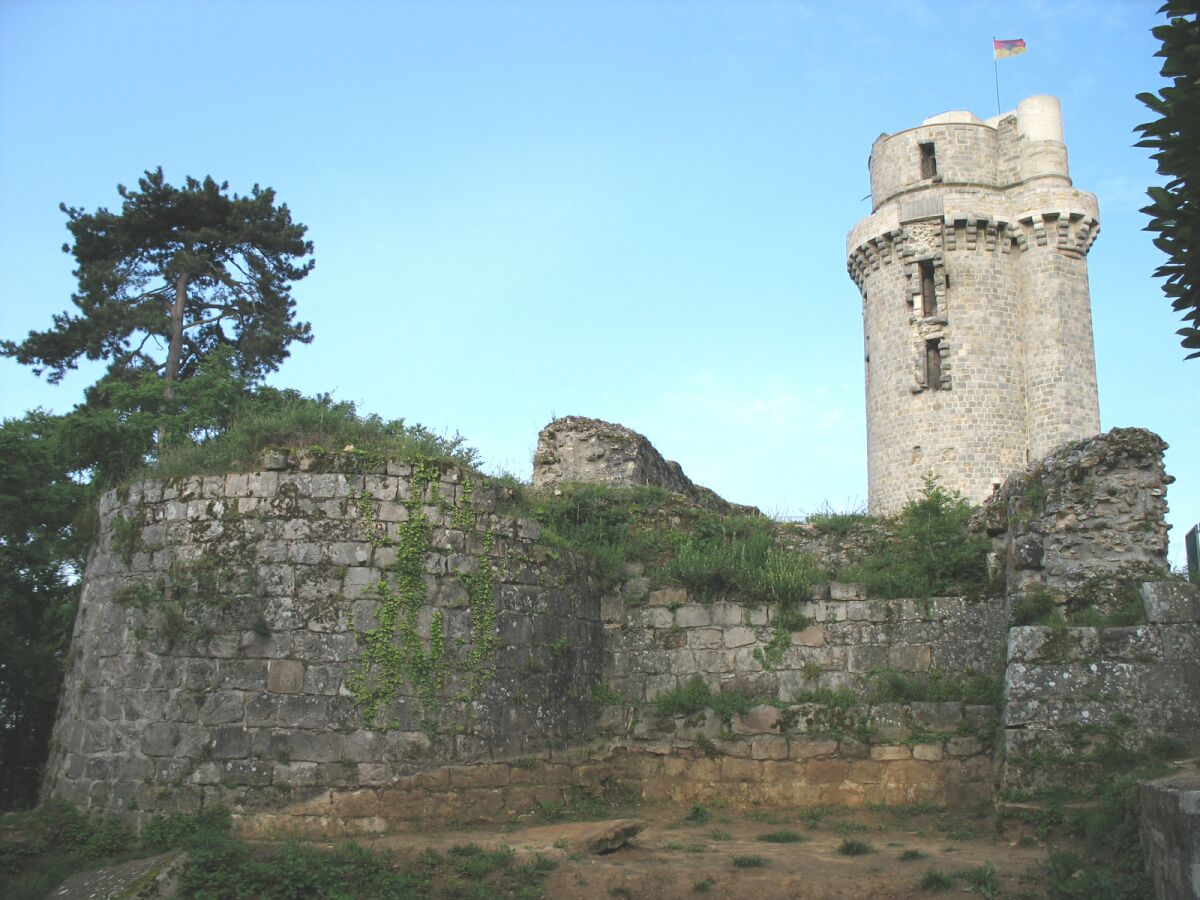
The Château de Montlhéry is a castle in the commune of Montlhéry in the Essonne département of France. Ruins date from various periods, most notably the 10th, 11th, 13th and 14th centuries.
The present 13th-century castle, with its prominent keep, succeeded a castle built in the 11th century, and an earlier foundation, built from 991 to 1015. The castle is a rectilinear pentagonal plan, with five surviving towers, one of which is much larger than the rest and serves as the keep, forming the point of the pentagon, at the end of the ridge. A gate tower protected the entrance on the opposite site. Recent evidence suggests that there may have a second court or bailey extending in front of the present gate, as well as a substantial chapel inside the presumed lower court.
Thanks to its position, the keep was notably connected with the scientific experiments of Pierre Gassendi (measurement of the speed of sound), Claude Chappe (experiments with optical telegraphy in 1794) and Alfred Cornu (measurement of the speed of light in 1874).
Visitors today can see the keep, the well, the moat and the remains of the curtain wall. The castle is state property. It has been listed since 1840 as a monument historique by the French Ministry of Culture.
Text adapted from “Château de Montlhéry” on Wikipedia, CC BY-SA 4.0.
Château de Montlhéry ranks #6,507 of 9,079 worldwide in the atlas's castle fame ranking, and #587 of the 793 mapped in France. Founded 991, it is older than 92% of the atlas's dated landmarks — one of 193 atlas entries founded in the 10th century. 22 more atlas landmarks stand within 25 km. The nearest day-trip guide is Paris, 25 km away. See how France compares in the castle statistics.
View on the interactive castle map →