 France · 13th century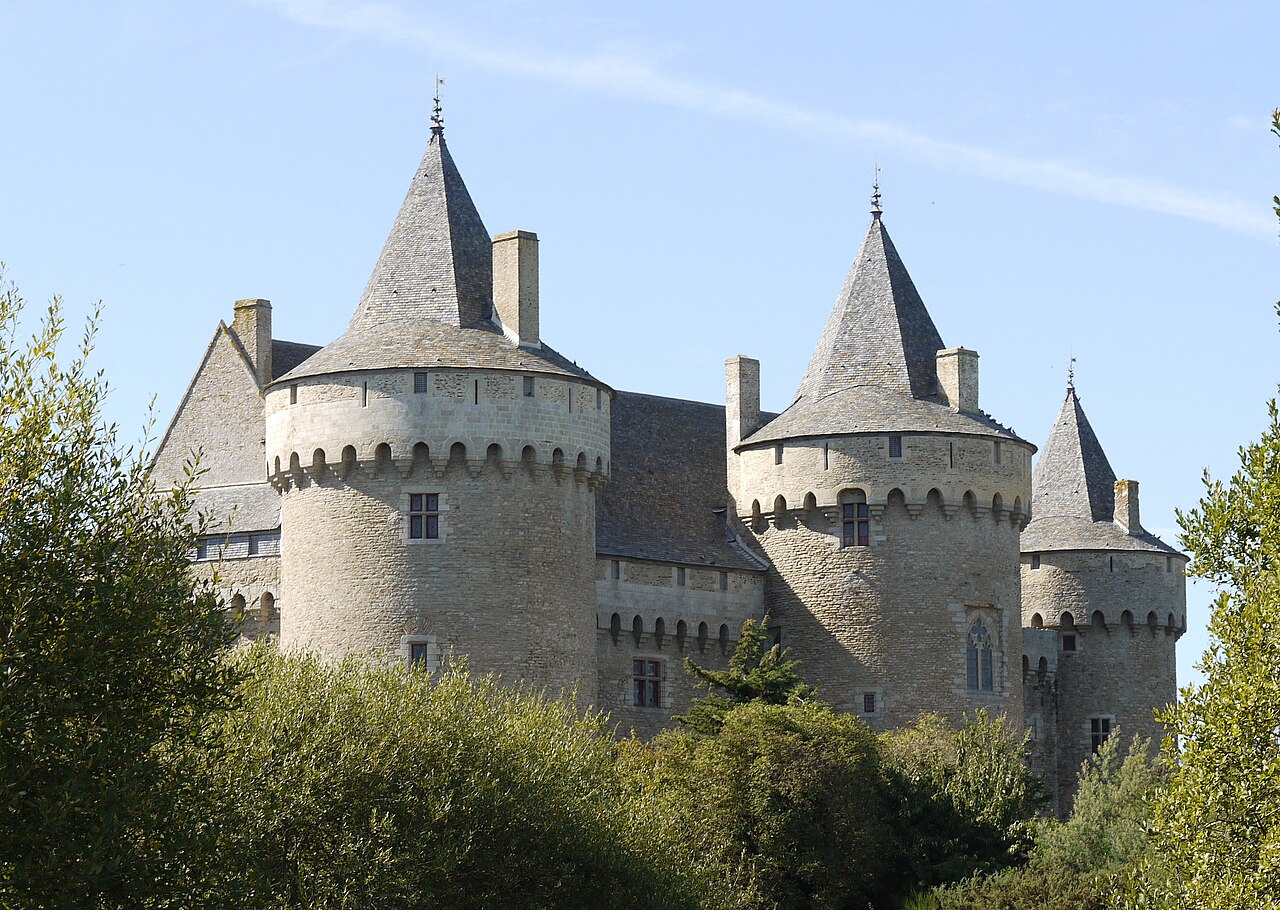
The Château de Suscinio or de Susinio is a Breton castle, built in the late Middle Ages, to be the residence of the Dukes of Brittany. It is located in the commune of Sarzeau in the département of Morbihan, near the coast along the Bay of Biscay. The spectacular site comprises the moated castle, a ruined chapel, a dovecote, and a few ruined outbuildings.
Designed to be a place of leisure, between the seaside and a forest full of game for hunting, the castle's first logis seigneurial (seigniorial house) dates from the beginning of the 13th century.
The castle was fortified and enlarged at the end of the 14th century, when the heirs of the duchy had to fight to keep their assets (Brittany was not yet fully united with France and did not become so until 1514), after the castle was taken by Bertrand du Guesclin, the infamous Constable of France. John V and John VI constructed a new seigniorial residence block with a large, new corner tower known as the Tour Neuve. A casemate was added at the end of the 15th century to protect artillery pieces.
From 1471 to 1484, the castle housed Jasper Tudor, Henry Tudor (later King Henry VII of England), and the core of their group of exiled Lancastrians, numbering about 500 by 1483. Since the castle could only house some 100 persons, the rest must have been billeted close about, in Kermoizin and other villages nearby.
Francis II, Duke of Brittany supported this group of exiled Englishmen, against all the Plantagenet demands that he should surrender them. For 11 years, Suscinio was an armed camp, alert against any attempt to kidnap Jasper and Henry and return them to England where they were under attainder and would have been promptly executed as threats to the Yorkist rule.
Duke Francis II supported the failed Lancastrian rebellion and invasion of England in 1483 with 40,000 gold crowns, 15,000 soldiers, and a fleet of transport ships. When the Duke suffered from one of his periods of incapacitating illness, his treasurer, Pierre Landais, agreed to surrender Henry Tudor to the representatives of the Yorkist King Richard III of England, in return for a pledge of 3,000 English archers to defend Brittany against a threatened French attack.
Text adapted from “Château de Suscinio” on Wikipedia, CC BY-SA 4.0.
Château de Suscinio ranks #1,183 of 9,079 worldwide in the atlas's castle fame ranking, and #94 of the 793 mapped in France. Founded c. 1225, it is older than 73% of the atlas's dated landmarks — one of 1080 atlas entries founded in the 13th century. Its Wikipedia articles were opened 11,447 times in the last 60 days, more than 95% of the atlas. 1 more atlas landmarks stand within 25 km. See how France compares in the castle statistics.
View on the interactive castle map →