 Switzerland · 18th century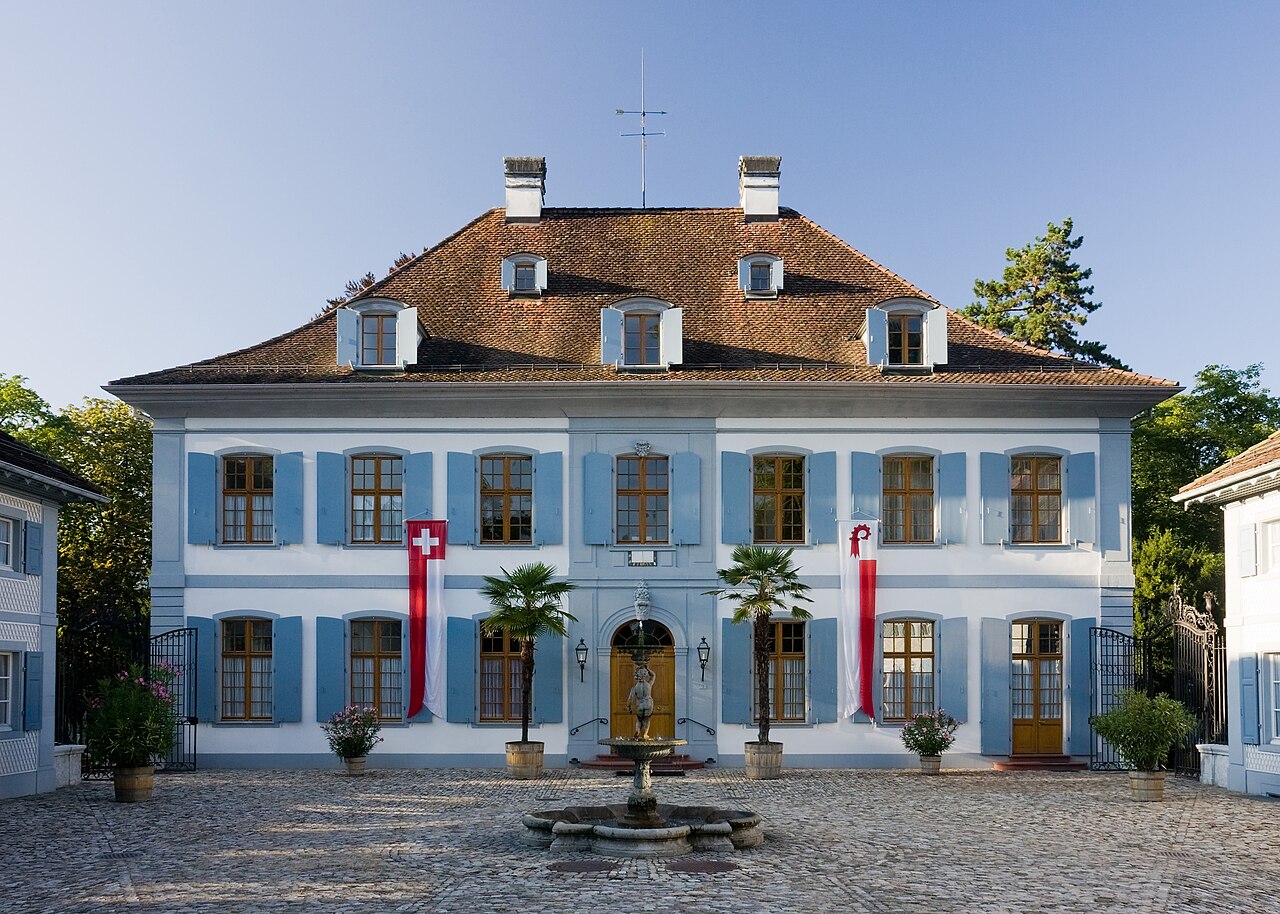
Schloss Ebenrain (German pronunciation: [ˌʃlɔs ˈeːbn̩ˌraɪn]) is a former country residence in Sissach, in the canton of Basel-Country, Switzerland. Built in 1774–1776, it is considered the most significant late baroque residence in northwestern Switzerland. It is now a public facility and the site of an agricultural school. It is listed as a Swiss cultural property of national significance.
Schloss Ebenrain was built as a summer residence for the wealthy Basel silk ribbon manufacturer and trader Martin Bachofen and his family. The Basel architect Samuel Werenfels designed the building. Bachofen intended at first to build a modest country residence, but changed his plans and built a luxurious estate. The gardens to the north and south of the residence were designed by Bernese architect Niklaus Sprüngli. Both gardens were converted to fashionable English parks in the early 19th century, but one landscape feature, namely the parallel rows of lindens lining the drive to the house, has remained essentially unchanged to the present day.
Elite Basel families typically stayed in the country from May to September, but Bachofen often extended his stays at Ebenrain until the end of hunting season in January or February. Bachofen died in 1814, and in 1817 his widow, Margaretha, sold Schloss Ebenrain to another Basel merchant, Johann Rudolf Ryhiner-Streckeisen. Seven years later the estate's new owner committed suicide at Ebenrain. Ryhiner was facing charges of bigamy, and on 29 July 1824 he killed himself with a pistol.
In 1836 Ryhiner's widow sold Schloss Ebenrain to Ludwig Vest, a businessman from Liestal. In 1838 Vest transferred the estate to Lukas Vischer, an art collector from Basel who had just returned from several years' residence in Mexico. Vischer died at Ebenrain in December 1840.
In 1849 the Vischer family sold Schloss Ebenrain to a Prussian military officer, Major Leopold von Orlich, who sold it the following year to Ernst Wilhelm Wilding, Prince Radali of Sicily. In 1857 Johannes David-Sickeler of Basel acquired it, and in 1860 it went to Charles Philibert Gobat, former minister of Tramelan in the Canton of Bern. Gobat, who had a large family, was in financial difficulties by March 1872, when he sold the estate to Albert Hübner-Allan from Mühlhausen.
Text adapted from “Schloss Ebenrain” on Wikipedia, CC BY-SA 4.0.
Ebenrain Château ranks #7,874 of 9,079 worldwide in the atlas's castle fame ranking, and #170 of the 213 mapped in Switzerland. Founded 1774, it is older than 14% of the atlas's dated landmarks — one of 696 atlas entries founded in the 18th century. 24 more atlas landmarks stand within 25 km. The nearest day-trip guide is Basel, 19 km away. See how Switzerland compares in the castle statistics.
View on the interactive castle map →