 Switzerland · 12th century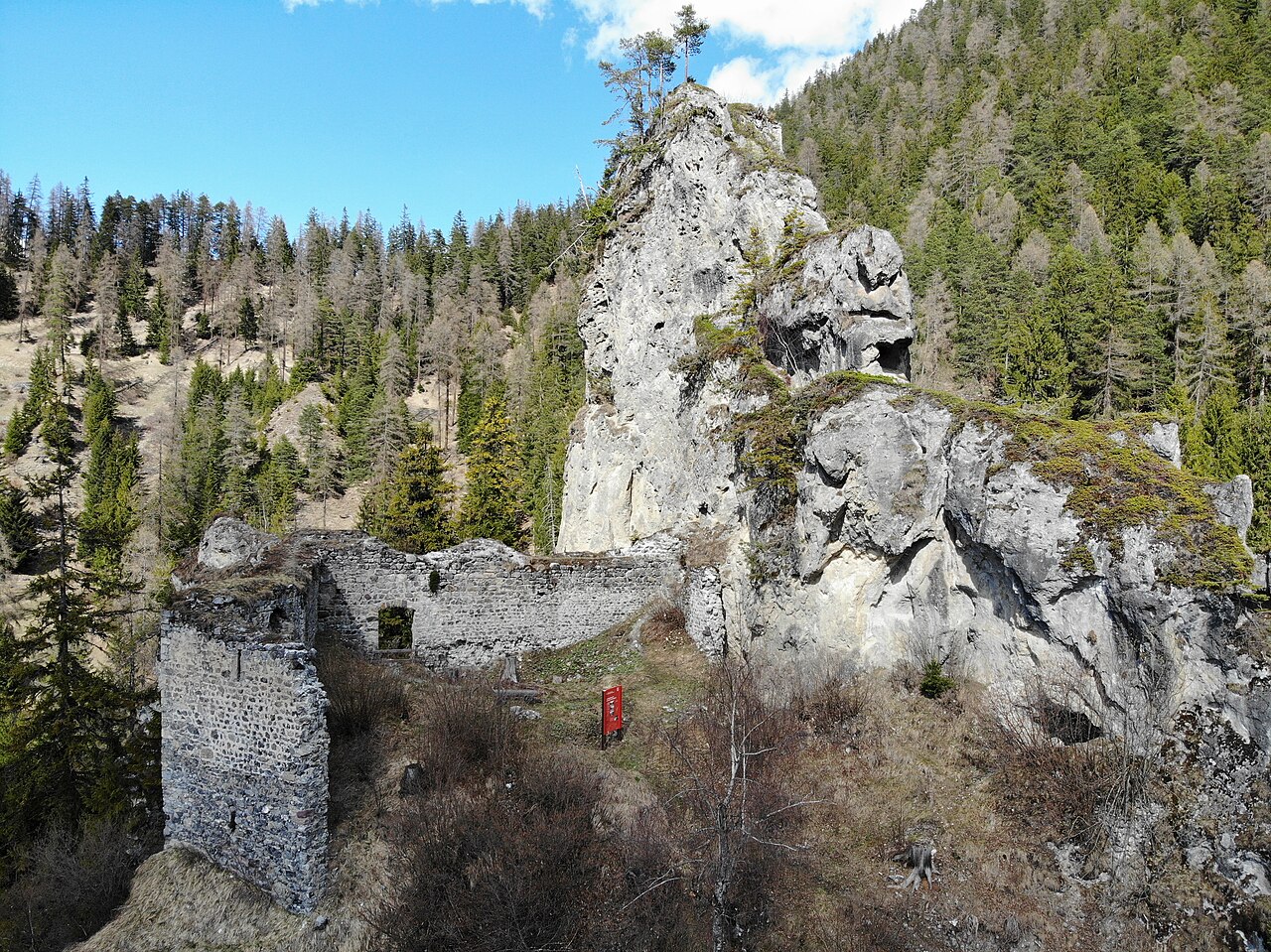
Greifenstein Castle is a ruined castle in the municipality of Filisur of the Canton of Graubünden in Switzerland. It is included on the register of the Swiss Inventory of Cultural Property of National and Regional Significance.
The castle was built on a rocky outcropping above the village probably in the 12th century as the home of the Greifenstein family. They were probably related to the Wildenberg-Sagogn and Frauenberg in Ruschein families. The first mention of them was in 1233 as Grifenstein when Rudolf von Greifenstein was ordered by the Pope to go on a crusade as penance for murdering Bishop Berthold von Helfenstein. In 1237, he finally left to join the Crusades. In 1243, his relatives Heinrich and Albert were listed as witnesses in a legal proceeding as Hainricus et Albertus de Grifinstain.
By the late 13th century the family disappears from the record and in 1300 the Wildenberg family owns the castle and surrounding lands. Whether the Greifensteins died out or if the Wildenbergs married into the family or were a branch of the family is unclear. In 1320 Count Hugo III von Werdenberg-Heiligenberg / von Wildenberg and his wife Anna von Wildenberg mortgaged the castle and lands to the Bishop of Chur for 1150 Marks. However, three years later, in 1323 the Wildenbergs defeated the Bishop's army near Greifenstein, but by 1339 the Freiherr von Marmels ruled over the herrschaft for the Bishop. In 1360 the Freiherr von Wildenberg-Sagogn sold it to the Freiherr von Matsch.
By 1392 the von Matsch family were robber knights who used the castle as a base for raids against the Bishop's estates. In 1394 Bishop Hartmann II successfully sent an army to drive out the robbers and take control of the castle. He appointed a vogt to administer the castle and lands for him, but was forced to mortgage it to the Marmels family in 1411. The Matsch family began raiding and sued the Bishop to return the castle to them. In 1421 Duke Ernst of Austria negotiated a compromise where by the Bishop kept both Greifenstein and Tschanüff Castles but had to pay the Matsch family 2,500 Marks.
In 1468 Greifenstein, along with several other of the Bishop's castles, were attacked and occupied by the League of God's House. The castles were returned to the Bishop following intervention by the city of Zurich.
Text adapted from “Greifenstein Castle” on Wikipedia, CC BY-SA 4.0.
Greifenstein Castle (Filisur) ranks #6,056 of 9,035 worldwide in the atlas's castle fame ranking, and #82 of the 213 mapped in Switzerland. Founded c. 1150, it is older than 80% of the atlas's dated landmarks, one of 763 atlas entries founded in the 12th century. 8 more atlas landmarks stand within 25 km. The nearest day-trip guide is Lugano, 93 km away. It is one of the 26 landmarks on the atlas's regional map of Graubünden. See how Switzerland compares in the castle statistics.
View on the interactive castle map →