 Japan · 16th century
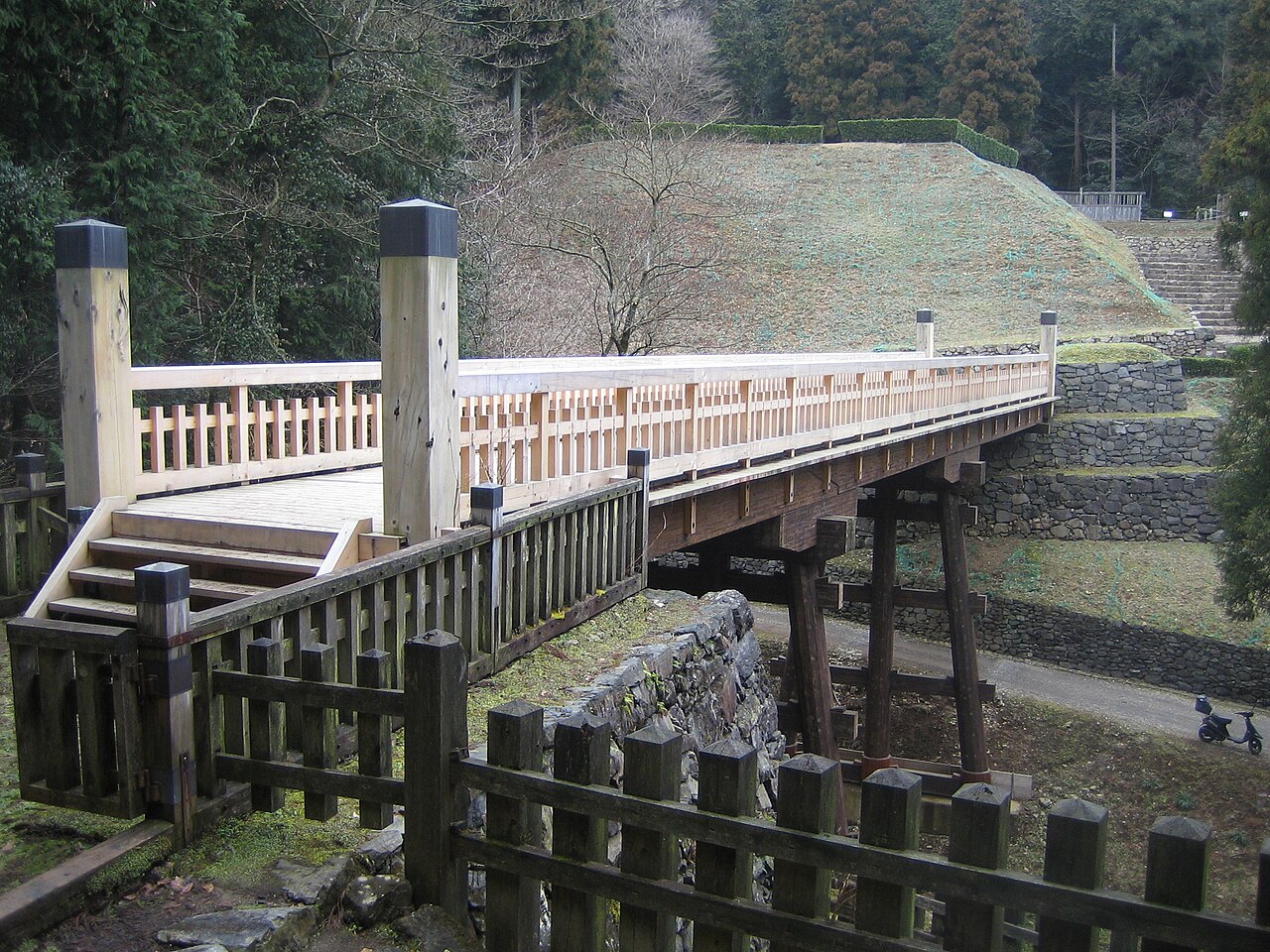
Hachiōji Castle (八王子城, Hachiōji-jō) was a Sengoku period Japanese castle, located in what is now the city of Hachiōji, Tokyo, in the Kantō region of Japan. Its ruins have been protected as a National Historic Site since 1951, with the area under protection extended in 2005.
It is called Hachioji because Hachioji Gongen a deity of the Gion faith. is enshrined there.
Hachiōji Castle is located on the top of Mount Fukasawayama, about five kilometers southwest of central of modern center of Hachioji. The castle was situated to control both main route (via the Kobotoke Pass) and sub-route (Ange Pass) of the main road connecting Kai Province (modern Yamanashi prefecture) and Musashi Province (modern Saitama prefecture and Tokyo Metropolis).
The castle was built on a hillside and on the top of a mountain. Around the mountain, the outer defense line consisted of clay ramparts and dry moats built to utilize the natural contours of the slope. On the hillside was a large enclosure which housed the residence of the castellan, surrounded by smaller enclosures. The front wall and the route to the main gate were lined with stones as a show of authority, and a drawbridge was constructed over a dry moat in front on the main gate. On the hilltop was the inner bailey; however, it was small and had no significant defenses. On a neighboring hill, a 20-minute walk from the inner bailey was a secondary fortification with stone wall. This was intended to protect the main case from attack from the rear.
The structure of the castle is unbalanced, with the hillside structures built using stone and with good defenses, but other areas severely lacking, reflecting its incomplete nature.
Hachiōji Castle was constructed in the 1570s by Hōjō Ujiteru, the younger brother of Hōjō Ujimasa, and effectively the military leader of the Late Hōjō clan. Ujiteru originally resided at Takiyama Castle on the Tama River approximately 15 kilometers to the north; however, that castle was built on a loose slope and had poor defenses. During an incursion by the Takeda clan in 1569, the invading Takeda army was able to penetrate the castle's outer defenses and it was only after a desperate struggle before the inner gates that the Hōjō were able to drive the Takeda back. This impressed strongly on Hōjō Ujiteru the need to have a stronger castle.
Text adapted from “Hachiōji Castle” on Wikipedia, CC BY-SA 4.0.
Hachiōji Castle ranks #1,777 of 9,035 worldwide in the atlas's castle fame ranking, and #108 of the 295 mapped in Japan. Founded 1571, it is older than 35% of the atlas's dated landmarks, one of 886 atlas entries founded in the 16th century. Its Wikipedia articles were opened 6,769 times in the last 60 days, more than 90% of the atlas. 1 more atlas landmarks stand within 25 km. The nearest day-trip guide is Sagamihara, 14 km away. See how Japan compares in the castle statistics.
View on the interactive castle map →