 Austria · 11th century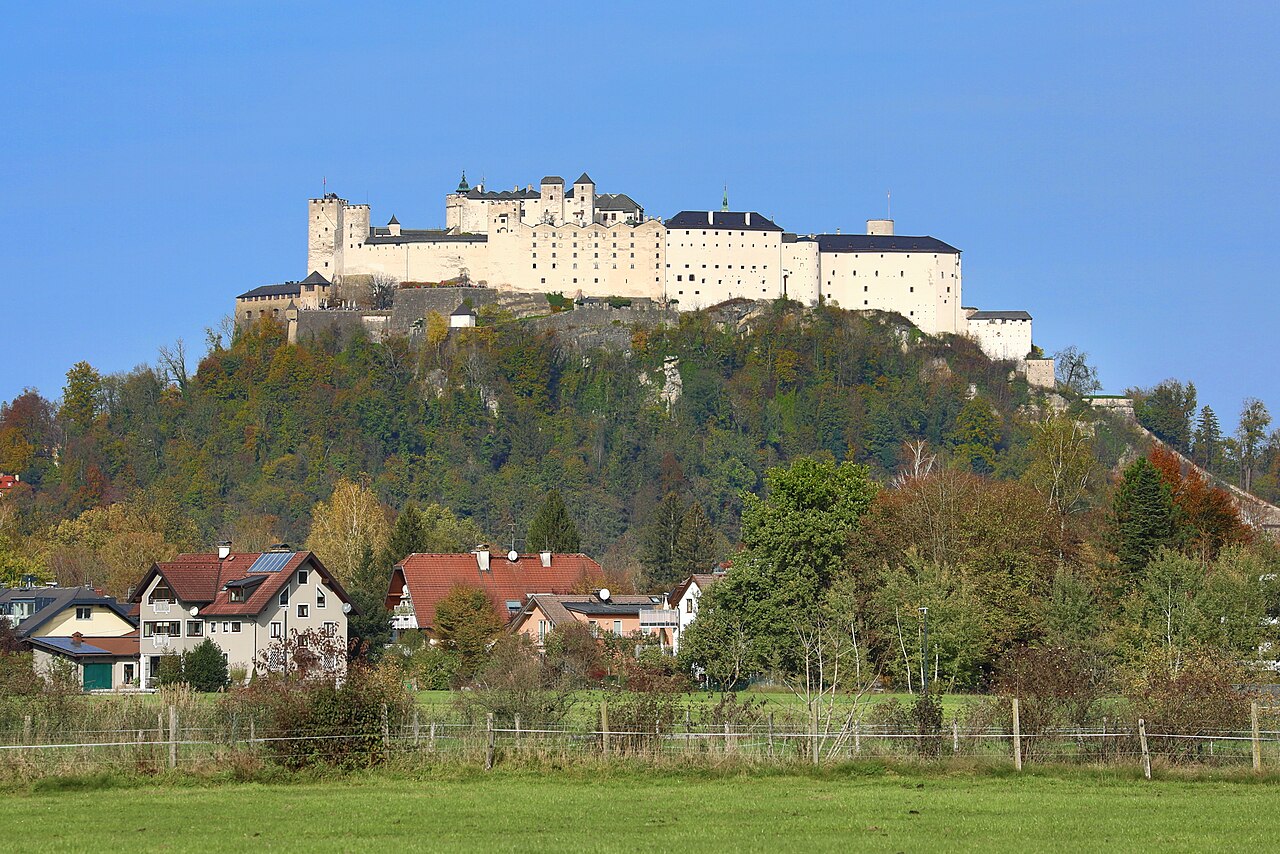
Hohensalzburg Fortress (German: Festung Hohensalzburg, lit. 'High Salzburg Fortress') is a large medieval fortress in the city of Salzburg, Austria. It sits atop the Festungsberg mountain at an altitude of 506 m. It was erected at the behest of the prince-archbishops of Salzburg. The fortress is 250 m (820 ft) long and 150 m (490 ft) wide making it one of the largest medieval castles in Europe.
Archaeological excavations have shown that a Roman fort existed at the highest point of the site. This should not be confused with the more significant Roman castrum superius on the Nonnberg terrace.
Construction of the current fortress began in 1077 under Archbishop Gebhard von Helfenstein. The original design was a basic bailey with a wooden wall. In the Holy Roman Empire, the archbishops of Salzburg were already powerful political figures and they expanded the fortress to protect their interests. Helfenstein's conflict with Emperor Henry IV during the Investiture Controversy influenced the expansion of the fortress, with the Archbishop taking the side of Pope Gregory VII and the German anti-king Rudolf of Rheinfelden. The fortress was gradually expanded during the following centuries. The ring walls and towers were built in 1462 under Prince-Archbishop Burkhard II von Weißpriach.
Prince-Archbishop Leonhard von Keutschach further expanded the fortress during his term from 1495 until 1519. His coadjutor Matthäus Lang von Wellenburg, who was later to succeed Leonhard, in 1515 wrote a description of the Reisszug, a very early and primitive funicular railway that provided freight access to the upper courtyard of the fortress. The line still exists, albeit in updated form, and is probably the oldest operational railway in the world. The current external bastions, begun in the 16th century and completed in the 17th, were added as a precaution because of fears of Turkish invasion.
The only time that the fortress actually came under siege was during the German Peasants' War in 1525, when a group of miners, farmers and townspeople tried to oust Prince-Archbishop Matthäus Lang, but failed to take the fortress. In 1617 the deposed Archbishop Wolf Dietrich von Raitenau died in the fortress prison. During the Thirty Years' War, Archbishop Count Paris of Lodron strengthened the town's defenses, including Hohensalzburg.
Text adapted from “Hohensalzburg Fortress” on Wikipedia, CC BY-SA 4.0.
Hohensalzburg Fortress ranks #156 of 9,079 worldwide in the atlas's castle fame ranking, and #4 of the 240 mapped in Austria. Founded 1077, it is older than 87% of the atlas's dated landmarks — one of 436 atlas entries founded in the 11th century. Its Wikipedia articles were opened 19,425 times in the last 60 days, more than 97% of the atlas. 12 more atlas landmarks stand within 25 km. The nearest day-trip guide is Salzburg, 1 km away. See how Austria compares in the castle statistics.
View on the interactive castle map →