Castle
Homburg Castle
🇩🇪 Germany · 13th century
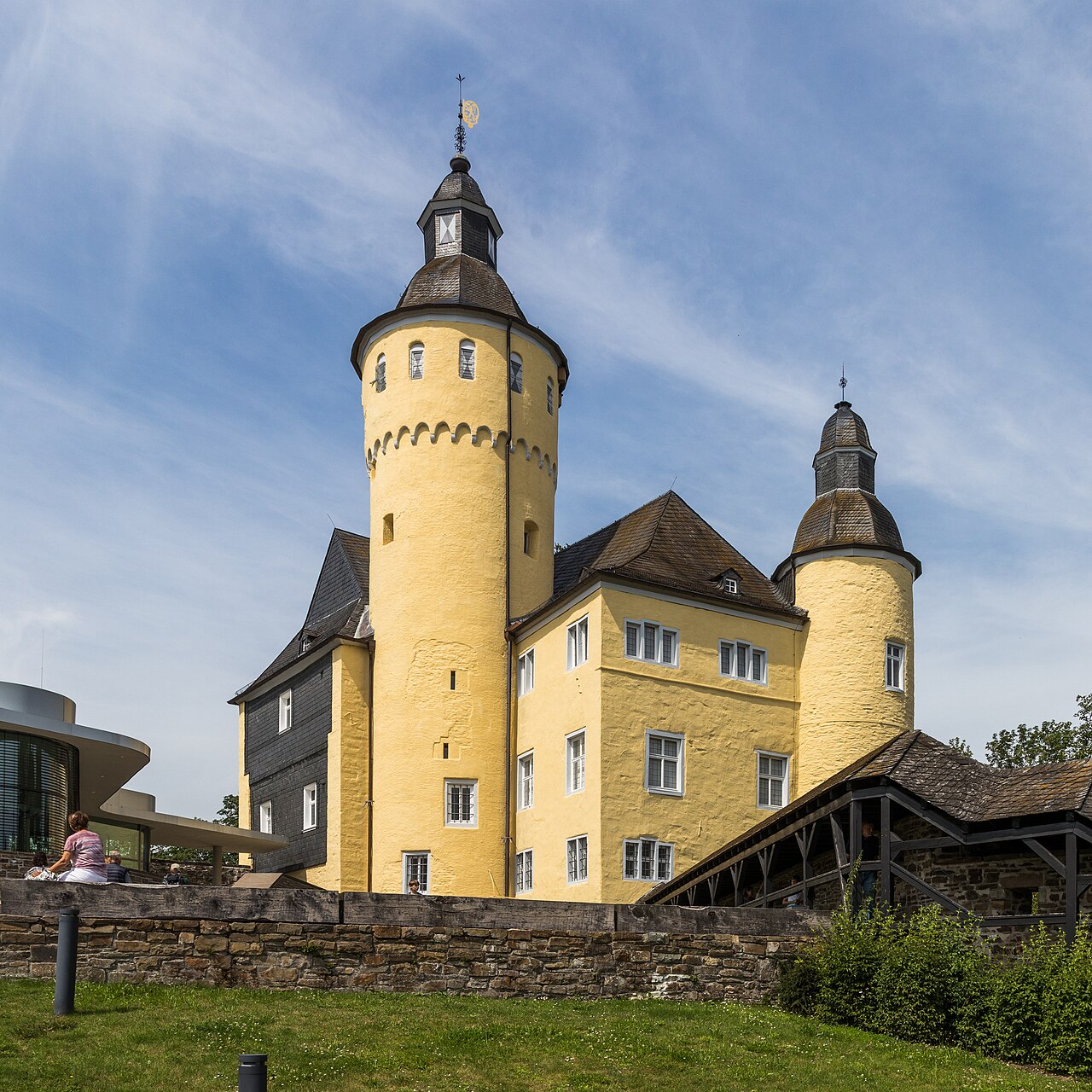
Homburg Castle is an old hill castle in Nümbrecht, Oberbergischer Kreis in the German state of North Rhine-Westphalia.
The Homburg is first mentioned in records of 1276. Gottfried I of Sayn from the House of Sponheim (1247-1283/84) transferred his castrum Homburg to the German King Rudolf of Habsburg, in order to place it under his protection. He received the castle back as an inheritance. The castle was the residence of the Counts of Homburg, an imperial fiefdom (Reichsherrschaft).
From 1635 Count Ernst von Sayn-Wittgenstein altered the castle to its present-day appearance. One hundred years later the line of Sayn-Wittgenstein-Berleburg took over its management; the structure then fell into disrepair. Not until 1904 was its decline halted and, in 1926, a museum, founded by Hermann Conrad, took over the premises. Today it is the Museum of Oberbergisches Kreis.
In 1999 during an excavation, a stone keep of about 12.5 metres diameter was uncovered. Experts estimate that it dates to the 11th century. A consequence of this was that the history of the castle had to be reassessed to that time.
At the beginning of 2005 the district council decided to upgrade the castle. Their plans included inter alia the expansion of the 'Red House' (Rotes Haus) and the construction of a central cash desk and toilet area. The old orangery was to be torn down and replaced by a new two-storey administration and exhibition building.
In the immediate vicinity are a sawmill and mill with a bakery. In addition, in the former farmhouse building, the 'Red House', the castle's tithe barn, is the headquarters of the Oberberg Biological Station, whose main fields of work are the scientific and practical support of the Oberberg nature reserves and various landscape conservation projects.
The nature trail was established in 2004. This is a circular walk that was the initiative of the Oberberg Biological Station and German Forest Conservation Society (Schutzgemeinschaft Deutscher Wald).
The footpath and nature trail starts at the castle and runs through Homburg Bröl and Huppichteroth, past the historic Holstein Mill and the Dicke Steine back to Homburg Castle. Nine information stations have been set up along the route which describe the natural environment around Homburg Castle and the Bröl meadow to walkers. The stations are:
Forests around Homburg Castle (Wälder um Schloss Homburg).
Text adapted from “Homburg Castle” on Wikipedia, CC BY-SA 4.0.
Homburg Castle ranks #5,291 of 8,764 worldwide in the atlas's castle fame ranking, and #440 of the 618 mapped in Germany. Founded 1276, it is older than 68% of the atlas's dated landmarks — one of 906 atlas entries founded in the 13th century. Its Wikipedia articles were opened 1,350 times in the last 60 days, more than 57% of the atlas. 3 more atlas landmarks stand within 25 km. The nearest day-trip guide is Cologne, 41 km away. See how Germany compares in the castle statistics.
View on the interactive castle map →Frequently asked questions
Where is Homburg Castle?
Homburg Castle stands in Germany, at 50.91569°, 7.53694°.
When was Homburg Castle built?
The atlas dates its founding to 1276. Earlier structures may have stood on the site; this is the earliest documented founding year.
How famous is Homburg Castle?
In this atlas's fame ranking: #5,291 of 8,764 worldwide, and #440 in Germany. Fame here combines how many Wikipedia language editions cover a landmark with how many people read them.
What is the nearest castle to Homburg Castle?
Ehreshoven Castle, about 15 km away.
More castles in Germany
- Imperial Palace Gelnhausen Germany · 12th century
- Isenburg Castle Germany · 16th century
- Kransberg Castle Germany
- Landshut Residence Germany · 16th century
More castles
- Leuchtenburg Castle Germany · 13th century
- Rauenstein Castle Germany · 14th century
- Reinsberg Castle Germany
- Brennhausen Castle Germany