 Czech Republic · 18th century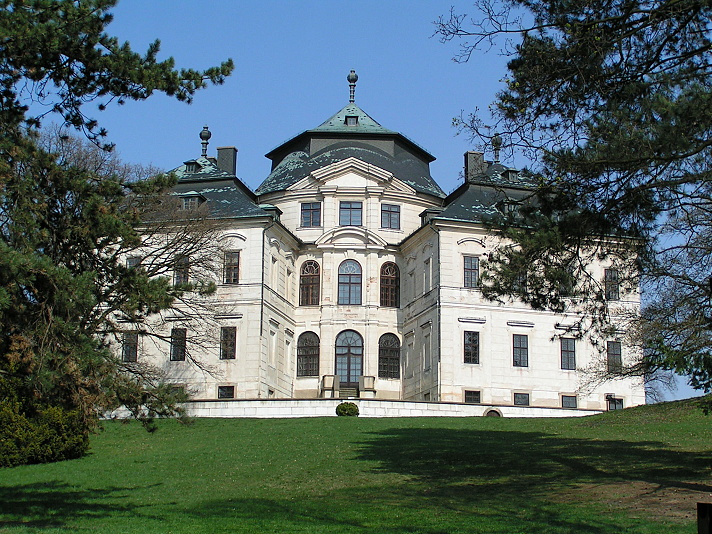
Karlova Koruna (German: Karlskron) is a château in the town of Chlumec nad Cidlinou in the Czech Republic.
The château was built for František Ferdinand Kinský in 1721–23.
Construction was completed in time for King Charles VI's coronation. František Ferdinand Kinský invited the king to the château and named the castle after the king (Karlova Koruna means Charles' crown in English).
Originally, there was a stronghold as nobleman seat in Chlumec nad Cidlinou town, and the first mention in a source-books is from 1424 when the stronghold was conquered by the warrior Boček of Poděbrady. In the beginning of the 16th century a new renaissance fortification was built. The Kinský family obtained this property in the beginning of the 17th century and kept it till 1948. It was returned to the family after 1990. The High Chancellor of Bohemian Kingdom count František Ferdinand Kinský (1668 – 1741) decided to convert the building into a folly corresponding to the reputation of his noble family. Some of the best architects and master builders of that times – Jan Blažej Santini-Aichel and František Maxmilián Kaňka – were engaged to create this work of art.
As a dedication, this new pleasure house was named after emperor Karel VI. who visited Chlumec in September 1723 while returning from his coronation in Prague. In the middle of the 17th century the Kinský family began to use this folly more often. That is why the property was enlarged – detached administrative and accommodation wings were newly built. The hippodrome, where the Chlumec peasants of well-known uprising were imprisoned in 1775, also grew up in this time.
The basic architectural design was drafted by Santini-Aichel. The details and participation in the building process can be attributed to Kaňka. The manor's design reveals one of the most noteworthy manor dispositions created in the Czech lands. The central high cylindrical body of the building is occupied by a three storied main hall to which 3 wings are connected. Due to this the manor does not need passages and its external appearance changes as the observer walks around it.
The architecture of the chateau reflects the charisma and unique craft of Santini-Aichel and Kaňka. This is best demonstrated on a horizontal projection – three cubes are projecting from surmounting central cylinder.
Text adapted from “Karlova Koruna Chateau” on Wikipedia, CC BY-SA 4.0.
Karlova Koruna Chateau ranks #1,869 of 9,079 worldwide in the atlas's castle fame ranking, and #42 of the 243 mapped in Czech Republic. Founded 1723, it is older than 20% of the atlas's dated landmarks — one of 696 atlas entries founded in the 18th century. Its Wikipedia articles were opened 2,459 times in the last 60 days, more than 74% of the atlas. 3 more atlas landmarks stand within 25 km. The nearest day-trip guide is Pardubice, 27 km away. It is one of the 189 landmarks on the atlas's regional map of Bohemia. See how Czech Republic compares in the castle statistics.
View on the interactive castle map →