 Switzerland · 13th century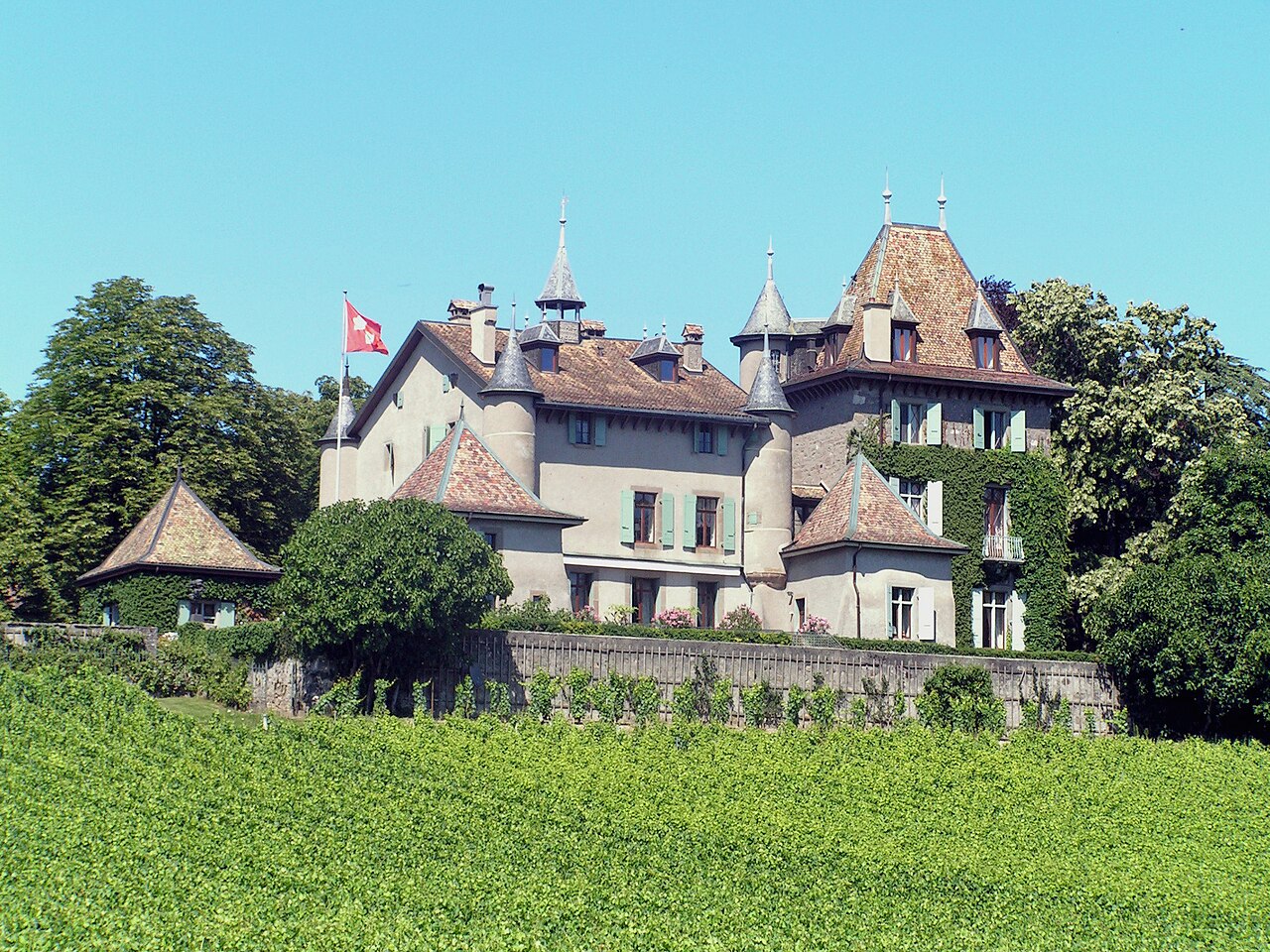
The Château Du Crest is a castle in the municipality of Jussy of the Canton of Geneva in Switzerland. It is a Swiss heritage site of national significance.
It is the only wine producing chateau in the left Bank of Lake Geneva in the Canton of Geneva.
Jussy was a vassal town of the Bishop of Geneva in the Middle Ages. The chateau was built on the grounds owned by the Bishop, circa 1220. Several families, such as the de Compesières and the de Rovorée clans, took turns in looking after the castle and its domains for the Bishop who had the legal jurisdiction over it.
With the advent of Reformation, the castle found itself in the middle of the intrigues between the city fathers of Geneva, who dislodged the Bishop as the lord of the city state in 1536, and the Duke of Savoy. The lord occupant of the castle, Michel de Blonay, refused to abandon his Catholic faith and side with Calvinism. Several attempts at resistance followed. With the defeat of the Saoy Duchy in the war of Escalade in 1598, the castle was taken by the Calvinists and destroyed in the 1590s. With the Treaty of St. Julien in 1603 that recognized Geneva as a Republic, the castle fell into ruins.
Agrippa d'Aubigné, a nobleman and reformed French Huguenot squire of Henry IV, was expelled from France as result of his participation in the conspiracy against Duke of Luynes before acquiring the rights to the ruins of the chateau. Hired to direct the work of fortification in the cantons of Geneva, Bern and Basel, d'Aubigné rebuilt the castle du Crest. Due to the previous experiences with fortifications this close to Geneva, the city fathers did not want to see a fortified structure and hence permitted only the right to build "a manor house to safeguard against thieves and murderers."
However, Agrippa d'Aubigné went beyond the permission granted to him. He built fortifications regardless, such as turrets, loopholes, a drawbridge, and a deep moat. He justified this to Geneva as a protection against papal armies. d'Aubigné died in 1630, and the castle passed into the hands of the Micheli family.
In 1637, Jacques Micheli of Lucca in Tuscany acquired the lordship. His descendants own the property to this day. The family played an important part in shaping the politics of Geneva and held several important positions.
Text adapted from “Crest Castle” on Wikipedia, CC BY-SA 4.0.
Le Crest Castle and outbuildings ranks #7,658 of 9,079 worldwide in the atlas's castle fame ranking, and #159 of the 213 mapped in Switzerland. Founded c. 1220, it is older than 74% of the atlas's dated landmarks — one of 1080 atlas entries founded in the 13th century. 13 more atlas landmarks stand within 25 km. The nearest day-trip guide is Geneva, 9 km away. See how Switzerland compares in the castle statistics.
View on the interactive castle map →