Fortress
Letychiv Fortress
🇺🇦 Ukraine · 16th century
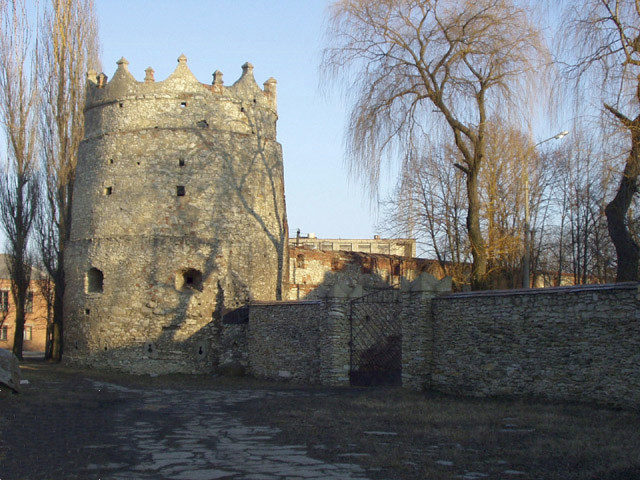
The Letychiv Fortress (Ukrainian: Лети́чівський замок, romanized: Lrtychivs'kyi zamok) is a complex of limestone walls built in 1598 by Jan Potocki to defend Podolia from the regular raids of the Crimean Tatars. The north-western tower, the eastern wall and parts of the southern wall still stand in the town of Letychiv, Ukraine. The most prominent feature on the grounds of the fortress is the Baroque church of the Assumption (1606–1638, rebuilt 1724). There's also a statue of Ustym Karmaliuk, a rebel leader buried at Letychiv. During World War II, the castle served as a notorious slave labor camp.
Text adapted from “Letychiv Fortress” on Wikipedia, CC BY-SA 4.0.
Letychiv Fortress ranks #5,418 of 8,134 worldwide in the atlas's castle fame ranking, and #77 of the 188 mapped in Ukraine. Founded 1598, it is older than 34% of the atlas's dated landmarks — one of 755 atlas entries founded in the 16th century. 1 more atlas landmarks stand within 25 km. See how Ukraine compares in the castle statistics.
View on the interactive castle map →Frequently asked questions
Where is Letychiv Fortress?
Letychiv Fortress stands in Ukraine, at 49.38503°, 27.62423°.
When was Letychiv Fortress built?
The atlas dates its founding to 1598. Earlier structures may have stood on the site; this is the earliest documented founding year.
How famous is Letychiv Fortress?
In this atlas's fame ranking: #5,418 of 8,134 worldwide, and #77 in Ukraine. Fame here combines how many Wikipedia language editions cover a landmark with how many people read them.
What is the nearest castle to Letychiv Fortress?
Medzhybizh Fortress, about 16 km away.
More castles in Ukraine
- Chornokozyntsi Castle Ukraine · 18th century
- Pniv Castle Ukraine · 14th century
- Izmail Fortress Ukraine · 16th century
- Mikhailovskaya Battery Ukraine · 19th century
More fortresses
- Fort of Buenos Aires Argentina · 16th century
- Fortress of Santa Cruz Brazil
- Fort Angké Indonesia · 17th century
- Kasbah of Mehdia Morocco · 10th century