 Ghana · 20th century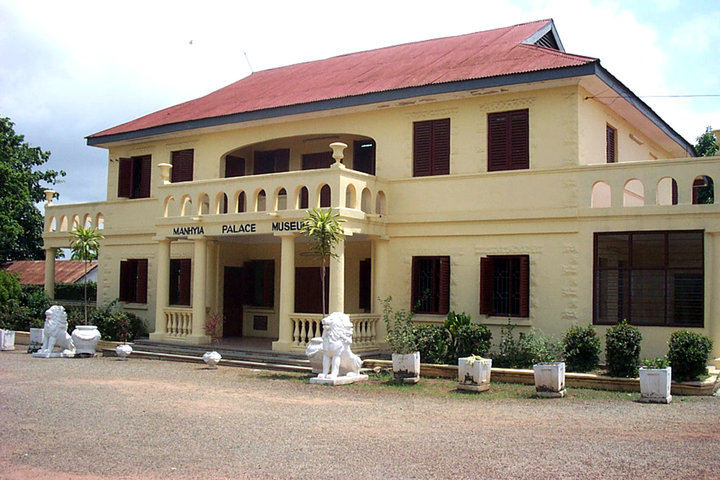
The Manhyia Palace (Akan: Oman hyia, English: Gathering of the people) is the seat of the Asantehene, as well as his official residence. It is located in Manhyia, Kumasi, the capital of the Ashanti Region of Ghana. The first palace is now a museum. Otumfuor Opoku Ware II built the new palace, which is close to the old one and is where the current Asantehene, Otumfuor Osei Tutu II, resides.
The palace was built in 1925 by the British after they had demolished the Aban Palace built by Ashanti Empire. The British were said to have been impressed by the size of the original palace and the scope of its contents, which included "rows of books in many languages", but during the War of the Golden Stool, the British demolished the royal palace with explosives. The palace consequently erected is 1 km (0.62 mi) from the Centre for National Culture, Kumasi.
Upon the return from exile of the Asantehene Nana Prempeh I from the Seychelles Islands, the building was offered to him for use as his residence. This was because prior to the Asantehene's exile, his old palace had been burnt down in the Yaa Asentewa War. The war was fought between the British and the Asantes because of the refusal of the Asantehene to offer the Golden stool to the then governor of the Gold Coast. Prempeh I only accepted the offer after he had paid for the cost of the building in full. Two kings lived in the palace, namely Otumfuo Prempeh I and Otumfuo Sir Osei Agyeman Prempeh II, KBE, the 13th and 14th kings of the Asante nation.
The old palace was converted into a museum in 1995 after the new palace was built. Opoku Ware II was the first king to live in the new palace, which he occupied until his death in 1999.
The palace was converted into a museum and officially opened on 12 August 1995 by the then king Opoku Ware II. Several artifacts are displayed in the museum. They include furniture used by the kings, the bronze head of Osei Agyeman Prempeh II, and a sketch map of the Asanteman. There is also the Asanteman's first television at the museum, as well as life-sized wax effigies of some of the kings and queens of Asanteman.
The architecture of the palace is akin to Asante's architecture of the early 1900s. The palace is a two-story building with both floors having open verandas, giving a view of the palace's environs.
Text adapted from “Manhyia Palace” on Wikipedia, CC BY-SA 4.0.
Manhyia Palace ranks #2,406 of 9,079 worldwide in the atlas's castle fame ranking, and #6 of the 35 mapped in Ghana. Founded 1925 — one of 169 atlas entries founded in the 20th century. Its Wikipedia articles were opened 2,388 times in the last 60 days, more than 73% of the atlas. 1 more atlas landmarks stand within 25 km. See how Ghana compares in the castle statistics.
View on the interactive castle map →