Fortress
Naganeupseong
🇰🇷 South Korea · 14th century
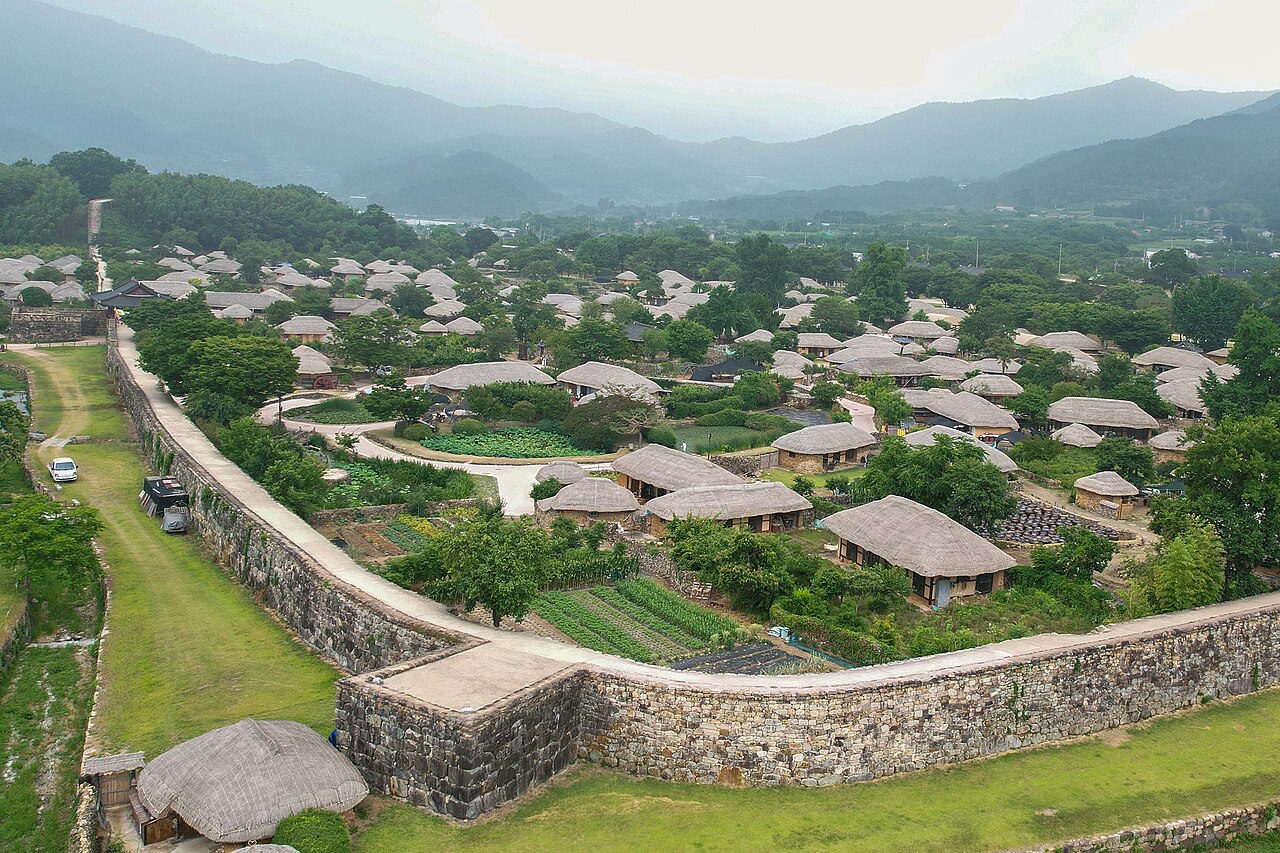
Naganeupseong Folk Village (Korean: 낙안읍성; Hanja: 樂安邑城) is a Korean historic village located in Nagan-myeon, Suncheon, South Jeolla, South Korea. This well-preserved walled town served as an administrative core for the county during the Joseon Dynasty and it is designated as historical site N0. 302.
Naganeupseong is a former administrative town. It consists of three neighborhoods located inside fortress walls, on a level field surrounded by mountains. It has well-preserved buildings such as a fortress, government buildings, and a cluster of private houses. The houses are hanok-style: they have straw roofs, clay rooms, and Korean-style verandas. This is notable because the original town was mainly inhabited by common people and not aristocrats.
Even today, the town is still actively occupied by around 100 households. Many work as farmers that carry out the traditional lifestyle and arts of the region.
The fortress was constructed in 1397 by general Kim Bin-gil, during the reign of King Taejo of Joseon. The fortress was intended to defend the area after the defeat of the Wokou pirates. It was initially surrounded by a sand wall, but was fortified with a stone wall during the rule of King Injo in order to better defend itself against Japanese pirates. The project was carried out under the guidance of general Im Gyeong-eop (1594–1646), who served as the governor of Nagan from 1626 to 1628. When he died, a monumental house was built by the people of Nagan, which still stands in the village to this day.
Nine 19th century thatched-roof houses are designated as national heritages, because they are valuable examples of South Jeolla architecture during the Joseon period.
Naganeupseong was designated as National Heritage (Historic Site No. 302) in 1983. Since then, a series of projects have been conducted to preserve the village landscape. 231 houses were kept in their original condition, and are thus considered valuable sources for academic research. The village was also included on the tentative list of UNESCO's World Heritage Sites in 2010.
The fortress and the village are home to various cultural events of the region. One of the most celebrated is the annual South Jeolla Food Festival, held every year in October, where people can enjoy and learn about the regional cuisine.
Text adapted from “Naganeupseong” on Wikipedia, CC BY-SA 4.0.
Naganeupseong ranks #4,400 of 8,134 worldwide in the atlas's castle fame ranking, and #15 of the 58 mapped in South Korea. Founded 1397, it is older than 54% of the atlas's dated landmarks — one of 604 atlas entries founded in the 14th century. 1 more atlas landmarks stand within 25 km. See how South Korea compares in the castle statistics.
View on the interactive castle map →Frequently asked questions
Where is Naganeupseong?
Naganeupseong stands in South Korea, at 34.90611°, 127.33583°.
When was Naganeupseong built?
The atlas dates its founding to 1397. Earlier structures may have stood on the site; this is the earliest documented founding year.
How famous is Naganeupseong?
In this atlas's fame ranking: #4,400 of 8,134 worldwide, and #15 in South Korea. Fame here combines how many Wikipedia language editions cover a landmark with how many people read them.
What is the nearest castle to Naganeupseong?
Suncheon Castle, about 22 km away.
More castles in South Korea
- Gongsanseong South Korea
- Ulsan Castle South Korea
- Geumjeongsanseong South Korea · 18th century
- Busanjinseong South Korea · 16th century
More fortresses
- Fortaleza de Santa Teresa Uruguay · 18th century
- Verkhoturye Kremlin Russia · 17th century
- Fortress of Muxima Angola · 16th century
- Borj Nord Morocco · 16th century