 Switzerland · 13th century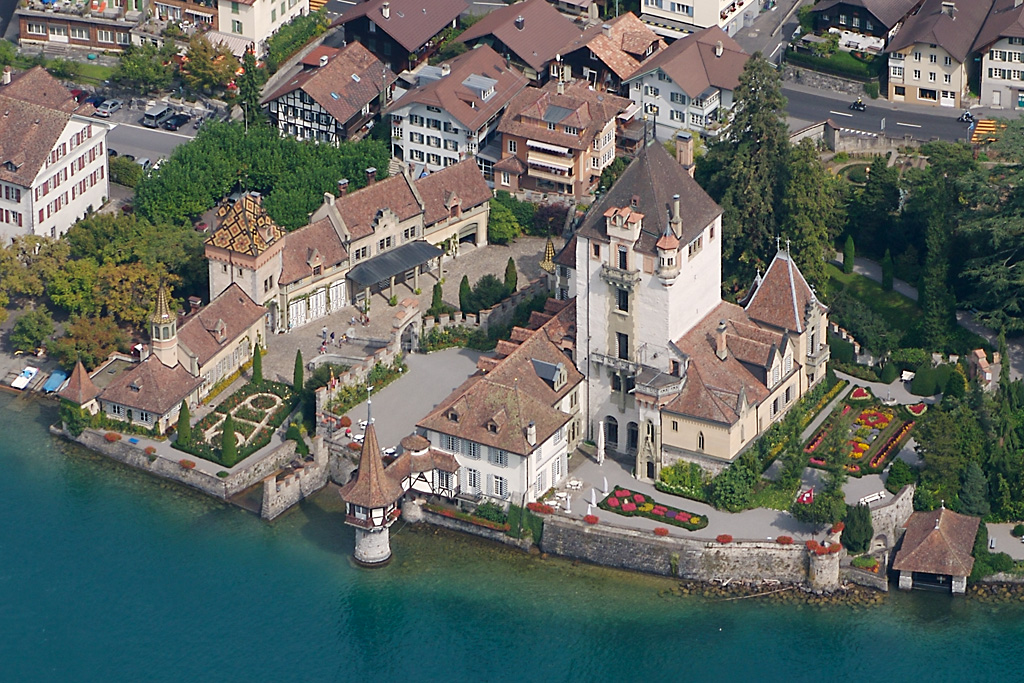
Oberhofen Castle is a castle in the municipality of Oberhofen of the Canton of Bern in Switzerland. It is a Swiss heritage site of national significance.
During the High Middle Ages the Freiherr von Oberhofen built Balm Castle on a hill above the village. In 1200, a daughter of the family, Ita, married into the von Eschenbach family and gave this family the castle and village. In the 13th century they began a new, moated castle on the shores of Lake Thun. One of the last owners of the castle, Walter IV von Eschenbach, was assassinated along with King Albert I in 1308 by Albert's nephew John. In 1306 the von Eschenbach family was forced to sell Oberhofen and the castle to the Habsburgs. The Habsburgs appointed a succession of vassals to administer the area for them, especially the Kyburgs who also owned Thun Castle. Following the Kyburg defeat in the Burgdorferkrieg of 1383-84 and the decisive Habsburg defeat at the Battle of Sempach in 1386, Bern began to expand into the Austrian lands in the Bernese Oberland. They occupied Oberhofen in 1386 and were finally able to purchase or usurp all the land and rights from every feudal land holder in 1397. In the following year they sold the castle and Oberhofen Herrschaft to Ludwig von Seftigen, a citizen of Bern.
Over the following centuries the town, castle and herrschaft passed through several Bernese patrician families. After the male line of the von Erlach family in Oberhofen died out in 1652, Bern acquired the castle and lands. They created the bailiwick of Oberhofen and converted Oberhofen Castle into the administrative center for the bailiwick. Following the 1798 French invasion, Oberhofen am Thunersee became part of the Helvetic Republic Canton of Oberland. After the collapse of the Republic and 1803 Act of Mediation it joined the newly created Thun District.
The castle passed into private hands after 1803 and had several owners in the following years. In 1849-52 the Pourtàles family renovated and expanded the castle to its present appearance. In 1940 the American William Maul Measy established the Oberhofen Castle foundation to administer and maintain the castle. In 1952 it became a part of the Historical Museum of Bern and two years later they opened a branch in the castle.
Text adapted from “Oberhofen Castle” on Wikipedia, CC BY-SA 4.0.
Oberhofen Castle ranks #2,344 of 9,035 worldwide in the atlas's castle fame ranking, and #21 of the 213 mapped in Switzerland. Founded c. 1250, it is older than 67% of the atlas's dated landmarks, one of 1090 atlas entries founded in the 13th century. Its Wikipedia articles were opened 2,523 times in the last 60 days, more than 75% of the atlas. 15 more atlas landmarks stand within 25 km. The nearest day-trip guide is Bern, 30 km away. See how Switzerland compares in the castle statistics.
View on the interactive castle map →