 France · 12th century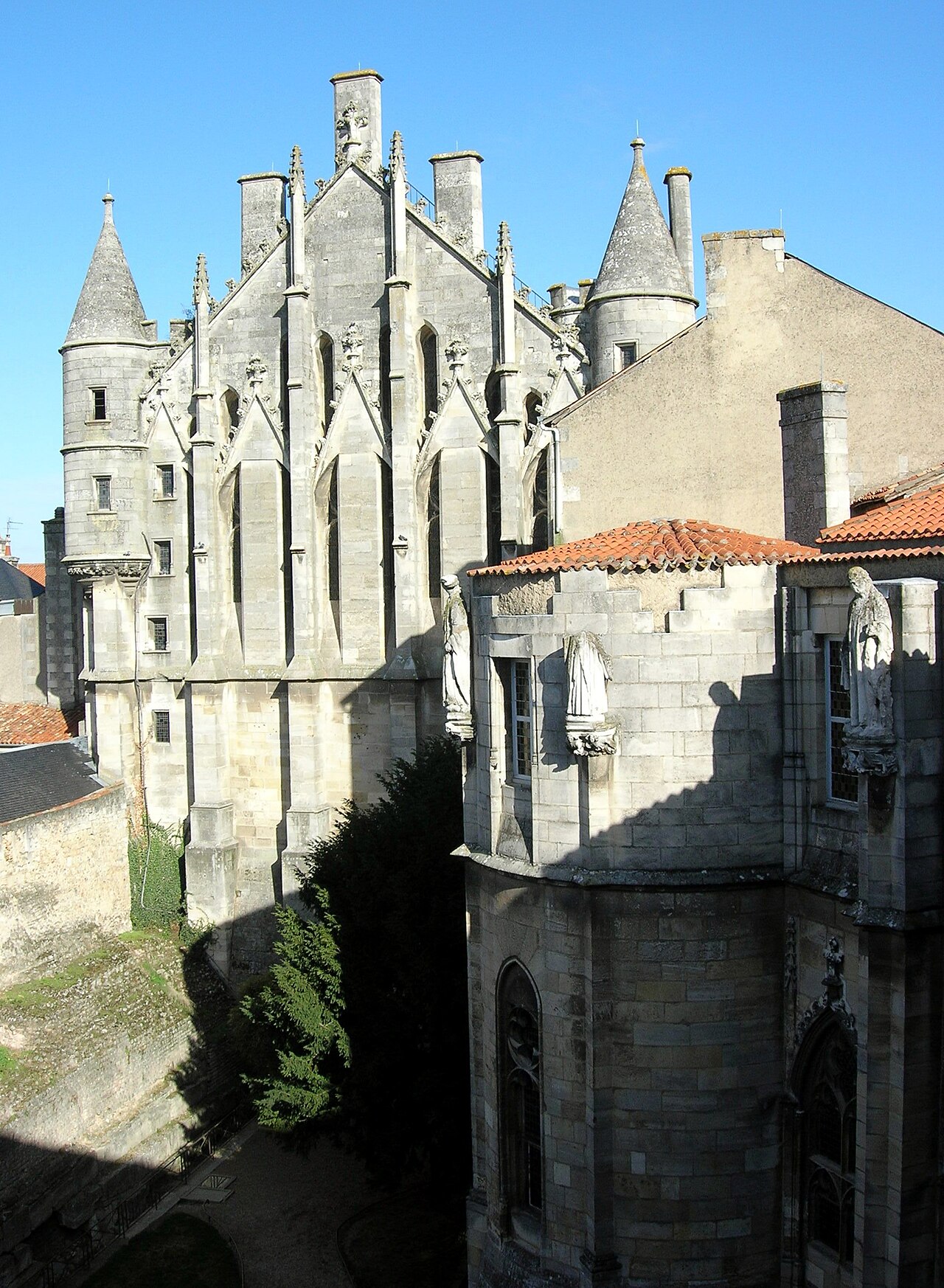
The Palace of Poitiers was the palace of the Counts of Poitiers and subsequent Dukes of Aquitaine in Poitiers, in Poitou, western France. It is a medieval testimony of the Plantagenet style of architecture. Until 2019, this building was used as a courthouse.
The former Merovingian kingdom of Aquitaine was re-established by Charlemagne for his son Louis the Pious; in the 9th century, a palace was constructed or reconstructed for him, one among many, above a Roman wall datable to the late 3rd century, at the highest spot of the town. Louis stayed there many times as a king and then returned to the palace after becoming emperor, in 839 and 840. The palatium was specifically called a palace in the reign of Charles the Bald. After the disintegration of the Carolingian realm, the palace became the seat of the Counts of Poitiers. The first palace of Poitiers was completely destroyed by a fire in 1018.
The palace was completely rebuilt, straddling the wall, by the Count-Dukes of Aquitaine, then at the pinnacle of their power. In 1104, Count William IX added a donjon on the town side. It is known as the tour Maubergeon, after his mistress Amauberge ("the Dangerous"), wife of Vicomte Aimery de Châtellerault and grandmother of Eleanor of Aquitaine. The rectangular keep is reinforced with four smaller square towers projecting from each corner; it was greatly damaged when the southern portion of the palace was set ablaze by Henry of Grosmont, Duke of Lancaster in 1346.
Between 1191 and 1204, Eleanor (locally "Alienor") fitted up a dining hall, the Salle des Pas Perdus, the "hall of lost footsteps", where a footfall was silenced by the vastness of its space— 50 metres in length, 17 metres in width, perhaps the largest in contemporary Europe. The hall has not retained its original beamed ceiling; it has been covered by chestnut woodwork, constructed in 1862 by a team of marine carpenters from La Rochelle. The walls of the hall are daubed and painted so as to imitate stone facing. Their monotony is relieved by cusped arches resting on slender columns. A stone bench rings the walls of the hall.
In 1384–86 Jean I, duc de Berry, who was also appanage count of Poitiers, rebuilt the part of the palace which had been destroyed by fire.
Text adapted from “Palace of Poitiers” on Wikipedia, CC BY-SA 4.0.
Palace of Poitiers ranks #2,459 of 9,035 worldwide in the atlas's castle fame ranking, and #191 of the 787 mapped in France. Founded c. 1150, it is older than 80% of the atlas's dated landmarks, one of 763 atlas entries founded in the 12th century. Its Wikipedia articles were opened 3,219 times in the last 60 days, more than 79% of the atlas. 1 more atlas landmarks stand within 25 km. The nearest day-trip guide is Tours, 94 km away. See how France compares in the castle statistics.
View on the interactive castle map →