 Democratic Republic of the Congo · 20th century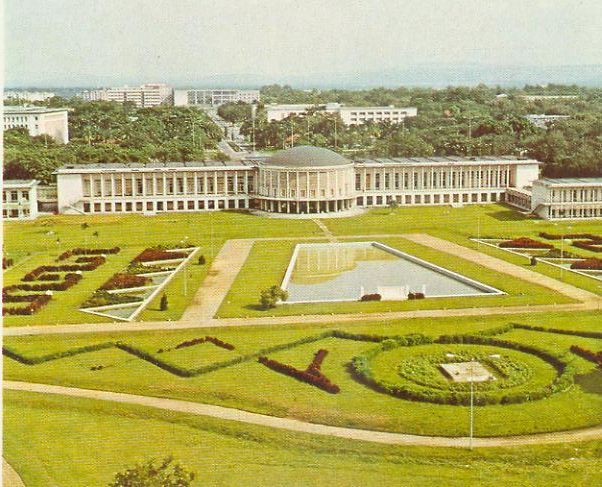
The Palace of the Nation (French: Palais de la Nation) is the official residence and principal workplace of the President of the Democratic Republic of the Congo. It is situated in Gombe, in the northern part of Kinshasa, next to the Congo River. It has held this role since 2001, following the assassination of Laurent-Désiré Kabila.
Constructed in 1956 based on Marcel Lambrichs' design, the palais was initially conceived as the residence for the colonial Governor-General. After independence from Belgium, in 1960, the Palais metamorphosed into a symbol of the new state. The official proceedings commemorating the nation's newfound autonomy, including King Baudouin's Proclamation, declaring the Congo's independence and Patrice Lumumba's speech denouncing colonialism, took place in the palais on June 30. After the nation's independence, the residence briefly served as the seat of the Congolese parliamentary body, which now convenes in the People's Palace.
In the aftermath of the reconstruction and revival of the Congolese state following the fall of Mobutu Sese Seko, a mausoleum honoring Laurent-Désiré Kabila was unveiled near the palace's entrance on 18 January 2002.
Text adapted from “Palais de la Nation (Kinshasa)” on Wikipedia, CC BY-SA 4.0.
Palace of the Nation ranks #2,016 of 9,079 worldwide in the atlas's castle fame ranking, and #1 of the 2 mapped in Democratic Republic of the Congo. Founded 1956 — one of 169 atlas entries founded in the 20th century. Its Wikipedia articles were opened 4,248 times in the last 60 days, more than 84% of the atlas. See how Democratic Republic of the Congo compares in the castle statistics.
View on the interactive castle map →