 Timor-Leste · 19th century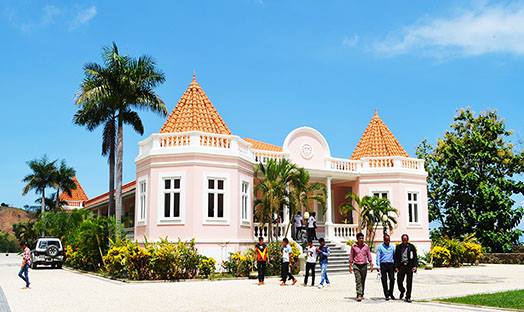
The Palácio de Lahane (transl. Lahane Palace), also known as the Palácio das Nobres (transl. Nobre Palace or, lit., Palace of the Nobles), is a historic building in Timor-Leste. As of 2022, its primary function was as a reception space for the East Timorese government.
Conceived as an official residence for the colonial governors of Portuguese Timor, the palace has its roots in a house built on the site in 1860–61, during the governorship of Afonso de Castro (1859 to 1861 and 1862 to 1863). Construction of that house was a first step in the relocation of the colony's capital from Dili to the mountains; the lowlands around the Bay of Dili were considered to be malaria-infested, especially during the rainy season.
Governor João Maria Pereira (1883–1885) later planned the building of an official residence at the site, but it was only during the governorship of Alfredo de Lacerda Maia (1885–1887) that Pereira's plan was realised, as the Palácio de Lahane. Built between 1884 and 1886, it was an elongated building with turrets. In the early 1930s, it was replaced by a new official residence, in a style vaguely reminiscent of that of chalets, with colonial art deco influences.
In October 1942, during the closing stages of the Battle of Timor, which was ultimately won by the Japanese forces, most of the Portuguese civilians remaining in Portuguese Timor were interned by the Japanese, and the governor, Manuel Ferreira de Carvalho, was confined to the palace. There, he and 18 other people, including members of his family, survived on rations provided by the Japanese. Normally, they received only rice, and all occupants of the palace, including the servants, would share the rations. The only exception to the "normal" ration was on 5 October, Portugal's Republic Day (Portuguese: Implantação da República), when the Japanese would pay their respects to the governor: "At that time they gave us fish and meat to cook for them."
On 1 September 1945, the day before the Empire of Japan signed the instrument of surrender aboard USS Missouri in Tokyo Bay to bring World War II to an end, the Japanese vice consul made another special visit to the governor at the palace, to inform him of the surrender of Japan on 15 August 1945.
On 28 November 1975, the Fretilin political party made a unilateral declaration of independence of East Timor from Portuguese colonial rule.
Text adapted from “Palácio de Lahane” on Wikipedia, CC BY-SA 4.0.
Palácio de Lahane ranks #7,474 of 9,035 worldwide in the atlas's castle fame ranking, and #1 of the 2 mapped in Timor-Leste. Founded 1884, one of 705 atlas entries founded in the 19th century. See how Timor-Leste compares in the castle statistics.
View on the interactive castle map →