 Bolivia · 19th century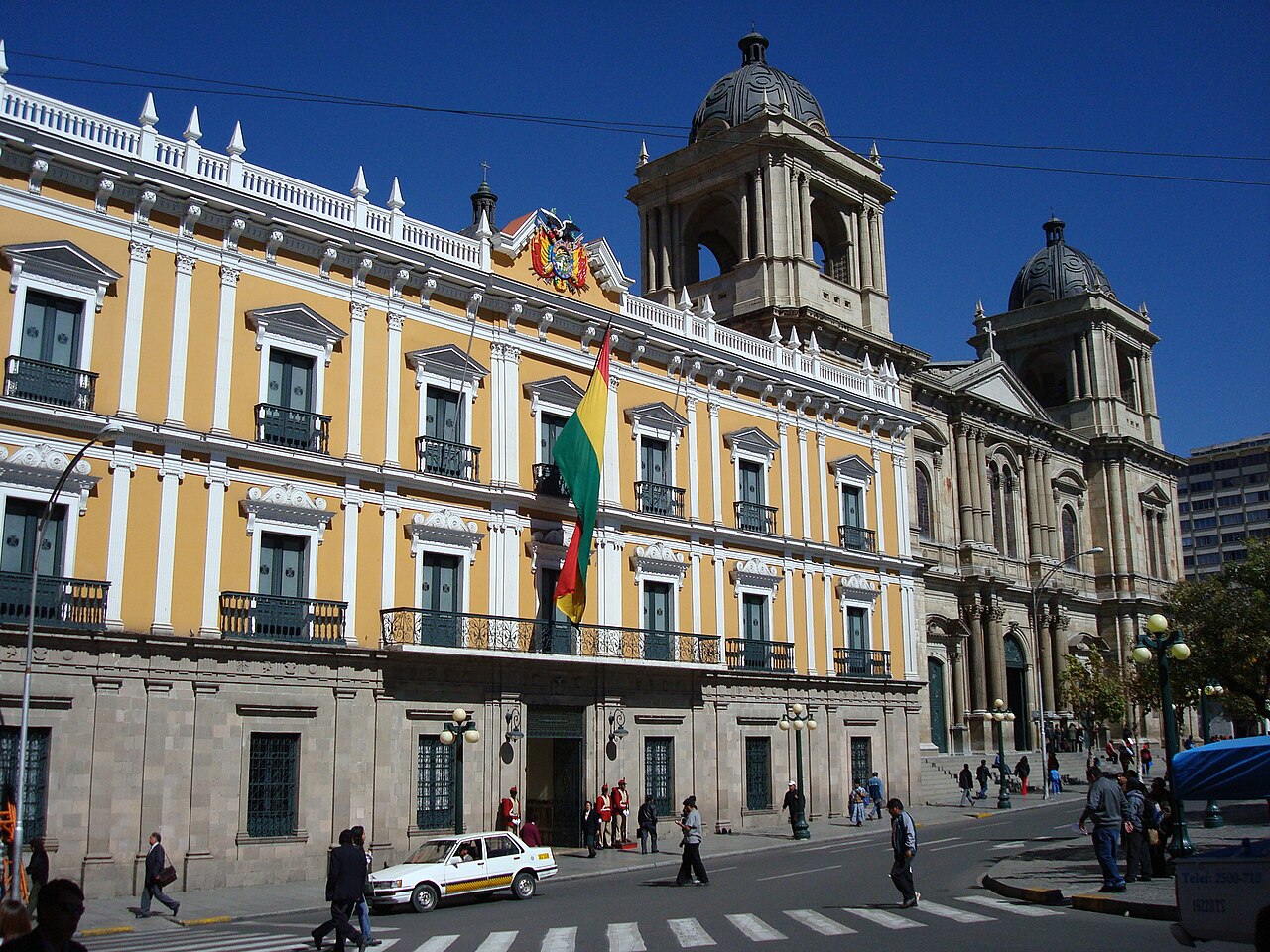
The Bolivian Palace of Government, better known as Palacio Quemado (Spanish: [paˈlasjo keˈmaðo], Burnt Palace), was the official residence of the President of Bolivia from 1853 to 2018 and again briefly from 2019 to 2020. It is located in downtown La Paz on Plaza Murillo, next to the La Paz Cathedral and across from the Bolivian legislature. On 9 August 2018, it was replaced by the Casa Grande del Pueblo as the residence of the president by President Evo Morales. The interim government of Jeanine Áñez briefly reverted to occupying the Palacio Quemado from 2019 until 2020 when the newly elected Luis Arce returned to using the Casa Grande. It now serves as a museum.
Its nickname originates from the fact that it was set aflame and burned almost to the ground during an uprising in 1875. It has since been rebuilt and redecorated a number of times, but the name stuck.
Text adapted from “Palacio Quemado” on Wikipedia, CC BY-SA 4.0.
Palacio Quemado ranks #1,768 of 9,035 worldwide in the atlas's castle fame ranking. Founded 1853, it is older than 7% of the atlas's dated landmarks, one of 705 atlas entries founded in the 19th century. Its Wikipedia articles were opened 3,276 times in the last 60 days, more than 80% of the atlas. See how Bolivia compares in the castle statistics.
View on the interactive castle map →