 Spain · 20th century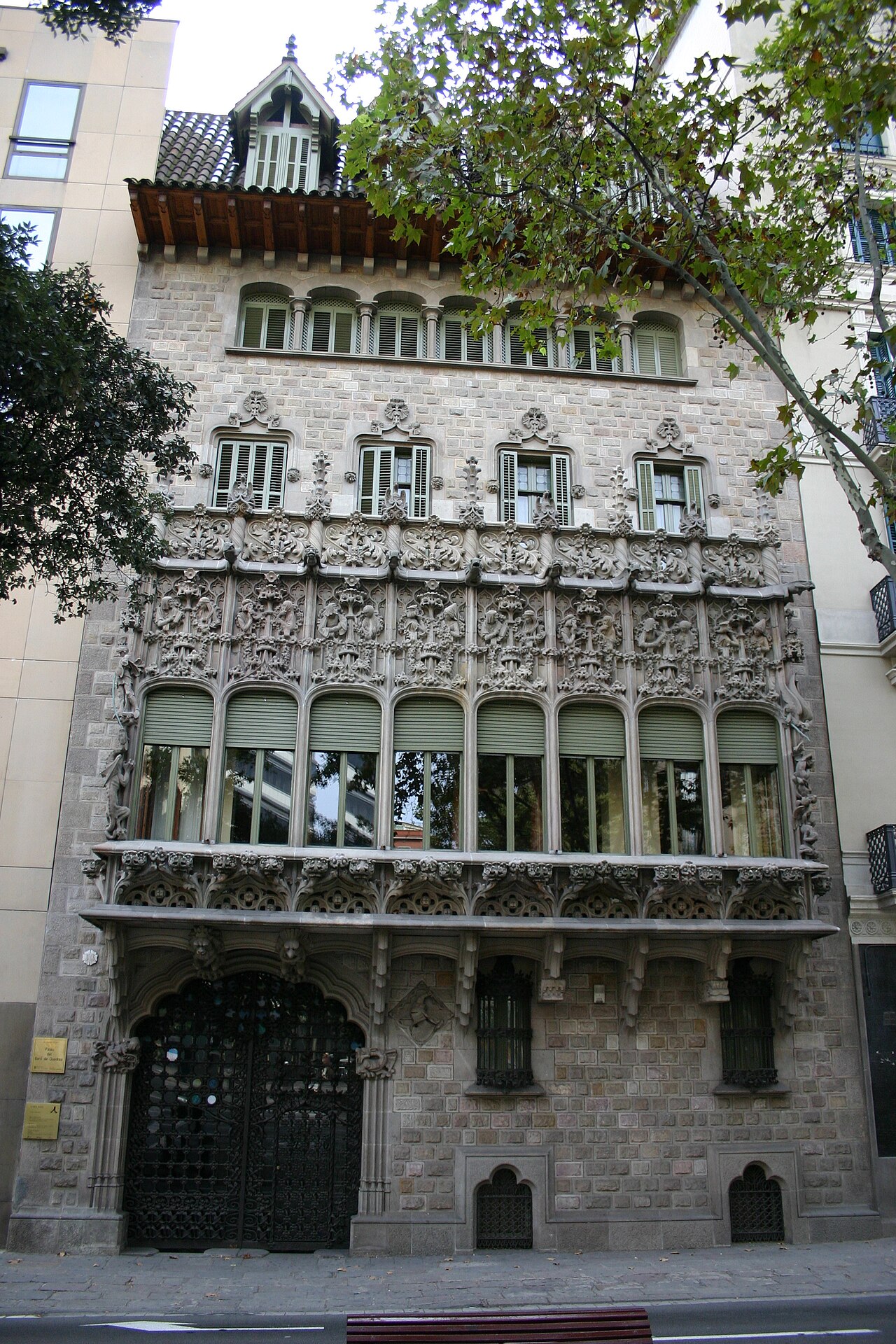
The Palau Baró de Quadras is a small modernista palace located in Barcelona on Avinguda Diagonal, equidistant from La Pedrera and Casa de les Punxes. It was built by the Catalan architect Josep Puig i Cadafalch between 1904 and 1906. In 1976 it was designated as Nacional National Historical Monument of Artistic Interest. Currently houses the main offices of the Institut Ramon Llull.
Starting with a thorough renovation of an existing building on a narrow plot of land that faced Carrer Rosselló, Puig i Cadafalch created this small Modernista building, now with two facades, Diagonal and Rosselló. The palace is situated in the Quadrat d'or, where the most important Modernista buildings can be found including Casa Milà – La Pedrera, Casa Batlló and Casa Calvet designed by Antoni Gaudí, Casa Amatller and Casa de les Punxes created by Josep Puig i Cadafalch or Casa Lleó Morera designed by Lluís Domènech i Montaner.
The Avinguda Diagonal façade has one of the most impressive Gothic revival balconies seen in Modernista architecture. The artisans Alfons Juyol and Eusebi Arnau used carved stone for their design.
The rear façade, facing Carrer Rosselló, has floral motifs extending horizontally and vertically along the three balconies and down the four floors.
The building has an entryway characterized by an elaborate decoration of the stairway, a glasswork on the skylight and a Roman mosaic flooring. Its central position provides the axis around which the stairwell and layout of the first floor revolve. The iron grillwork on the ground floor doors, facing both Avinguda Diagonal and Carrer Rosselló, were forged by master ironworker Manuel Ballarín i Lancuentra.
The large rooms facing Avinguda Diagonal are the most public spaces in the building and meant for receiving visitors. They feature Moorish-style stone arches with colorful ceramic floral motifs and Gothic sculptural elements.
The spaces that face Carrer Rosselló were designed for family use, with more detailed floral stucco relief work gracing the walls. Bold Ionic columns covered with floral and plant motifs, in the English Arts and Crafts style, face the fireplace, the symbol of home life.
It's important to see the extraordinary woodwork of the coffered ceilings and the hardwood flooring with various geometric designs.
The Palau was restored in 1980 to house the Music Museum of Barcelona.
Text adapted from “Palau Baró de Quadras” on Wikipedia, CC BY-SA 4.0.
Palau del Baró de Quadras ranks #3,168 of 9,079 worldwide in the atlas's castle fame ranking, and #118 of the 607 mapped in Spain. Founded 1904 — one of 169 atlas entries founded in the 20th century. Its Wikipedia articles were opened 1,233 times in the last 60 days, more than 56% of the atlas. 12 more atlas landmarks stand within 25 km. The nearest day-trip guide is Barcelona, 2 km away. See how Spain compares in the castle statistics.
View on the interactive castle map →