Palace
Palazzo Bartolini Salimbeni
 Italy · 16th century
- Founded
- 1520
- Style
- Renaissance architecture
- Architect
- Baccio d'Agnolo
- Location
- Florence
- Coordinates
- 43.77019°, 11.25169°
- Open data
- Wikidata Q896608
- Links
- Wikimedia Commons
Description
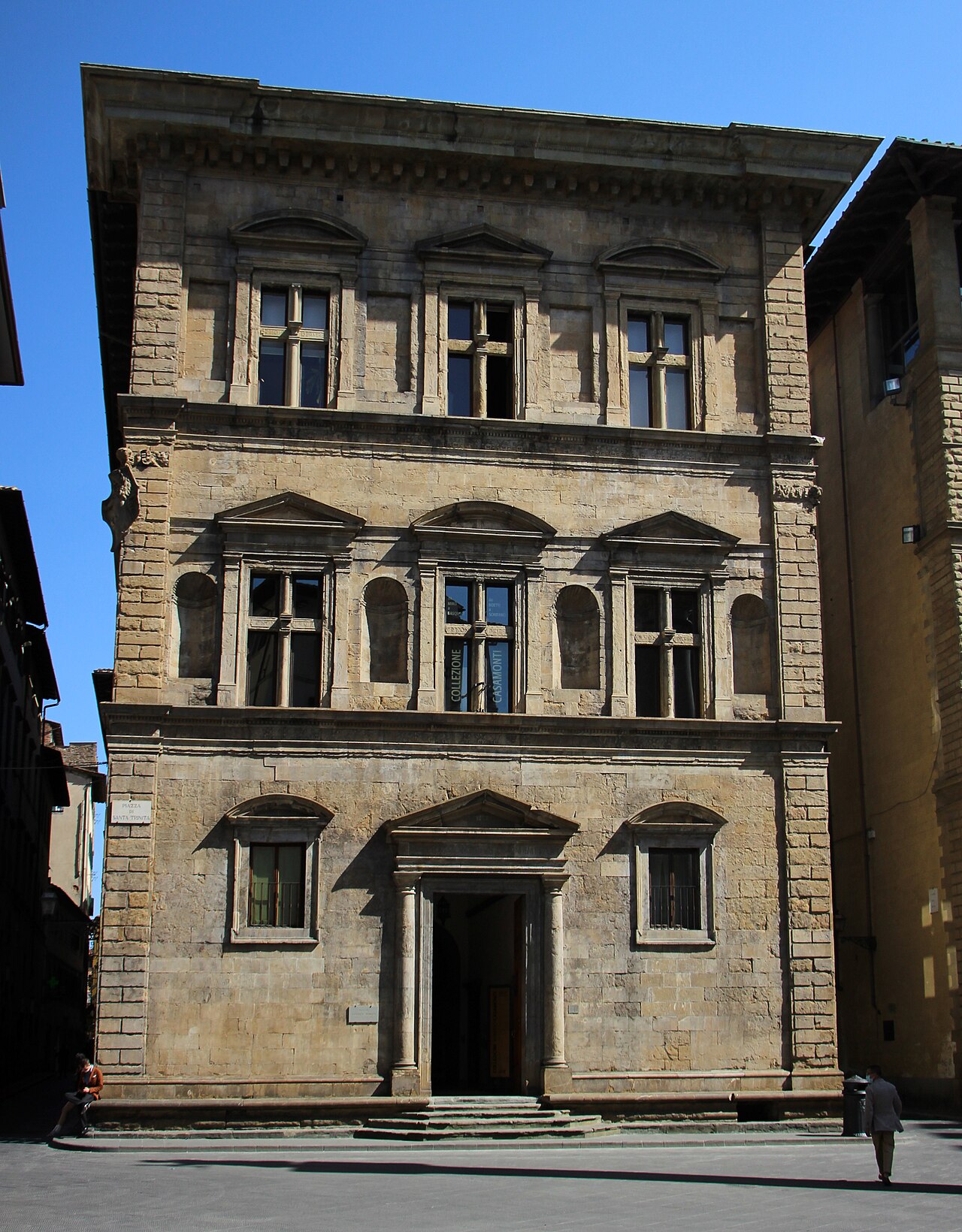
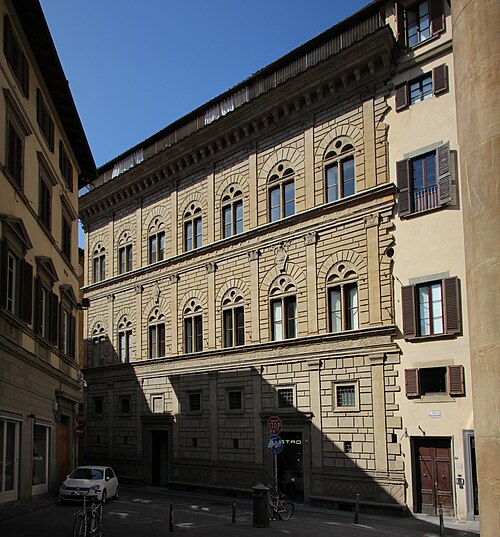
The Palazzo Bartolini Salimbeni is a High Renaissance-style palace located on Via de' Tornabuoni on Piazza Trinita in central Florence, Italy.
Since 2018 the piano nobile of the palace hosts the Collezione Roberto Casamonti, an exhibition itinerary dedicated to modern and contemporary art from the late 19th century to the early 21st century.
The palace arose at the site which once held the residence of the Soldanieri and later Dati families, which was bought by Bartolomeo Bartolini-Salimbeni.
The current edifice was erected by the architect Baccio d'Agnolo between 27 February 1520 and May 1523, as testified by a diary kept by Bartolini. The architect was paid two florins per month. The structure represents one of the earliest buildings in Florence expressing the High Renaissance style of Rome, where Baccio had spent several formative years. Another palace partially designed by Baccio is the Palazzo Antinori.
The Bartolini-Salimbeni lived in the palace until the early 19th century. In 1839 it became the Hotel du Nord, where figures such as the American writer Herman Melville sojourned. In 1863 it was acquired by the Pio di Savoia princes and split between different owners.
The palace was restored in 1961 and it is now a private property.
Palazzo Bartolini Salimbeni is the first palace in Florence built according to the "Roman" Renaissance style: details new to the city included the portal with columns at the sides, the use of pilasters, the square windows with a triangular pediment and the corners with rustication.
The singular new style, according to the Renaissance art historian Giorgio Vasari, caused much criticism. Though a generation later Vasari praised it as gentile di membra, "noble in its detail", in response to contemporary Florentine criticisms Baccio had the Latin inscription set over the door Carpere promptius quam imitari, "Criticizing is easier than imitating". The windows bear another inscription, in Italian, Per non dormire ("[A reward] For not sleeping"), the motto of the Salimbeni family that is also recalled by the Bartolini-Salimbeni coat of arms in the frieze at the first floor, featuring three poppies.
The palace has a central court in pure Classical style. It has a portico on three sides, with columns and round arches in traditional pietra serena. The ground and first floors have grotesque monochrome decorations.
Text adapted from “Palazzo Bartolini Salimbeni” on Wikipedia, CC BY-SA 4.0.
In the rankings
Palazzo Bartolini Salimbeni ranks #3,221 of 9,902 worldwide in the atlas's castle fame ranking, and #258 of the 624 mapped in Italy. Founded 1520, it is older than 42% of the atlas's dated landmarks, one of 933 atlas entries founded in the 16th century. Its Wikipedia articles were opened 1,112 times in the last 60 days, more than 58% of the atlas. 21 more atlas landmarks stand within 25 km. The nearest day-trip guide is Florence, 1 km away. It is one of the 52 landmarks on the atlas's regional map of Tuscany. See how Italy compares in the castle statistics.
Castles nearby
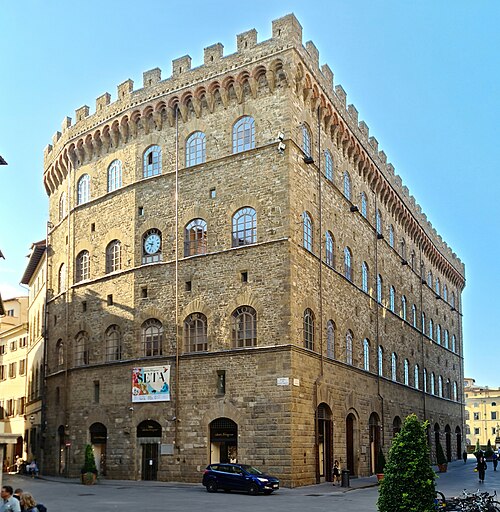
- Palazzo Spini Feroni1 km · Italy
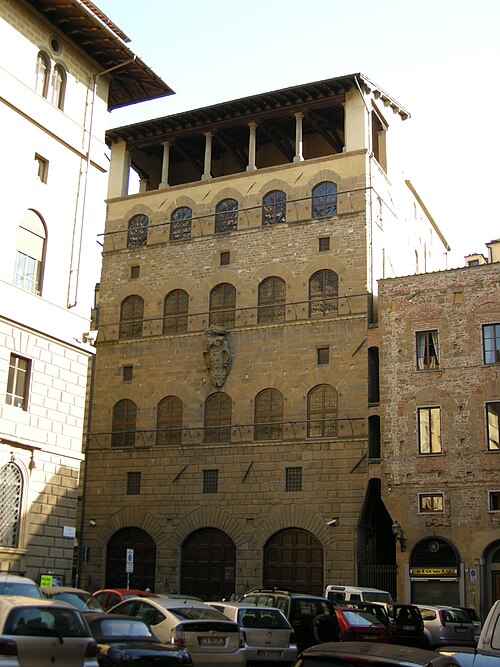
- Palazzo Davanzati1 km · Italy
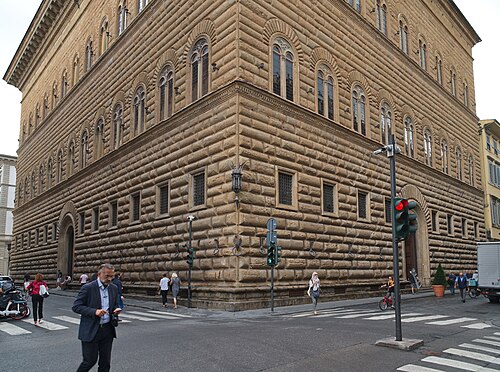
- Palazzo Strozzi1 km · Italy
- Palazzo Rucellai1 km · Italy
More castles in Italy
- Palazzo di Sangro di Casacalenda, NaplesItaly · 18th century
- Palazzo San FeliceItaly · 18th century
- Palazzo del PanormitaItaly · 15th century
- Palazzo MariglianoItaly · 16th century