 Italy · 16th century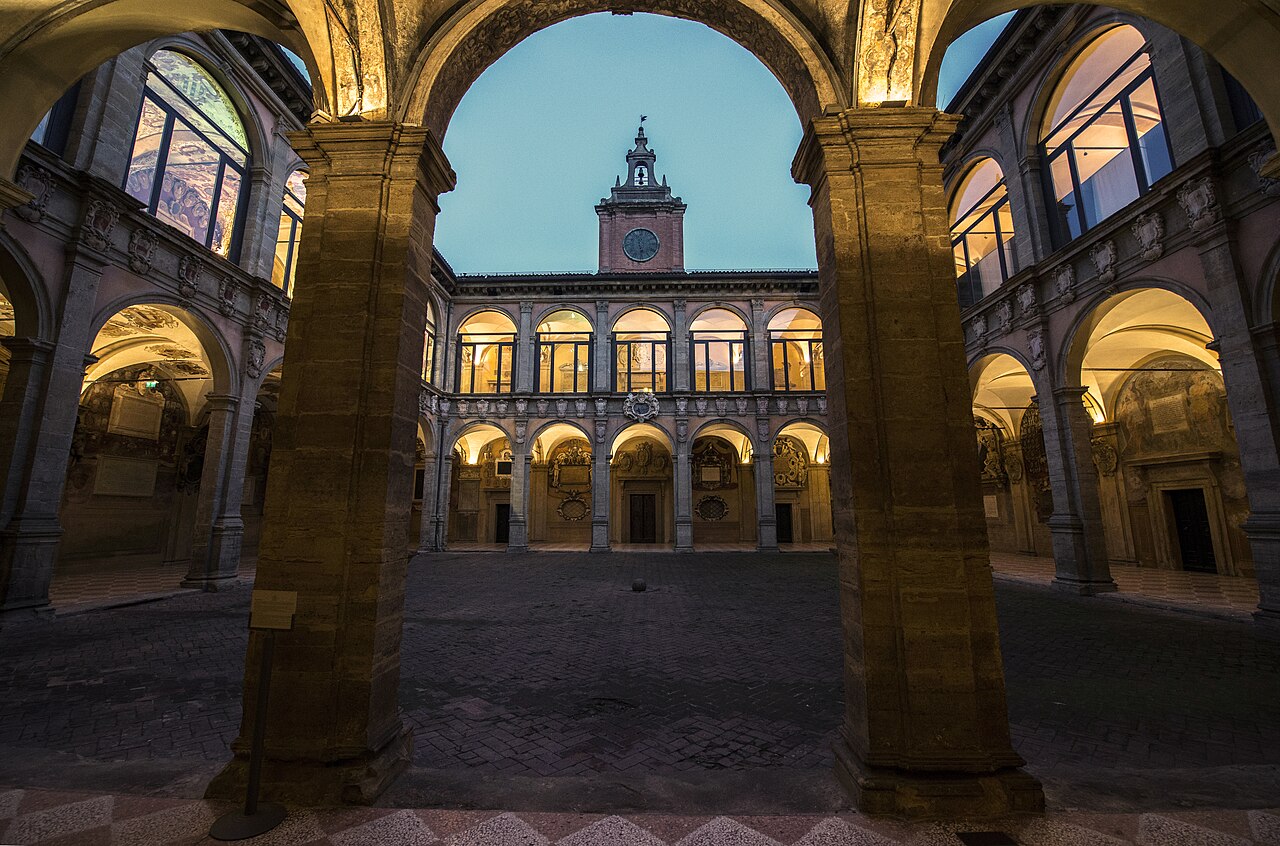
The Archiginnasio of Bologna is one of the most important buildings in the city of Bologna; once the main building of the University of Bologna, it currently houses the Archiginnasio Municipal Library and the Anatomical Theatre.
In the heart of the palace is the university Chapel of Santa Maria dei Bulgari, a reflection of history.
The construction of the Archiginnasio dates back to the 16th century, when the Piazza Maggiore was drastically remodeled under papal orders; the Fountain of Neptune was built during this same period. The construction of the Archiginnasio was commissioned by Pope Pius IV through papal legate Charles Borromeo and vice-legate Pier Donato Cesi during the years of the Council of Trent, who then entrusted the project to Antonio Morandi (known as il Terribilia). Construction began at the end of February 1562; built very quickly, it was inaugurated on October 21, 1563. The goal of this project was to create a single place where the Schools of the "Legisti" (Canon and Civil law) and "Artisti" (philosophy, medicine, mathematics, natural sciences and physics), previously located in various places across the town, could be hosted together.
The building of the new "Schools" was named Archiginnasio after the classical term which was used to designate the Studium, as the University was first called, of Bologna.
The Archiginnasio ceased to be a University in 1803 when the University was moved to Palazzo Poggi where it is still located today. Scuole Pie (primary schools) were housed in this building for a few years and later, from 1838 onwards, were replaced by the city library. Archiginnasio Municipal Library is the largest library in Emilia-Romagna. It was first established to keep the books collected from the closure of the religious orders made by Napoleon. It houses 850,000 volumes and pamphlets, including 2,000 incunabula, about 15,000 16th century editions, 8,500 manuscripts, letters, collections of autographs, prints and drawings and 250 archives. All of this material, handwritten and printed collections, are of the utmost importance. They deal with the civil, cultural, religious and social history of Bologna and its territory.
Upon entering, visitors are asked to hand over all bags and writing materials which can be picked up when leaving.
Text adapted from “Archiginnasio of Bologna” on Wikipedia, CC BY-SA 4.0.
Palazzo dell’Archiginnasio ranks #1,647 of 9,035 worldwide in the atlas's castle fame ranking, and #121 of the 555 mapped in Italy. Founded c. 1550, it is older than 36% of the atlas's dated landmarks, one of 886 atlas entries founded in the 16th century. Its Wikipedia articles were opened 5,262 times in the last 60 days, more than 87% of the atlas. 10 more atlas landmarks stand within 25 km. The nearest day-trip guide is Bologna, 1 km away. See how Italy compares in the castle statistics.
View on the interactive castle map →