 Italy · 17th century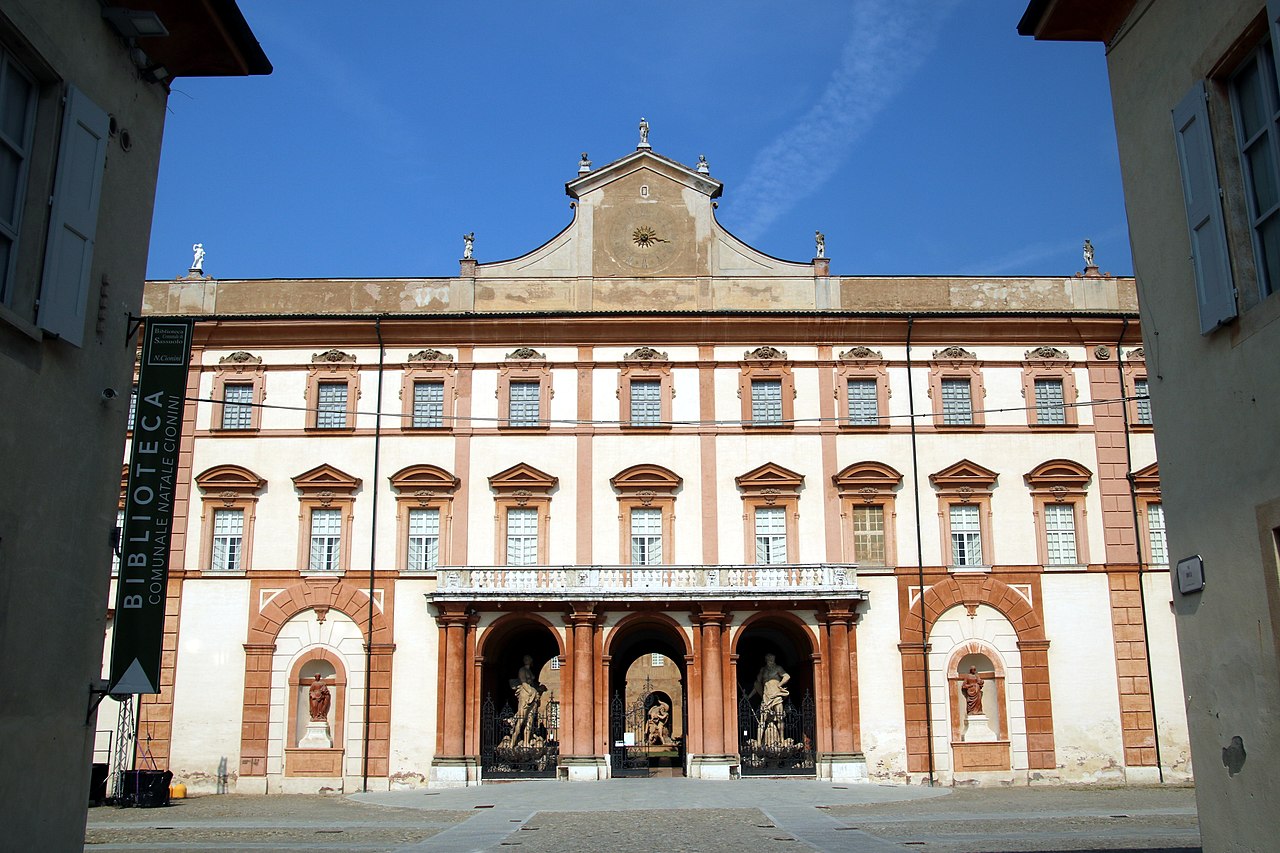
The Ducal Palace of Sassuolo (Italian: Palazzo ducale di Sassuolo) is a Baroque villa located in the town of Sassuolo, thirty minutes outside Modena, northern Italy.
The palace was built on the site of a medieval castle or rocca. Obtained by Niccolò III d'Este from the della Rosa family in the 15th century, and converted into a court residence by Borso d'Este in 1458.
The exterior facade seems to reference Tuscan villas more than those of the Veneto. In the mid-16th century, the first pleasure summer villa was built on the site. In the early 17th century, the Duke Francesco I d'Este commissioned the present building from the architect Bartolomeo Avanzini. Over the centuries, the palace has had many owners, but is now owned by the town of Sassuolo and the Gallerie Estensi, who contributed to the picture galleries the Orlando, Princess and Secchia apartments.
The palace is best known for its highly decorated interior frescoes (1638–1656) by the French Este court painter Jean Boulanger, as well as several perspectival ceilings by Ottavio Vivani, Giacomo Cialdieri, Angelo Michele Colonna, Agostino Mitelli, Baldassare Bianchi and Giovanni Giacomo Monti. Lattanzio Maschio and Luca Colombi were also invited by Boulanger to work on the palace stucco decoration. Giovanni Lazzoni, Nicolas Régnier, Salvator Rosa, and Ludovico Lana also contributed to the palace's art collection.
The palace is also known for its garden vistas reminiscent of Versailles and its fanciful Peschiera or fish-tank. The latter was originally designed by Avanzini and Gaspare Vigarani as a large rectangular "pool" surrounded by a boundary wall in the form of a ruined amphitheatre, for which it earned its sobriquet the "Fontanazzo" (Rough Fountain). Highlights of the complex also include larger-than-life fountain sculptures based on the designs of Gian Lorenzo Bernini and Renaissance fresco fragments by Nicolò dell’Abbate recovered from the Scandiano palace in Reggio Emilia.
Restoration of the piano nobile in 2001 has allowed the palace to be equally used as a space for contemporary art exhibitions, fusing past and present. Terminating the tour of the Duke and Duchesses’ private and public apartments on the first floor, the Stuccoed apartments have hosted the exhibition “MONOCHROMATIC LIGHT” since 2003.
Text adapted from “Ducal Palace of Sassuolo” on Wikipedia, CC BY-SA 4.0.
Palazzo Ducale ranks #3,578 of 9,079 worldwide in the atlas's castle fame ranking, and #275 of the 560 mapped in Italy. Founded c. 1650, it is older than 25% of the atlas's dated landmarks — one of 721 atlas entries founded in the 17th century. Wikidata records about 18,000 visitors in 2022. 1 more atlas landmarks stand within 25 km. The nearest day-trip guide is Bologna, 45 km away. See how Italy compares in the castle statistics.
View on the interactive castle map →