 Italy · 17th century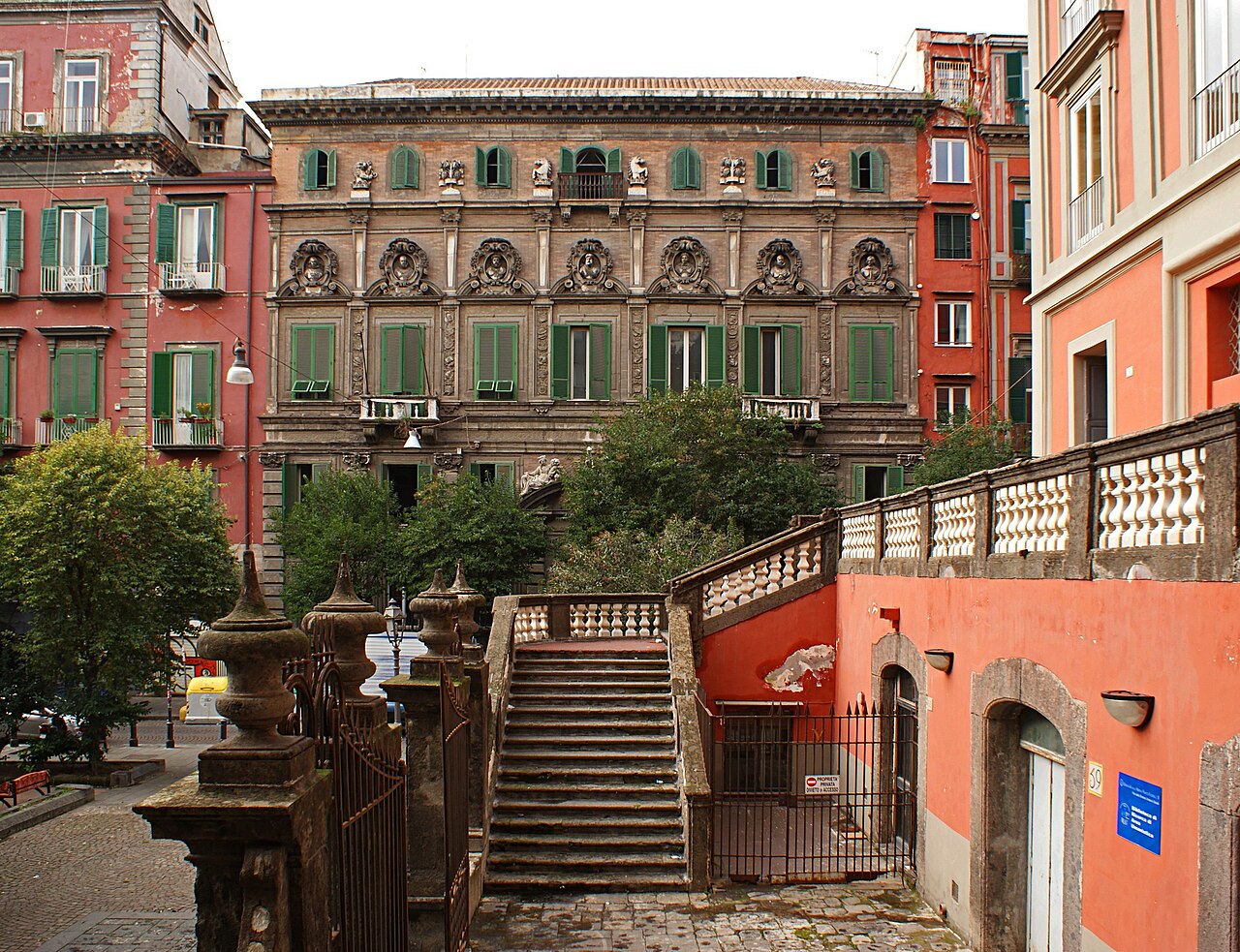
The Palazzo Firrao or Palazzo Bisignano, once called Palazzo di Santa Agata, is a monumental palace located on Via Santa Maria di Costantinopoli number 98, facing Piazza Bellini, in central Naples, Italy.
A palace at the site existed by the early 1500s, since it is known it once sported external frescoes by Polidoro di Caravaggio. The palace was purchased in the early 17th century by Cesare Firrao, Prince of Sant’Agata and Luzzi, in Calabria. It is generally held that he commissioned the Baroque architect Cosimo Fanzago to rebuild the palace, and that this architect designed the present facade. Others attribute much of the work to Jacopo Lazzari and his son Dionisio. The palace facade was apparently completed by 1630-1640s.
The close affiliation of Firrao to the viceroy's government almost led to the destruction of the palace during the 1647 revolution of Masaniello, but thanks to the intervention of Cardinal Ascanio Filomarino, the palace was spared. Tradition holds that the cardinal was able to dissuade the mobs by pointing to the bust of Charles I of Spain, Holy Roman Emperor, on the facade, and invoking that king's restrained taxation.
The male family of Firrao died out by the second half of the 17th century, and the palace passed through a daughter Livia Firrao, to the line of her husband Tommaso di Sanseverino, Prince of Bisignano. In modern times, it housed government offices.
The base floors of the facade are constructed with rusticated piperno rock, carved with sturdy but tall Ionic pilasters. The ground floor windows are topped with interrupted pediments with decorative urns. The superior tympanum of the portal is flanked by two reclining statues, each with cornucopiae, depicting Magnanimity (with lion) and Charity (with eagle). In the center, below a forward prancing horse, is a shield displaying the heraldic symbols of the Firrao family.
The superior floors also are rich in sculptural elements, with two stories of carved pilasters, the topmost of which are surmounted by symbols of the Firrao family: grapes, lions, and raring horses. But the striking element are the seven medallion niches containing marble busts of rulers of Naples, mostly from the House of Habsburg, which Firrao served.
Text adapted from “Palazzo Firrao, Naples” on Wikipedia, CC BY-SA 4.0.
Palazzo Firrao ranks #5,492 of 9,079 worldwide in the atlas's castle fame ranking, and #399 of the 560 mapped in Italy. Founded c. 1645, it is older than 27% of the atlas's dated landmarks — one of 721 atlas entries founded in the 17th century. 24 more atlas landmarks stand within 25 km. The nearest day-trip guide is Naples, 2 km away. See how Italy compares in the castle statistics.
View on the interactive castle map →