 Italy · 16th century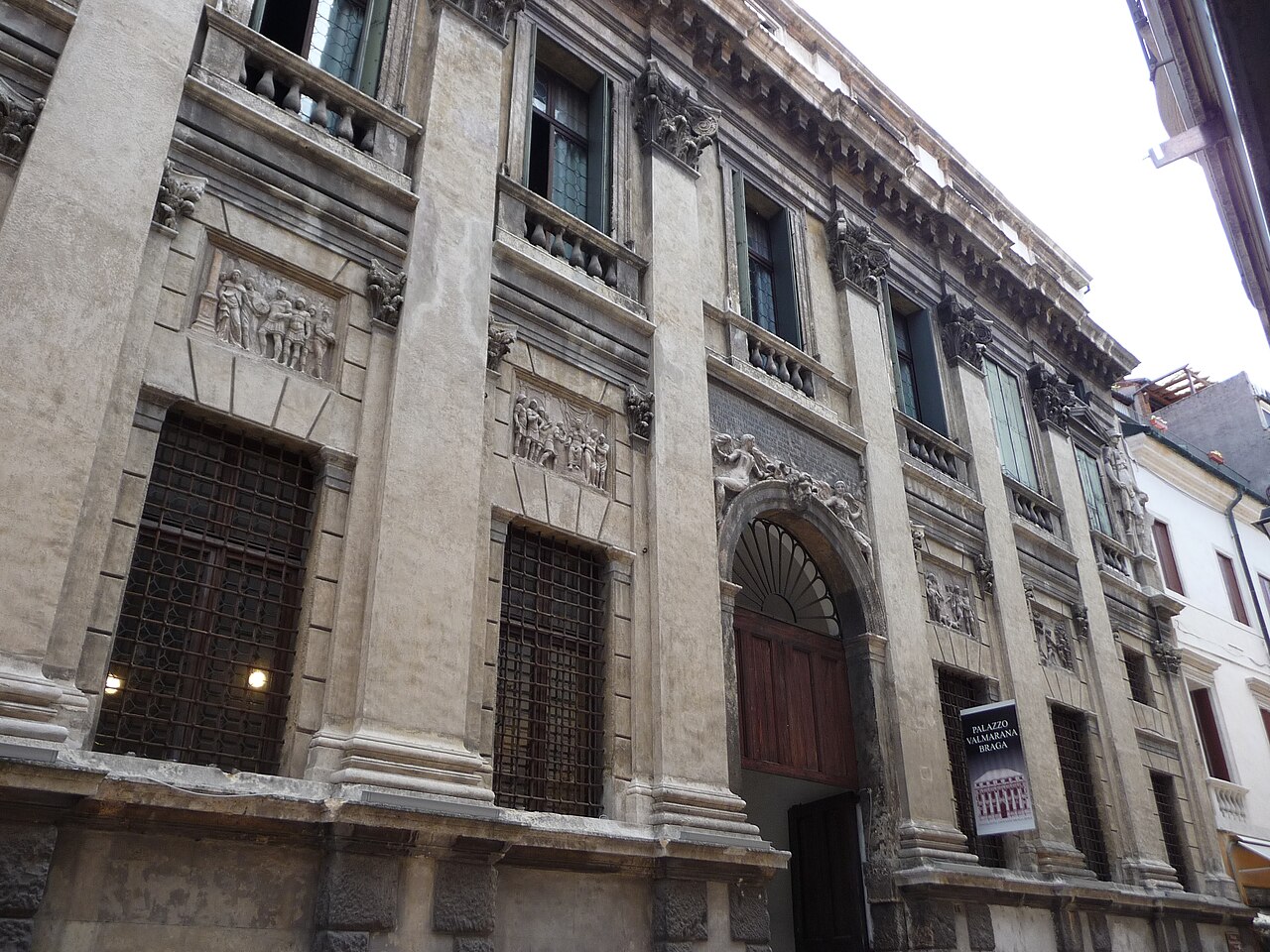
Palazzo Valmarana is a palace in Vicenza. It was built by Italian Renaissance architect Andrea Palladio in 1565 for the noblewoman Isabella Nogarola Valmarana. Since 1994 it is part of the UNESCO World Heritage Site "City of Vicenza and the Palladian Villas of the Veneto".
The foundation medal of this building bears engraved the date 1566 as well as the bust of Isabella Nogarola Valmarana, and it is the latter who signed the construction contracts with the builders in December 1565. Nevertheless, no doubts can remain about the role her deceased husband, Giovanni Alvise (died 1558), played in choosing Palladio as designer of his family palace. In 1549, along with Girolamo Chiericati and Giangiorgio Trissino, Giovanni Alvise Valmarana had publicly supported Palladio’s project for the porticoes of the Basilica Palladiana, evidently on the basis of an opinion formed six years prior, when Giovanni Alvise supervised the execution of ephemeral structures, conceived by Palladio under Trissino’s direction, to honour the entrance into Vicenza of Bishop Niccolò Ridolfi (1543).
Furthermore, it was a space designed by Palladio – the Valmarana Chapel in the church of Santa Corona – which would eventually host the mortal remains of Giovanni Alvise and Isabella, on the commission of their son Leonardo.
On the site later occupied by the new 16th century (Cinquecento) palace, the Valmarana family possessed buildings right from the end of the 15th century (Quattrocento), which were progressively combined until they became the object of Palladio’s renovation. The planimetric irregularity of the internal spaces doubtless derives from the oblique orientation of the façade and of pre-existing walls. In this sense it becomes quite evident just how much the Olympian regularity of the palace illustrated in I quattro libri dell'architettura (1570) was the product of Palladio’s usual theoretical abstraction, especially since not only was the extension of the palace beyond the square courtyard never realised, but nor does it seem it was even intended by Leonardo Valmarana, who bought up neighbouring properties rather than continuing the construction of the family palace.
The palazzo was heavily damaged during the World War II by an Allied bombing on 18 March 1945. The roof, part of the attic and most of the main hall at the piano nobile were destroyed.
Text adapted from “Palazzo Valmarana” on Wikipedia, CC BY-SA 4.0.
Palazzo Valmarana ranks #2,741 of 9,079 worldwide in the atlas's castle fame ranking, and #213 of the 560 mapped in Italy. Founded 1565, it is older than 36% of the atlas's dated landmarks — one of 891 atlas entries founded in the 16th century. Its Wikipedia articles were opened 1,079 times in the last 60 days, more than 52% of the atlas. 10 more atlas landmarks stand within 25 km. The nearest day-trip guide is Vicenza, 1 km away. See how Italy compares in the castle statistics.
View on the interactive castle map →