Palace & château
Pejačević Manor
🇭🇷 Croatia · 19th century
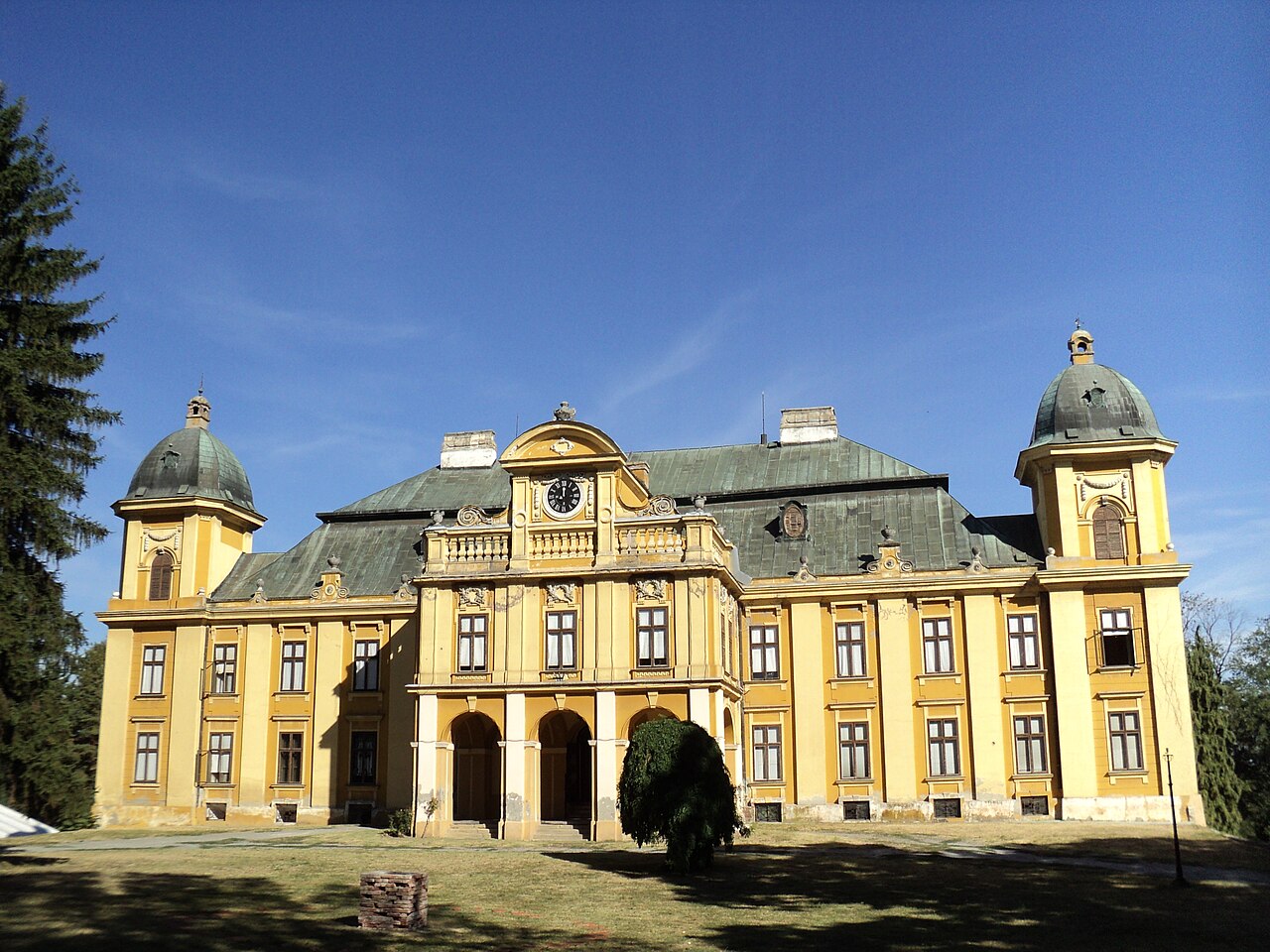
Pejačević Castle in Našice (Croatian: Dvorac Pejačević u Našicama) is a Baroque-revival style lowland structure in Našice, a town in Osijek-Baranja County, northeastern Croatia. The Building bears its name thanks to the Pejačević noble family, whose members owned several castles in the region of Slavonia in the modern era.
The castle was built in 1811/1812 by the order of Vincencije Ljudevit Pejačević (*1780–†1820). After an earthquake in 1817 it was repaired and in the middle of the 19th century it was renovated and expanded by Vincencije's brother Ferdinand Karlo Rajner (*1800–†1878) and his son Ladislav (*1824–†1901), who later became Ban of Croatia. The building was enlarged with thirteen new window openings added on the north and south facades. A decorative gable with volutes, a balustrade and a clock were also added.
Apart from its artistic significance, Pejačević Castle also has historical significance. In the late 19th and early 20th century, the famous Croatian composer Dora Pejačević, the daughter of Croatian Ban Teodor, lived there.
During the World War II, the castle was used by the German Army between 1943 and 1945. A German war hospital was located in the basement. The facade and roof of the castle were damaged during the war.
After the war, the castle was used for various purposes: as a barracks, school, kindergarten or as an office of the state administration, for various associations, etc. Today, the castle houses the local history museum, the city music orchestra, the city library with the reading room and the art gallery.
Due to the slope of the terrain, the castle is one-floor building on the entrance side and two-floor one on the park side. It is richly decorated with stucco, wood paneling and built-in furniture. In the large lobby there is a double, semi-visible staircase with a stone railings.
First original castle from 1812 was built in the classicist style and was smaller than today's one. It had a rectangular floor plan, with nine window openings on the southern entrance facade. The central part of the castle, in the width of three window axes, was highlighted by larger windows and gazebo supported by three arches. The look of the castle was later expanded and changed.
Not far from the castle there is a smaller building called the Small Castle.
Text adapted from “Pejačević Castle in Našice” on Wikipedia, CC BY-SA 4.0.
Pejačević Manor ranks #5,879 of 8,764 worldwide in the atlas's castle fame ranking, and #53 of the 79 mapped in Croatia. Founded 1811, it is older than 12% of the atlas's dated landmarks — one of 655 atlas entries founded in the 19th century. 1 more atlas landmarks stand within 25 km. See how Croatia compares in the castle statistics.
View on the interactive castle map →Frequently asked questions
Where is Pejačević Manor?
Pejačević Manor stands in Croatia, at 45.49187°, 18.09312°.
When was Pejačević Manor built?
The atlas dates its founding to 1811. Earlier structures may have stood on the site; this is the earliest documented founding year.
How famous is Pejačević Manor?
In this atlas's fame ranking: #5,879 of 8,764 worldwide, and #53 in Croatia. Fame here combines how many Wikipedia language editions cover a landmark with how many people read them.
What is the nearest castle to Pejačević Manor?
Ružica grad, about 18 km away.
More castles in Croatia
- Udbina Castle Croatia · 15th century
- Kamičak Castle Croatia · 14th century
- Erdut Castle Croatia · 15th century
- Fort Bourguignon Croatia · 19th century
More palaces & châteaux
- Château Malromé France · 16th century
- Château de Dunois (Beaugency) France
- Château de Lanquais France
- Château de Lignières France · 17th century