 Jordan · 20th century
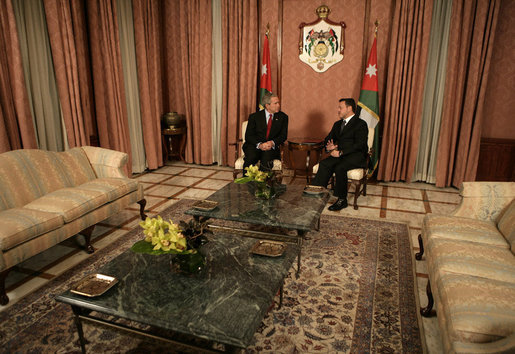
Raghadan Palace (Arabic: قصر رغدان, romanized: Qaṣr Raġadān), the first Hashemite structure in Jordan, was built by King Abdullah I, the founding monarch of the country. Upon his arrival in Amman, King Abdullah I initially resided in a modest Ottoman-style house near the Roman Theater. He also used a hilltop area in Marka to welcome delegations and host celebrations.
Following successful negotiations with the British authorities, resulting in their recognition of an independent government in Eastern Jordan, King Abdullah I selected an elevated location in 1924 to construct an official royal residence overlooking downtown Amman. This coincided with the first Hashemite restoration. The palace was named "Raghadan", symbolizing prosperity and comfort, and embodied hope and optimism. The design of the palace was intended to reflect both grandeur and simplicity, while harmonizing with the historical significance of the city. The palace's stained glass windows were inspired by the style of Al-Aqsa Mosque.
Text adapted from “Raghadan Palace” on Wikipedia, CC BY-SA 4.0.
Raghadan Palace ranks #1,487 of 9,035 worldwide in the atlas's castle fame ranking, and #10 of the 23 mapped in Jordan. Founded 1926, one of 161 atlas entries founded in the 20th century. Its Wikipedia articles were opened 7,594 times in the last 60 days, more than 91% of the atlas. 3 more atlas landmarks stand within 25 km. The nearest day-trip guide is Amman, 4 km away. It is one of the 105 landmarks on the atlas's regional map of the Levant. See how Jordan compares in the castle statistics.
View on the interactive castle map →