Palace & château
Ranighat Palace
🇳🇵 Nepal · 19th century
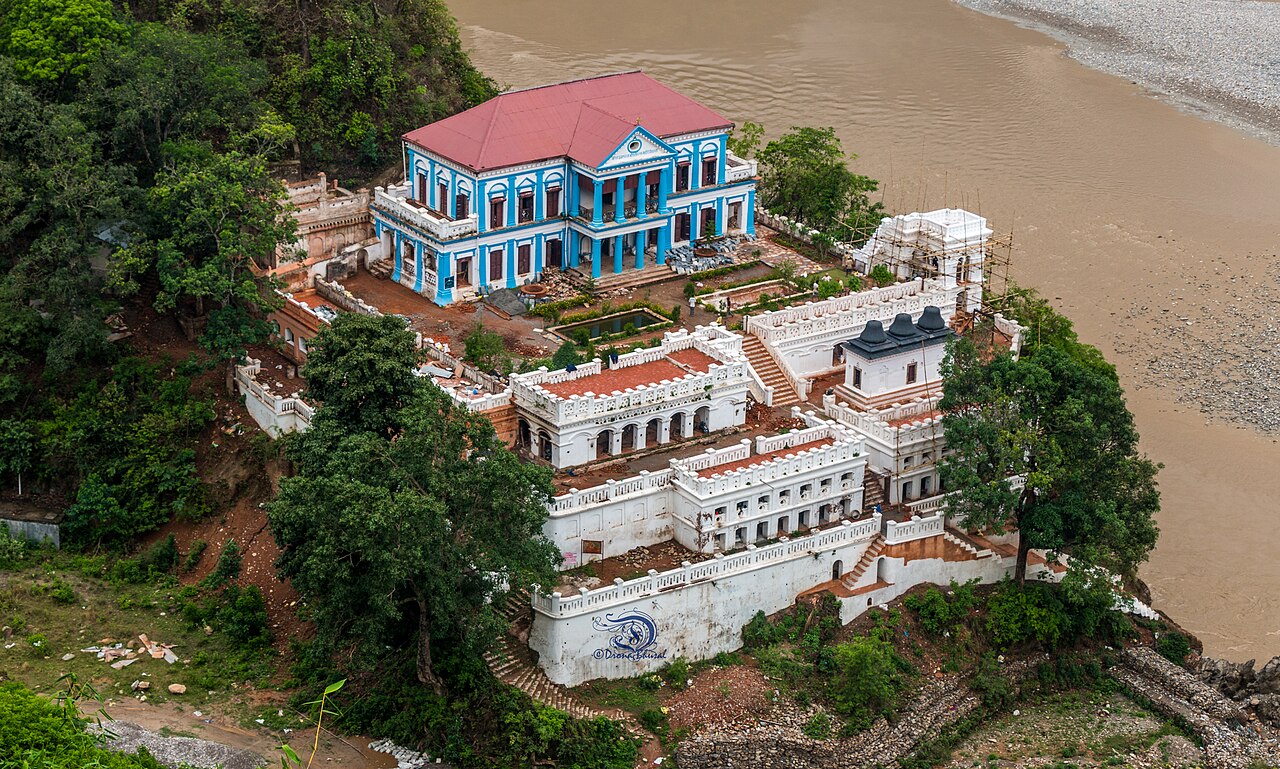
Ranighat Palace or Rani Mahal (Nepali: रानीमहल) is a historic Rana palace located on the banks of Kali Gandaki River in Palpa district of Nepal. This palace was constructed by General Khadga Shamsher Jang Bahadur Rana in 1893.
In 1885 Khadga Samsher Rana assassinated Ranauddip Shamsher Rana to make Bir Shumsher Jung Bahadur Rana as the prime minister and himself as the Commander in Chief of Nepal. He was in the line of succession for the next prime minister. In 1887 Khadga Samsher conspired to remove Bir Shumsher Jung Bahadur Rana from prime-ministership in an unsuccessful coup attempt. For this, he was arrested and forced to drop his royal titles and the position of Commander in Chief. He was banished to Thada, a place in Gulmi district in western Nepal. In 1888, a limited power was reinstated by assigning as the Governor General and the commander in chief (Tainathi) of western Nepal and allowed to relocated in Palpa-Gauda.
At Palpa-Gauda, Khadga Shumsher's youngest wife Tej Kumari Devi died in 1892. To commemorate his grief and the queen's last wish to construct a place of pilgrim, Khadga decided to build a palace. The name Rani Mahal literally translates as Queen's Palace.
The palace was designed by a British architect, and construction workers were brought from India. The four army platoon under him at Palpa and local villagers were also mobilized. To accomplish the construction, forced labour using neighbouring villagers was also used. Agri, a community of special caste, was employed to break the rock along the road to the palace and the foundation of the palace building. It took four years to complete the construction. He also named the nearby forest as Rani Ban (Queen's forest) along with naming the Ghats as Rani Ghat. In 1902, Khadga Samsher Rana along with his family fled to India abandoning Rani Mahal.
As Khadga Samsher abandoned the palace and fled to India, Rani Mahal was left behind without any proper owner or caretaker. Rani Mahal was in the verge of turning into rubble by the end of the 20th century. The poor condition of the palace was realized by the locals and became a concern of the government of Nepal. In 2017, the Government of Nepal allocated budget and restored the palace to the original state. A museum was also established in the building.
Text adapted from “Ranighat Palace” on Wikipedia, CC BY-SA 4.0.
Ranighat Palace ranks #3,617 of 8,764 worldwide in the atlas's castle fame ranking, and #3 of the 5 mapped in Nepal. Founded 1893 — one of 655 atlas entries founded in the 19th century. Its Wikipedia articles were opened 1,644 times in the last 60 days, more than 63% of the atlas. See how Nepal compares in the castle statistics.
View on the interactive castle map →Frequently asked questions
Where is Ranighat Palace?
Ranighat Palace stands in Nepal, at 27.9264°, 83.5278°.
When was Ranighat Palace built?
The atlas dates its founding to 1893. Earlier structures may have stood on the site; this is the earliest documented founding year.
How famous is Ranighat Palace?
In this atlas's fame ranking: #3,617 of 8,764 worldwide, and #3 in Nepal. Fame here combines how many Wikipedia language editions cover a landmark with how many people read them.
What is the nearest castle to Ranighat Palace?
Hanuman Dhoka, about 177 km away.
More palaces & châteaux
- Bożków Palace Poland · 16th century
- Raczyński Palace in Rogalin Poland · 18th century
- Palácio do Freixo Portugal · 18th century
- Baroque Palace in Oradea Romania · 18th century