 Hungary · 18th century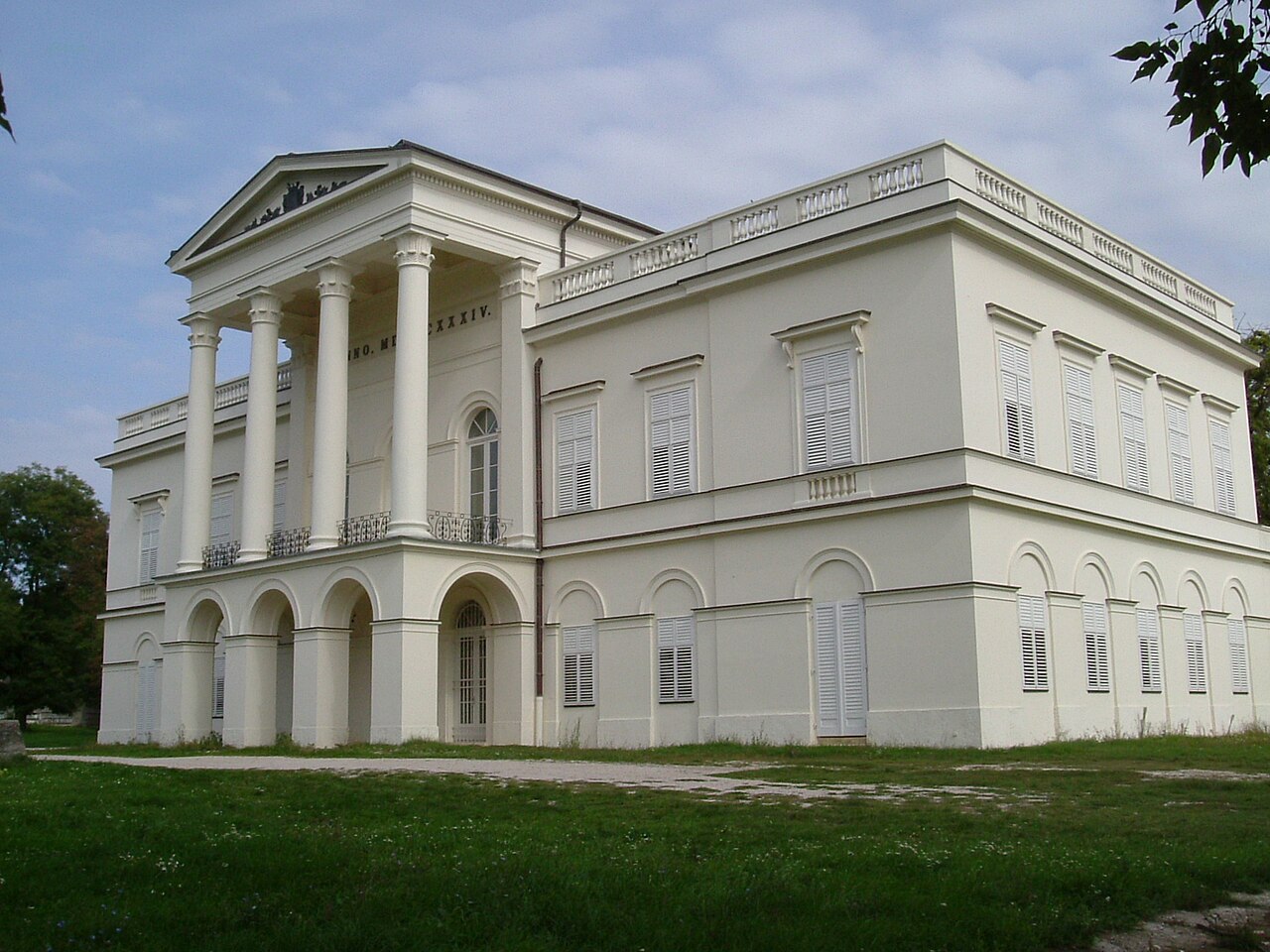
The Sándor-Metternich mansion (Hungarian: Sándor–Metternich-kastély) is a classicist manor in Bajna in Esztergom County, Hungary. It lies approximately 50 kilometres northwest of Budapest. It was the main country residence of the Metternich-Sándor family. It has been restored from ruins with the help of the European Union and is open for visitors.
Already at the end of the 15 century, a noble manor house existed on the site of the current mansion. It was acquired by the Sándor family in 1696, and they made it the center of their estates. The family belonged to the Hungarian nobility and held important positions. Their main residence at the time was in the city of Esztergom. Count Menyhért Sándor (1661-1723), deputy-lieutenant of the Esztergom county, erected a hunting lodge on the site of the current mansion and surrounded it by a game garden. Count Antal Sándor (1734-1788) replaced the lodge with a manor house, which was completed in 1776 when archbishop József Batthyány consecrated the mansion's chapel.
Count Móric Sándor was famous for his horsemanship throughout Europe. He earned himself the nickname the Devil's Horseman. In February 1835, he married the daughter of the Austrian chancellor Klemens von Metternich, princess Leontine von Metternich (1811 - 1861). As he wanted to present her with a mansion worthy to her status, he started to transform the manor house into a fifty-nine room palace a year before the marriage (1834). He entrusted one of the most famous architects of his time, József Hild, to help. He created the two-storey building with a portico with four columns. Legend tells that count Móric Sándor jumped from the balcony with his horse as a bet.
The ground level of the mansion contained a billiard room, a dining room, a smoking room, a conservatory, a house chapel and the card room. The bedrooms of the count and countess, the living room and the library were located on the first floor. Alessandro Sanquirico, an Italian architect from Milan, was engaged in the design of the interior. The dominating colors were sky blue and white. Sanqurico was inspired by Etruscan and Pompeian art, as well as Raphael. In addition to inlaid stucco created by Maria Piazza, the walls were decorated with paintings of Sándor familu members, antlers, hunting trophies and gilded mirrors.
Text adapted from “Sándor-Metternich mansion” on Wikipedia, CC BY-SA 4.0.
Sándor-Metternich Mansion ranks #7,155 of 9,079 worldwide in the atlas's castle fame ranking, and #53 of the 135 mapped in Hungary. Founded 1776, it is older than 14% of the atlas's dated landmarks — one of 696 atlas entries founded in the 18th century. 5 more atlas landmarks stand within 25 km. The nearest day-trip guide is Budapest, 37 km away. See how Hungary compares in the castle statistics.
View on the interactive castle map →