Fortress
São Marcelo Fort
🇧🇷 Brazil
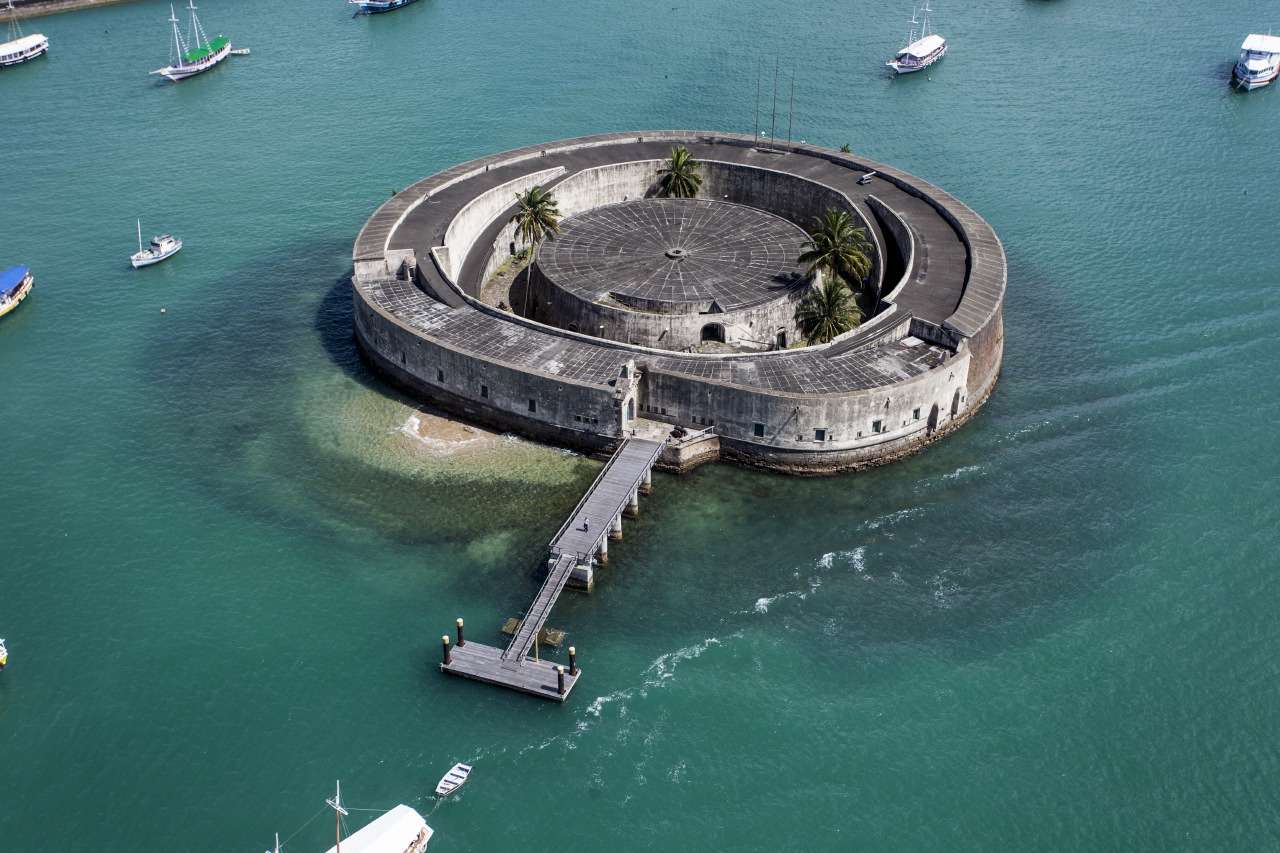
São Marcelo Fort (Portuguese: Forte São Marcelo), also known as Forte de Nossa Senhora do Pópulo e São Marcelo or Forte do Mar, is located in Salvador in Bahia, Brazil. It is located in small bit of land off the coast in the Baía de Todos os Santos. Standing on a small bank of reefs about 300 metres (980 ft) from the coast, it is one of two forts separated by water from land in Brazil, the other being the Fort Tamandaré da Laje Tamandaré in Rio de Janeiro. It is the only cylindrical fort in Brazil. Its design follows those of Castel Sant'Angelo in Italy and São Lourenço do Bugio Fort in Portugal. It is popularly known as the "Forte do Mar" (Fort of the Sea). It was built to protect the important port city Salvador from threats; the city had the largest number of forts during the colonial period of Brazil.
Text adapted from “São Marcelo Fort” on Wikipedia, CC BY-SA 4.0.
São Marcelo Fort ranks #3,617 of 8,134 worldwide in the atlas's castle fame ranking, and #11 of the 80 mapped in Brazil. Its Wikipedia articles were opened 1,157 times in the last 60 days, more than 52% of the atlas. 11 more atlas landmarks stand within 25 km. See how Brazil compares in the castle statistics.
View on the interactive castle map →Frequently asked questions
Where is São Marcelo Fort?
São Marcelo Fort stands in Brazil, at -12.96992°, -38.51785°.
How famous is São Marcelo Fort?
In this atlas's fame ranking: #3,617 of 8,134 worldwide, and #11 in Brazil. Fame here combines how many Wikipedia language editions cover a landmark with how many people read them.
What is the nearest castle to São Marcelo Fort?
Rio Branco Palace, about 1 km away.
More castles in Brazil
- Fort Coligny Brazil · 16th century
- Fortaleza de São João Brazil · 16th century
- Fort of Monserrate Brazil · 16th century
- Fort Orange (Dutch Brazil) Brazil · 17th century
More fortresses
- Fort Michilimackinac United States · 18th century
- Konda Reddy Fort India
- Fort Mason United States · 20th century
- Fort Abercrombie United States · 19th century