Palace & château
Schloss Grafenegg
🇦🇹 Austria · 16th century
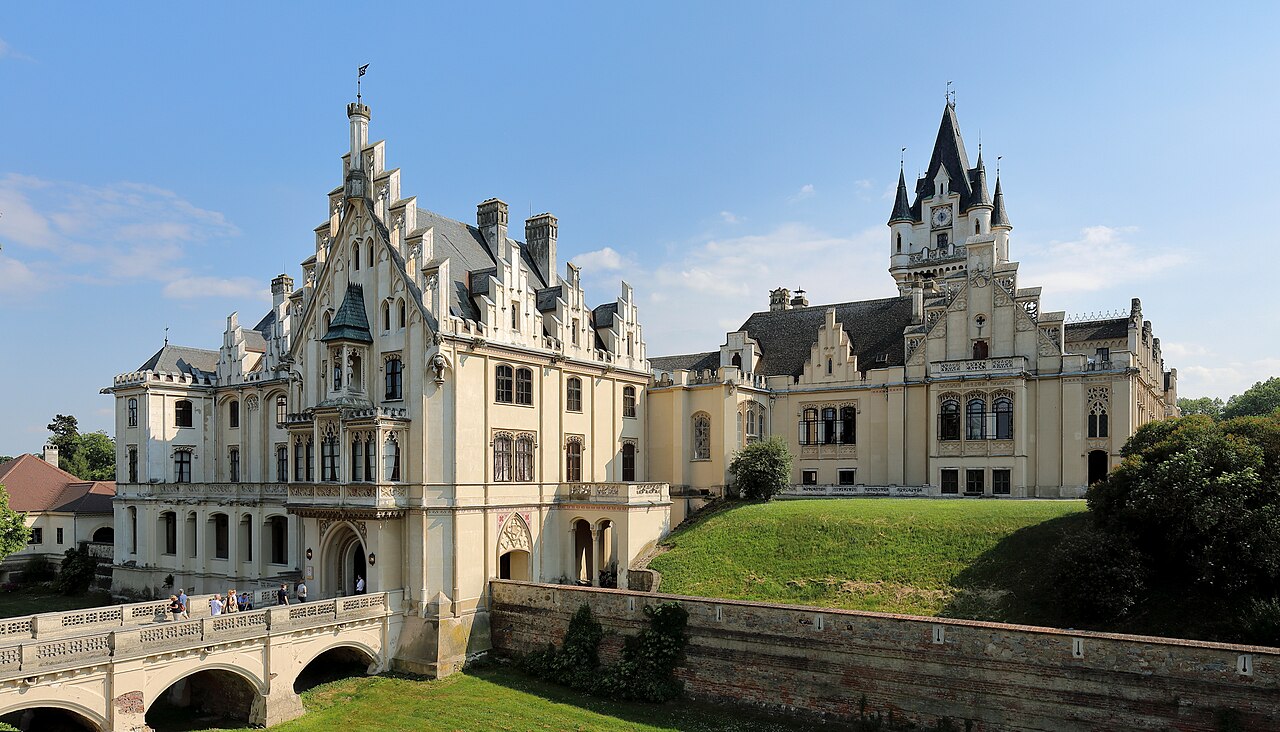
Schloss Grafenegg is a castle in Grafenegg, Lower Austria, Austria. Together with Burg Kreuzenstein and Schloss Anif near Salzburg, it is considered to be an outstanding example of romantic historical architecture in Austria.
In 1294, a small settlement named Espersdorf was mentioned for the first time on the current site of Schloss Grafenegg. At these times, there were only a mill and a farmstead. After 1435, the site was surrounded by a ring wall and a moat. It received the name Grafenegg in the second half of the 15th century, when it came into possession of its namesake Ulrich von Grafenegg. It passed to Holy Roman emperor Frederick III in 1477. His son, emperor Maximilian I sold it to Heinrich Prüschenk, whose son Johann I Count Hardegg reconstructed the castle around 1500. The slender tower in the east wing dates from this late gothic period.
In 1536, Bernhard I Thurzó acquired the castle and the lordship of Grafenegg. He had the portal to east tower constructed in Renaissance style in 1538. Also, he founded the Grafenegger branch of the Thurzó family, which died out with his son Bernhard II in 1596. The castle was inherited by his daughter Benigna, who was married to Martin von Starhemberg.
After several changes of ownership, Johann Baptist Verda von Verdenberg, chancellor and confidant of emperor Ferdinand II and his son emperor Ferdinand III, had the complex converted into a fortified palace between 1622 and 1633. At the four corners of the castle, surrounded by walls and a moat, so-called rampart houses were built, which still exist today. During the Thirty Years' War, these were used to set up artillery pieces. Nevertheless, the castle was still taken by Swedish troops in 1645 and temporarily occupied. In the course of the reconstruction work, a chapel was completed in the north wing in 1633, which was dedicated to the Holy Trinity.
From the Verdenberg family, the castle and its estates passed to the Counts of Enckevort and subsequently to the Counts of Breuner. Count August von Breuner-Enckevoirt (1796-1877) inherited Schloss Grafenegg in 1813. He and his son August Johann (1828-1894) reconstructed the castle between 1840 and 1888 in the spirit of romantic historicism with help of father and son Leopold and Hugo Ernst. Leopold Ernst was also the master builder of the St. Stephen's Cathedral in Vienna.
Text adapted from “Schloss Grafenegg” on Wikipedia, CC BY-SA 4.0.
Schloss Grafenegg ranks #3,150 of 8,764 worldwide in the atlas's castle fame ranking, and #75 of the 223 mapped in Austria. Founded 1538, it is older than 43% of the atlas's dated landmarks — one of 827 atlas entries founded in the 16th century. Its Wikipedia articles were opened 4,662 times in the last 60 days, more than 85% of the atlas. 4 more atlas landmarks stand within 25 km. The nearest day-trip guide is St. Pölten, 27 km away. See how Austria compares in the castle statistics.
View on the interactive castle map →Frequently asked questions
Where is Schloss Grafenegg?
Schloss Grafenegg stands in Austria, at 48.42861°, 15.74611°.
When was Schloss Grafenegg built?
The atlas dates its founding to 1538. Earlier structures may have stood on the site; this is the earliest documented founding year.
How famous is Schloss Grafenegg?
In this atlas's fame ranking: #3,150 of 8,764 worldwide, and #75 in Austria. Fame here combines how many Wikipedia language editions cover a landmark with how many people read them.
What is the nearest castle to Schloss Grafenegg?
Burgruine Senftenberg, about 14 km away.
More castles in Austria
- Schloss Mailberg Austria · 12th century
- Schloss Petronell Austria
- Schloss Rosenau (Waldviertel) Austria
- Schloss Schernberg Austria
More palaces & châteaux
- Hof van Savoye Belgium · 16th century
- Palace of Charles of Lorraine Belgium · 18th century
- Palace of Itamaraty Brazil · 19th century
- Pejačević Manor Croatia · 19th century