Palace & château
Schloss Pyrmont
🇩🇪 Germany · 16th century
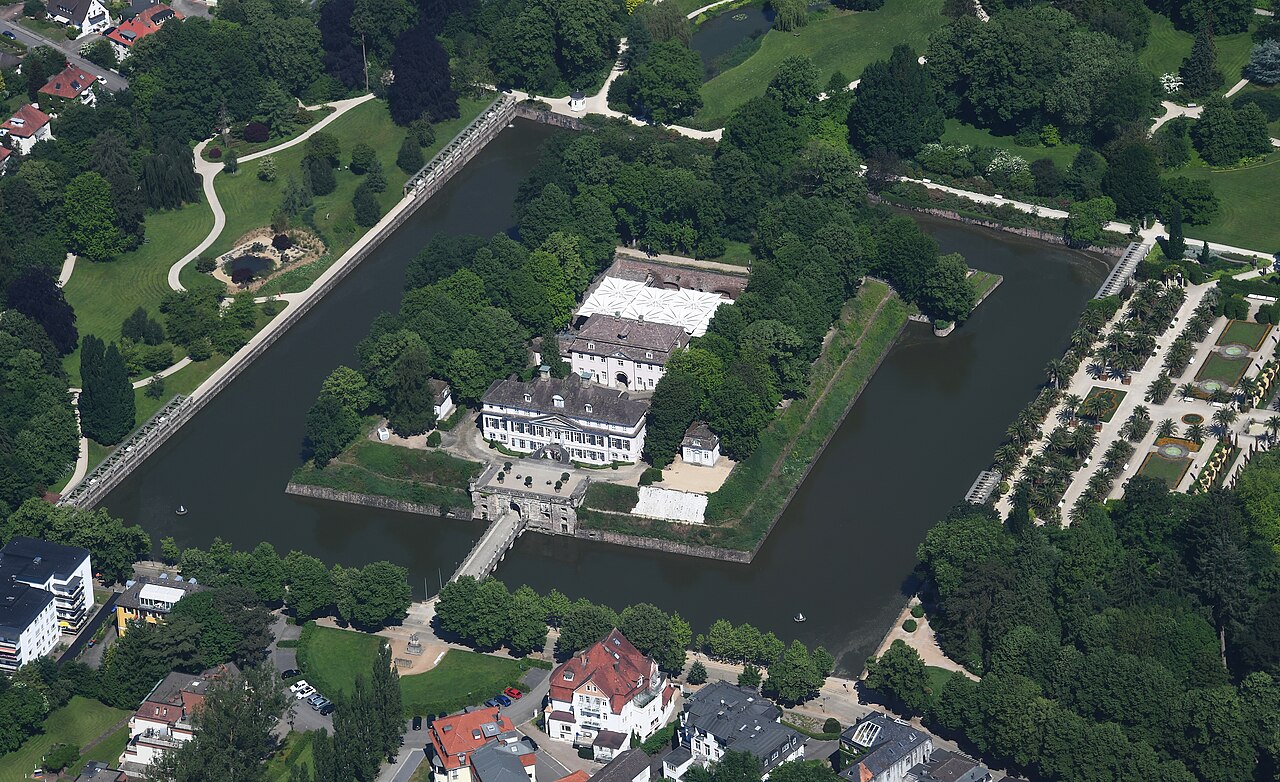
Schloss Pyrmont, sometimes called Pyrmont Castle, was a schloss and the summer residence of the counts of Spiegelberg and counts of Waldeck-Pyrmont in the present-day German town of Bad Pyrmont. The current building dates to the 18th century and houses a museum. The schloss is part of Pyrmont Fortress (Festung Pyrmont) which dates to the 16th century.
Between 1526 and 1536, Count Frederick VI of Spiegelberg, overlord of the County of Pyrmont, built a fortress and schloss in valley of Pyrmont. He had experience in the construction of the fortress when he had reinforced Coppenbrügge Castle with walls and roundels. The fortress of Pyrmont was almost square in shape with a 40-metre-wide moat. The walls had casemates and a stone corner bastion, which echoes the Italian style of fortification. Access to the fortress was via a wooden bridge and later a drawbridge. Buildings were built inside the walls and, in the south-western area, the first schloss was built.
Following the completion of the castle in 1536, it was garrisoned by Count Frederick VI, who resided in neighbouring Lügde. Later the schloss became the side wing of a larger schloss, which his son, Philip, had built in 1557 in the Weser Renaissance style. According to tradition, this was a three-storey building with three wall dormers, similar to the Hämelschenburg. In addition, a tower was built for archiving documents. Philip died before the completion of the Renaissance schloss. The building was completed by the husband of his sister, Hermann Simon of Lippe. Afterwards the counts of Lippe and the counts of Gleichen resided at the schloss. In 1625, Count Hans Louis of Gleichen transferred the County of Pyrmont to the Count of Waldeck.
During the Thirty Years' War, the succession dispute between the Bishopric of Paderborn and the Counts of Waldeck revived. For the Bishopric, troops under General Pappenheim, besieged the Pyrmont fortress in 1629, and its 400-man garrison surrendered after ten months. In 1633, Swedish troops recaptured the fortress, which was reconquered in 1636 by the Imperial Army. After being taken again by the Swedes in 1646, the fortress was handed over to the Counts of Waldeck in 1649. The schloss suffered damage as a result of the sieges.
Text adapted from “Schloss Pyrmont” on Wikipedia, CC BY-SA 4.0.
Schloss Pyrmont ranks #5,377 of 8,764 worldwide in the atlas's castle fame ranking, and #447 of the 618 mapped in Germany. Founded 1536, it is older than 43% of the atlas's dated landmarks — one of 827 atlas entries founded in the 16th century. Its Wikipedia articles were opened 1,261 times in the last 60 days, more than 55% of the atlas. 2 more atlas landmarks stand within 25 km. See how Germany compares in the castle statistics.
View on the interactive castle map →Frequently asked questions
Where is Schloss Pyrmont?
Schloss Pyrmont stands in Germany, at 51.9836°, 9.24836°.
When was Schloss Pyrmont built?
The atlas dates its founding to 1536. Earlier structures may have stood on the site; this is the earliest documented founding year.
How famous is Schloss Pyrmont?
In this atlas's fame ranking: #5,377 of 8,764 worldwide, and #447 in Germany. Fame here combines how many Wikipedia language editions cover a landmark with how many people read them.
What is the nearest castle to Schloss Pyrmont?
Schloss Hämelschenburg, about 8 km away.
More castles in Germany
- Schloss Richmond Germany · 18th century
- Schloss Tinz Germany · 18th century
- Schloss Weilburg Germany · 18th century
- Schloss Wickrath Germany · 19th century
More palaces & châteaux
- Schloss Wildenwart Germany · 12th century
- Schloss Wiligrad Germany
- Schloss Wittenberg Germany · 15th century
- Schloss Wolfegg Germany