 Portugal · 18th century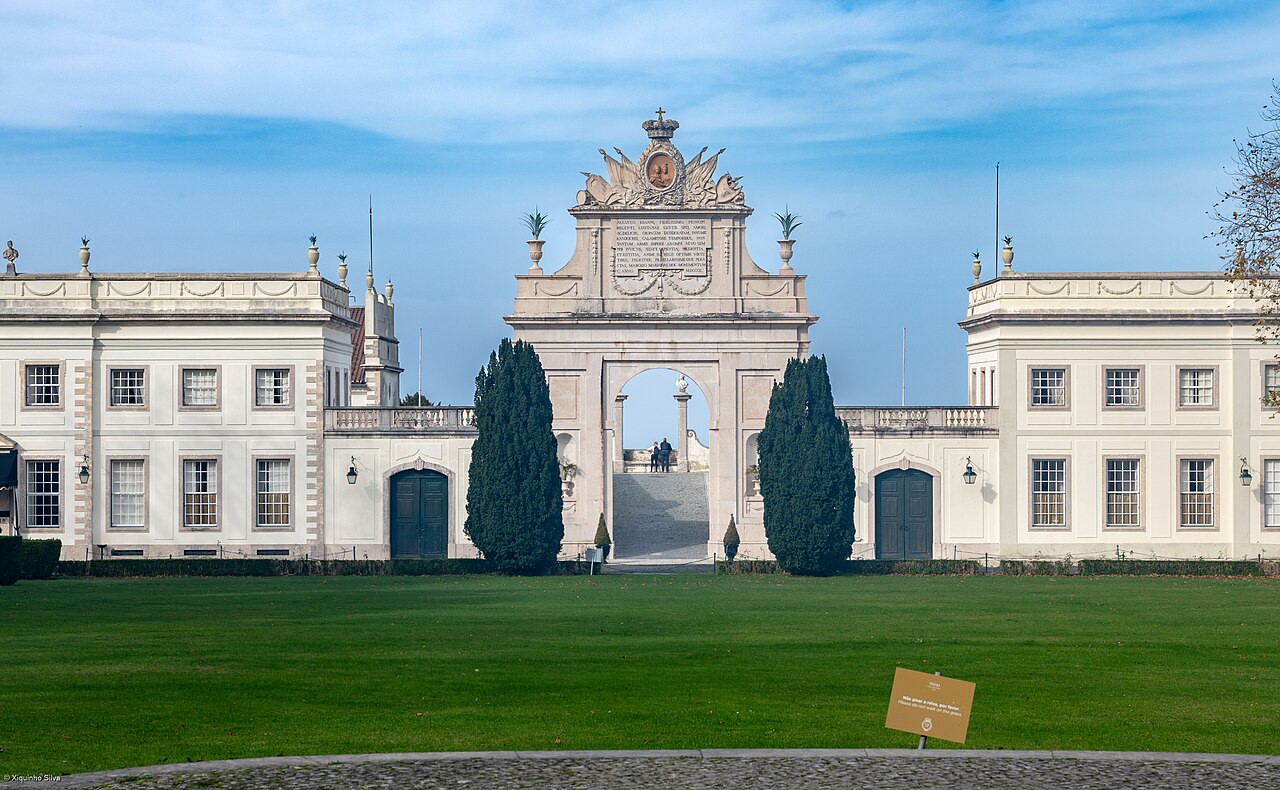
The Seteais Palace (Portuguese: Palácio de Seteais) is a neoclassical palace located in Sintra, on the Portuguese Riviera, operating as a luxury hotel known as the Tivoli Palácio de Seteais Hotel. The palace is a national landmark and is included in the UNESCO Cultural Landscape of Sintra World Heritage Site listing.
Jose Alfredo mentions in “Seteais fields” that this field is very old and has always been an integral part of the precinct behind the palace. Some people believe that its name comes from the tradition of shouting “ai” on the road where its echo is repeated 7 times. On the other hand, a very old manuscript by an anonymous author kept in Sintra library mentions that the origin of the word of Seteais derives from the land named Centeais where rye (Portuguese: Centeio) was being cultivated.
The Seteais Palace was built between 1783 and 1787 for the Dutch consul Daniel Gildemeester, on lands granted by Sebastião José de Carvalho e Melo, 1st Marquis of Pombal.
Although Daniel Gildemeester owned land, then known as Quinta da Alegria, there was no house to live in. He had stayed in the palace of the Marquis of Pombal as a tenant during summer. He started to build his own mansion close to (Monserrate Palace) owned by his friend, the British consul Gerard de Visme, in order to leave the palace of the Marquis of Pombal.
The consul chose to build his house on the border of an elevation, from which the vast landscape around the Sintra Mountains could be admired. The palace was surrounded with a large garden with fruit trees.
In 1797, some years after the consul's death, his widow sold the palace to Diogo José Vito de Menezes Noronha Coutinho, 5th Marquis of Marialva. The palace was enlarged between 1801 and 1802, probably by neoclassical architect José da Costa e Silva, architect of the São Carlos Theatre in Lisbon. The palace was turned into a symmetrical U-shaped building, with the consul's house becoming one of its wings. The cornice of the buildings that compose the main façade was decorated with typical neoclassical motifs like vases, busts and reliefs of garlands. The gardens of the palace were remodelled following romantic trends.
The old and the new wings were connected in 1802 by a neoclassical arch, built in honour of Prince regent John and Princess Carlota Joaquina, who visited the palace in that year.
Text adapted from “Seteais Palace” on Wikipedia, CC BY-SA 4.0.
Seteais Palace ranks #2,992 of 9,079 worldwide in the atlas's castle fame ranking, and #34 of the 212 mapped in Portugal. Founded c. 1750, it is older than 16% of the atlas's dated landmarks — one of 696 atlas entries founded in the 18th century. Its Wikipedia articles were opened 1,905 times in the last 60 days, more than 68% of the atlas. 23 more atlas landmarks stand within 25 km. The nearest day-trip guide is Sintra, 1 km away. See how Portugal compares in the castle statistics.
View on the interactive castle map →