 Czech Republic · 15th century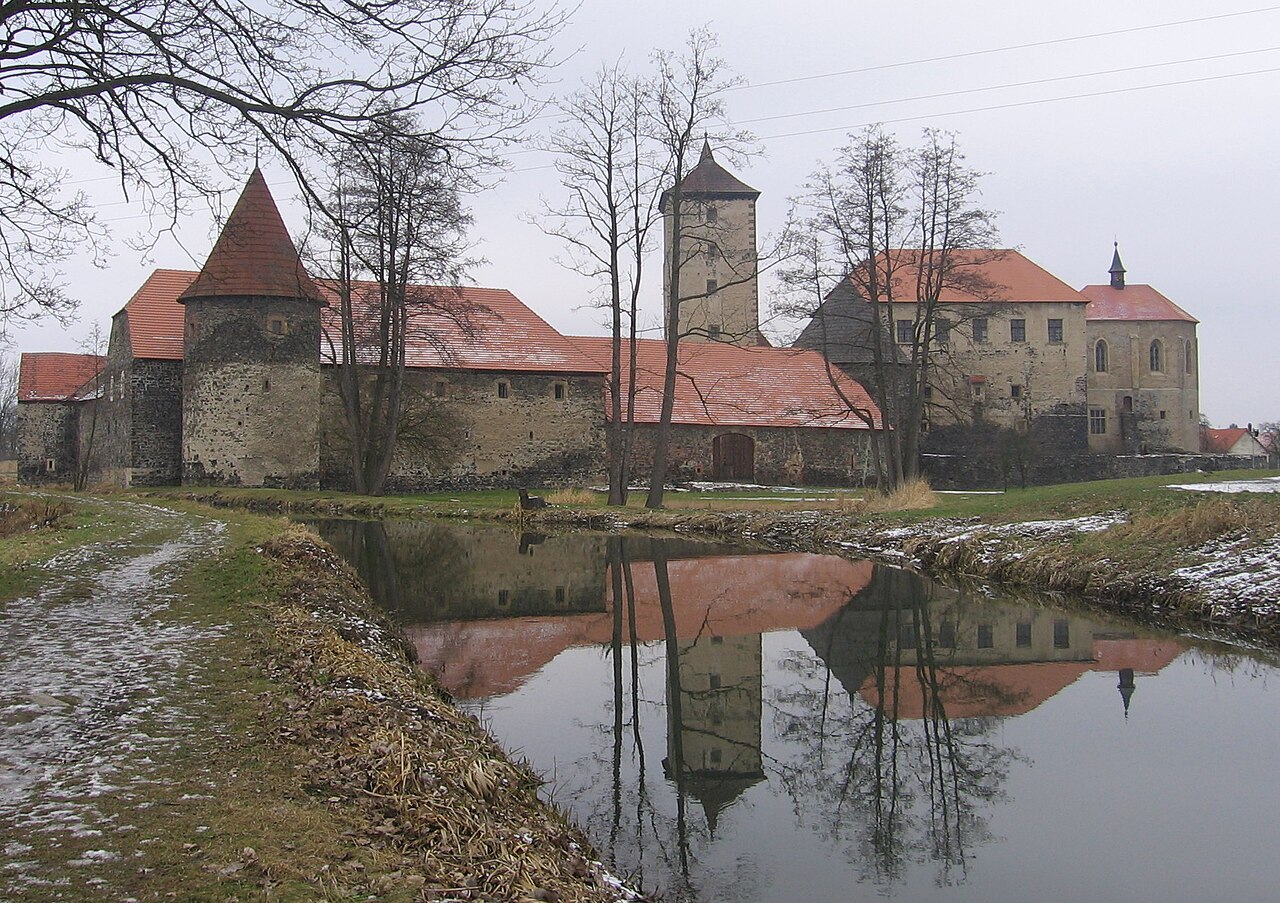
Švihov Castle (Czech: hrad Švihov; German: Schwihau) is a Gothic water castle in Švihov in the Plzeň Region of the Czech Republic.
Švihov Castle was built by the Rýzmberk of Skála noble family. It was besieged by the Hussites during the Hussite Wars, the garrison surrendered after the water moats were siphoned. It was rebuilt between 1480 and 1489 by the order of the castle's owner, Půta Švihovský of Rýzmberk, in the late Gothic style. His sons continued rebuilding the castle after he died and invited the famous architect Benedikt Rejt. In 1598, the Kavka of Říčany family took control of the castle, but were forced to sell it to the Czernin family 50 years later in 1598, due to their poor management. Then the Thirty Years' War came and the castle was unsuccessfully besieged by the Swedish army.
Benedikt Rejt invented the castle's moat system with massive bastions (horseshoe-shaped ground plans opening into the keep). He finished his works by 1520. He used the same system when he designed the fortification of Rabí Castle, one of the largest castles in Bohemia.
After the war, Emperor Ferdinand III ordered the demolition of the castle, possibly out of fear of it being an "unconquerable fort of anti-Habsburg resistance". Luckily, thanks to the constant postponement of the demolition, only part of the rampart was damaged. Castle palaces, chapel and other parts of the bastion were used as a granary, devaluating the whole complex, yet protecting it from being rebuilt. The castle stayed in Czernin's hands until the nationalization in 1945.
The castle consists of two residential palaces, five-level entrance tower and a chapel built on top of the bastion.
Only small parts of the rampart remained undamaged with four bastions -The Red Bastion, The White Bastion, The Green Bastion and The Gold Bastion (whose remains were discovered in 1951). There were two water moats around the castle. The inner moat was placed where today's inner courtyard is and the outer moat was between the inner and outer rampart (of which a part is still standing). If needed, the moats could be filled with water from three nearby ponds.
The castle's interior consists of typical late Gothic and Renaissance furnishings: furniture, rich tapestries, pewter and copper kitchenware, weapons and arms.
Text adapted from “Švihov Castle” on Wikipedia, CC BY-SA 4.0.
Švihov Castle ranks #2,178 of 9,079 worldwide in the atlas's castle fame ranking, and #50 of the 243 mapped in Czech Republic. Founded c. 1500, it is older than 43% of the atlas's dated landmarks — one of 554 atlas entries founded in the 15th century. Its Wikipedia articles were opened 2,397 times in the last 60 days, more than 73% of the atlas. Wikidata records about 36,000 visitors in 2022. 4 more atlas landmarks stand within 25 km. The nearest day-trip guide is Plzeň, 30 km away. It is one of the 189 landmarks on the atlas's regional map of Bohemia. See how Czech Republic compares in the castle statistics.
View on the interactive castle map →