 Sweden · 17th century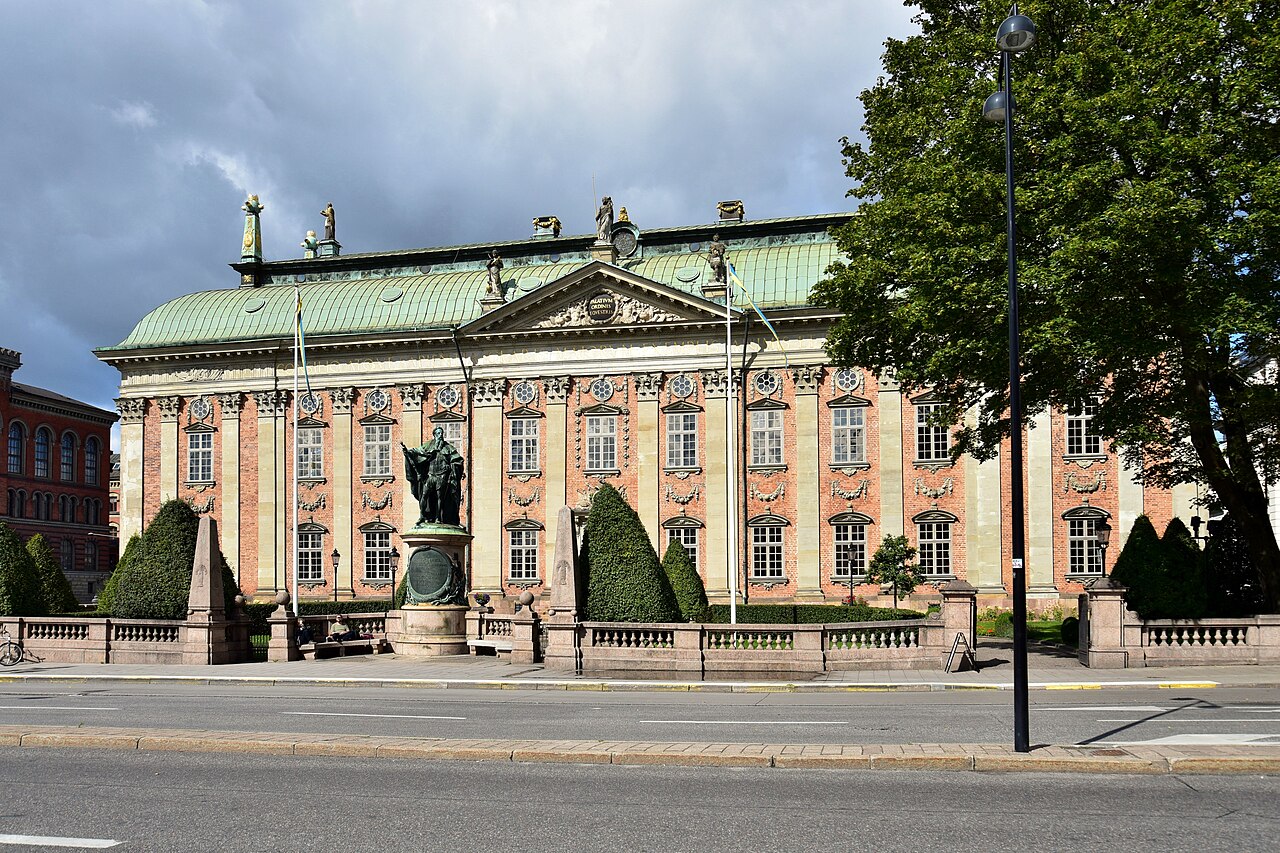
The House of Nobility (Swedish: Riddarhuset) in Stockholm, Sweden, is a corporation and a building that maintains records and acts as an interest group on behalf of the Swedish nobility.
The name is literally translated as House of Knights, as the knights (Swedish: riddare) belong to the higher ranks of the Swedish nobility, sometimes also together with titles as count (Swedish: Greve) and baron (Swedish: friherre). All esquires are also represented in the corporation (most of the families are so called untitled nobility, Swedish: obetitlad adel). This is a tradition from the Middle Ages when Sweden during the Kalmar Union only had one knight: Sten Sture.
Between the 17th and the 19th century the House of Nobility was a chamber in the Riksdag of the Estates.
In the 18th century, the building was often used for public concerts. From 1731, public concerts were performed here by Kungliga Hovkapellet. Elisabeth Olin is believed to have debuted here in the 1750s, and foreign artists performed such as Elisabetta Almerighi, Giovanni Ansani (1772) and Rosa Scarlatti.
In 1866, the Parliament of the Estates was replaced by the new Riksdag (Parliament of Sweden). From then on, the House of Nobility served as a quasi-official representative body for the Swedish nobility, regulated by the Swedish government. Since 2003, it has been a private institution which maintains records and acts as an interest group on behalf of the Swedish nobility, its main purpose being to maintain old traditions and culture. Since 1990 the House is a member of CILANE.
The House of Nobility is governed by the House of Nobility Act. Currently it’s the 1866 Act governing the body, but the first such act was introduced as far back as 1626.
The primary decision making body of the House is the Assembly of Nobles (Swedish: Adelsmötet), which convenes every 3 years to make decisions regarding how the nobility shall operate until the next meeting. The Head of each noble house which has been introduced into the house is entitled to attend and vote at the assembly. They may also send another member of their house to represent them.
Decisions taken by the assembly are then to be implemented over the next 3 years by the Directorate of the Swedish Nobility Foundation. This body is elected by the assembly and consists of a Chairman, a Deputy Chairman, 6 members and 3 deputy members.
Text adapted from “House of Nobility (Sweden)” on Wikipedia, CC BY-SA 4.0.
Swedish House of Nobility ranks #914 of 9,079 worldwide in the atlas's castle fame ranking, and #19 of the 209 mapped in Sweden. Founded 1678, it is older than 23% of the atlas's dated landmarks — one of 721 atlas entries founded in the 17th century. Its Wikipedia articles were opened 5,653 times in the last 60 days, more than 88% of the atlas. 30 more atlas landmarks stand within 25 km. The nearest day-trip guide is Stockholm, 1 km away. See how Sweden compares in the castle statistics.
View on the interactive castle map →