 Poland · 15th century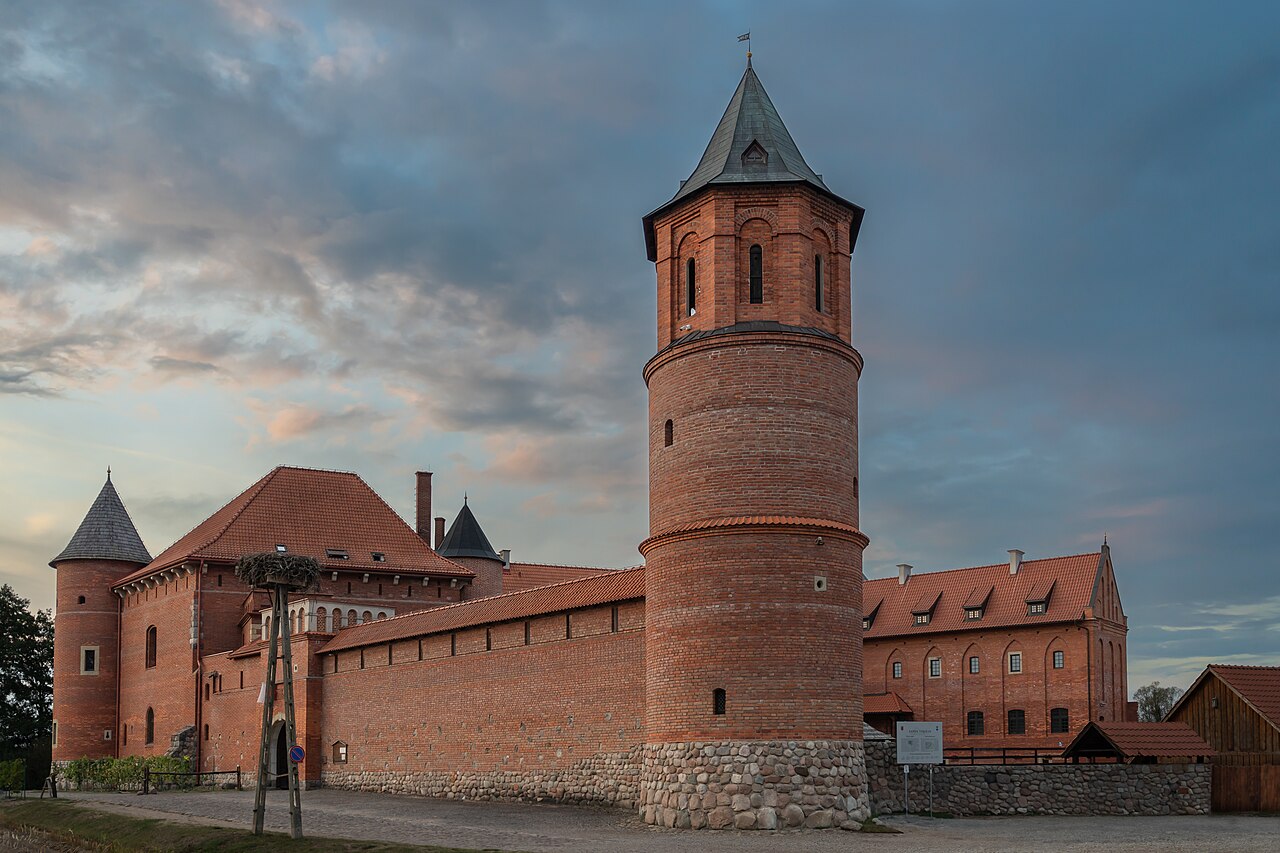
The Tykocin Royal Castle is a 15th-century castle located on the right bank of the river Narew in Tykocin, Poland. It fell into ruin in the 18th century and its reconstruction began in 2002.
The castle – then located on a border area in the Grand Duchy of Lithuania – was built in 1433 for Lithuanian noble Jonas Goštautas, voivode of Trakai and Vilnius, replacing the original wooden fortress. In the 1560s, upon the death of the last member of the Goštautas family the castle became the property of King Sigismund II Augustus, who expanded it. The construction was supervised by Hiob Bretfus, military engineer and royal architect. During the reign of Sigismund Augustus the structure served as a royal residence with an impressive treasury and library as well as the main arsenal of the crown. In 1611–1632 the castle was rebuilt again and surrounded with bastion fortifications by Krzysztof Wiesiołowski, starosta of Tykocin.
During the 1655 Deluge, the Radziwiłł army occupied the castle. On 31 December 1655, when the castle was besieged by troops of the Tyszowce Confederation, Janusz Radziwiłł, one of the most powerful people in the Polish–Lithuanian Commonwealth considered by some as the traitor, died here. Ultimately, the castle was captured on 27 January 1657.
In the following years the castle and surrounding lands were donated to Stefan Czarniecki in reward for his contribution in the war. The new owner rebuilt the castle after 1698. In November 1705 the meeting between King Augustus II the Strong and Peter the Great took place here. During this meeting the Order of White Eagle was established by the King of Poland.
In 1734 the castle was destroyed by fire. Since that time, the uninhabited building began to fall into disrepair. In 1771 remains of the castle were destroyed by flood and in 1914, during World War I, the material from the remaining walls was used by the German soldiers to build roads.
Based on the preserved plans of the fortress, found in the archives in Saint Petersburg, the residential part of the castle has been restored (west wing in the style of late Gothic). The original castle was built on a plan of a trapezoid with a courtyard and four cylindrical towers at the corners. The complex was surrounded with fortifications – curtains combined four terrestrial inner bastions.
Text adapted from “Tykocin Castle” on Wikipedia, CC BY-SA 4.0.
Tykocin Castle ranks #1,991 of 9,035 worldwide in the atlas's castle fame ranking, and #70 of the 397 mapped in Poland. Founded 1433, it is older than 49% of the atlas's dated landmarks, one of 556 atlas entries founded in the 15th century. Its Wikipedia articles were opened 4,339 times in the last 60 days, more than 84% of the atlas. 1 more atlas landmarks stand within 25 km. See how Poland compares in the castle statistics.
View on the interactive castle map →