 Germany · 16th century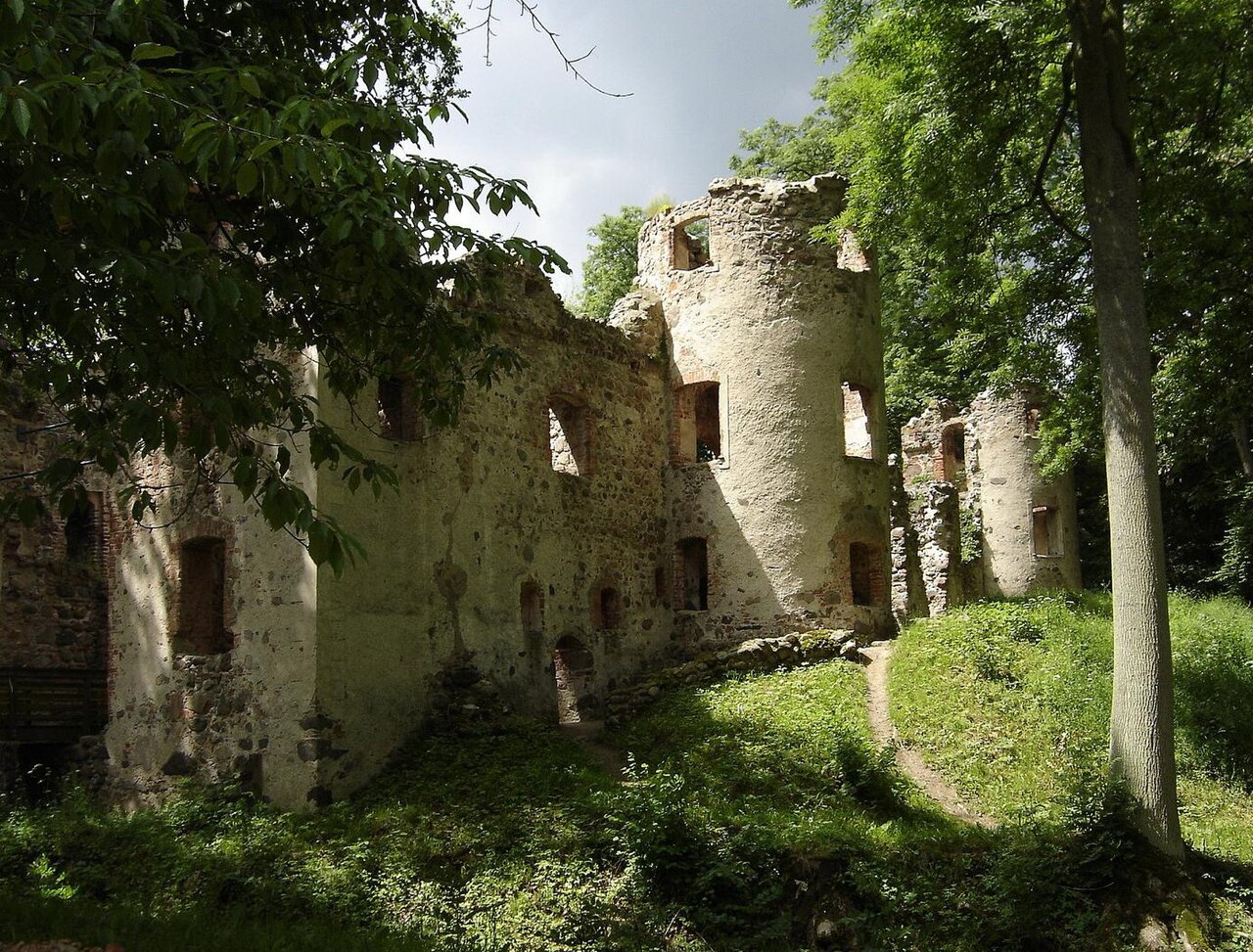
Veste Landskron or Lanzkron is a Renaissance water castle in the municipality Neuendorf B, Vorpommern-Greifswald district, Mecklenburg-Vorpommern, Germany. Built between 1576 and 1579, it deteriorated in the 17th century. Its ruins are a tourist attraction and frequently the site of cultural events.
Landskron is southeast of the junction of autobahn 20 and federal route B 199, south of the village Janow (part of the Neuendorf B municipality) and west of the village Rehberg (part of the Spantekow municipality). To the south is the Großer Landgraben valley, marking the border between Mecklenburg and Pomerania. Made of boulders and bricks, it is situated on an elevation of glacial till surrounded by swampy meadows.
Construction was started in 1576 by Ulrich II von Schwerin, member of one of the oldest Pomeranian noble houses. The von Schwerin family was divided in about 24 branches in the 17th century, whose members lived in Pomerania, Mecklenburg, Brandenburg, Poland and Sweden. Ulrich was the fifth son of another Ulrich von Schwerin, Großhofmeister at the Pomeranian ducal court. He financed the building, which cost about 40,000 gulden, from pay received for military service for the duke of Mecklenburg. The castle was designed as a Renaissance style water castle.
The rectangular main building, a keep about 25 metres (82 ft) long and 15 metres (49 ft) wide with three upper stories and a basement, was secured by four round towers attached to its edges, a wall and a moat. One of the keep's towers (Hungerturm) was used as a dungeon to incarcerate abducted people held for ransom. Attached to the keep's eastern front was the entrance building (Vorschloß), about 10 metres (33 ft) long and 12 metres (39 ft) wide. In front of the entrance to the keep, which could be reached by a drawbridge, laid the courtyard (Vorburg), and both the keep and the courtyard were surrounded by an outer wall and another moat.
In the west, the outer wall was immediately adjacent to the inner moat and comprised five small bastions. The castle was entered through a gatehouse in the northern outer wall, comprising a guardhouse west of the gateway that led to the courtyard, and the stables in its eastern part, where also a well was located. A second drawbridge, made from copper according to legend, spanned the outer moat in front of the gatehouse.
Text adapted from “Veste Landskron” on Wikipedia, CC BY-SA 4.0.
Veste Landskron ranks #5,987 of 9,079 worldwide in the atlas's castle fame ranking, and #525 of the 711 mapped in Germany. Founded 1576, it is older than 34% of the atlas's dated landmarks — one of 891 atlas entries founded in the 16th century. Its Wikipedia articles were opened 1,128 times in the last 60 days, more than 54% of the atlas. 2 more atlas landmarks stand within 25 km. See how Germany compares in the castle statistics.
View on the interactive castle map →