 Turkey · 13th century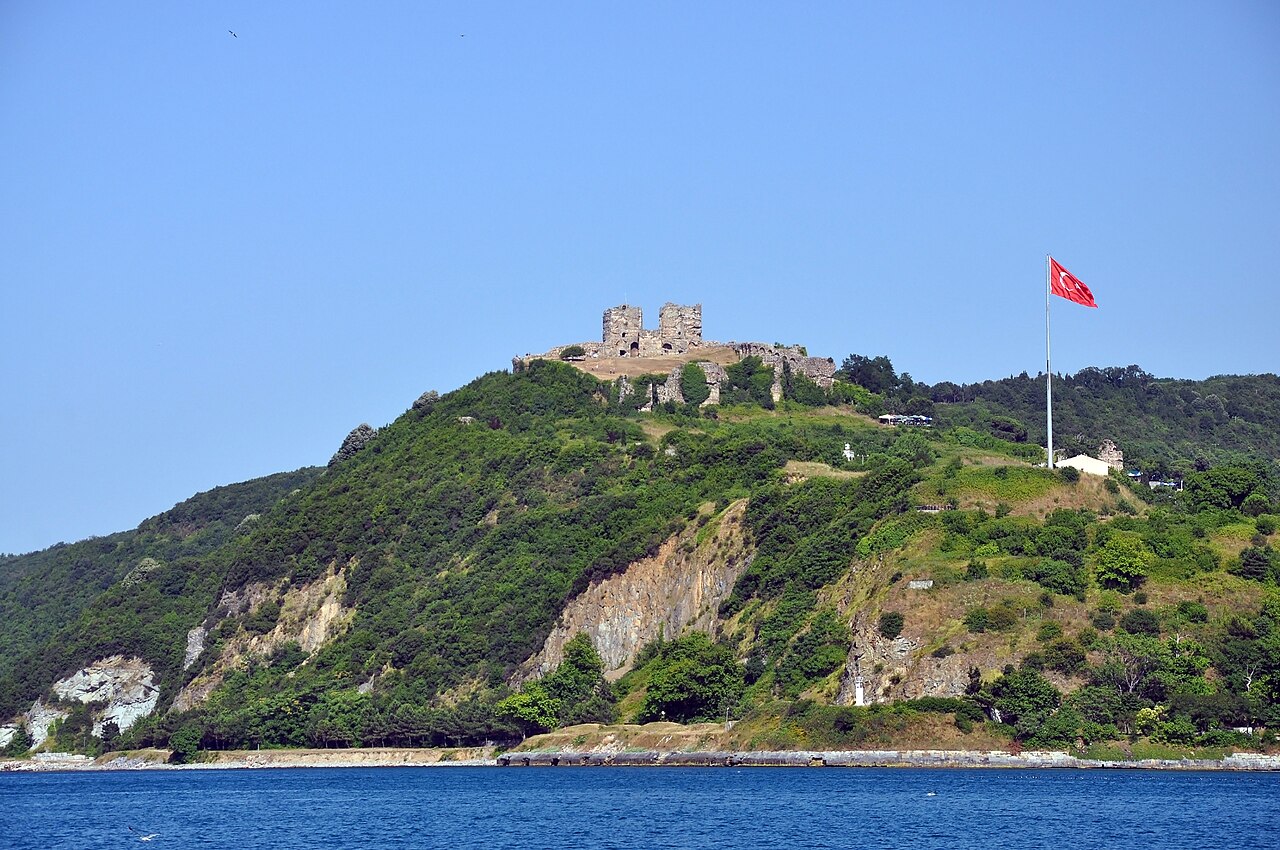
Yoros Castle (Turkish: Yoros Kalesi) is a ruined castle dating back to Byzantine times that stands above the confluence of the Bosphorus and the Black Sea, to the north of Joshua's Hill, in Beykoz district, Istanbul, Turkey. It is commonly referred to as the Genoese Castle, due to Genoa’s possession of it in the mid-15th century.
Yoros Castle sits on a hill surrounded by steep bluffs overlooking the confluence of the Bosphorus and the Black Sea. It is just north of a small fishing village called Anadolu Kavağı, on Macar Bay, and the entire area is referred to as Anadolu Kavağı. The castle overlooks one of the narrowest stretches of the Bosphorus, and on the opposite shore is Rumeli Kavağı, which formerly held a fortification similar to Yoros Castle. (Anadolu and Rumeli were Ottoman terms for the Anatolian and European parts of the empire).
Since 2016 the Third Bosphorus Bridge has been visible from Yoros Castle.
The future site of Yoros Castle was originally settled by the Phoenicians and Greeks for trading and military purposes. The Greeks called the area Hieron (Sacred Place). The remains of temples, including to Dios, to the Altar of the Twelve Gods, and to Zeus Ourios (Zeus, granter of fair winds) Belonging to the BCE era have been discovered here.
Yoros Castle was intermittently occupied throughout the course of the Byzantine Empire. Under the Palaiologos dynasty in its later years, Yoros Castle was strongly fortified, as was the castle on the opposite side of the Bosphorus. A massive chain could be extended between these two points, cutting the Strait off from enemy warships in the same way that the chain across the Golden Horn was used to defend Constantinople during the last Ottoman siege by Sultan Mehmed II.
The Byzantines, Genoese and Ottomans fought over this castle for centuries. It was first captured by Ottoman forces in 1305, but was retaken by the Byzantines shortly afterwards. Sultan Bayezid I took the castle again in 1391 while preparing for his siege of Constantinople, and it was used as a base during the construction of Anadolu Hisarı, which was to prove more important in the eventual successful siege. In 1399 the Byzantines attempted to take back Yoros Castle. The attack failed, but the village of Anadolu Kavağı was burned to the ground. The Ottomans held the fortress from 1391–1414, losing it to the Genoese in 1414.
Text adapted from “Yoros Castle” on Wikipedia, CC BY-SA 4.0.
Yoros Castle ranks #1,098 of 9,079 worldwide in the atlas's castle fame ranking, and #25 of the 129 mapped in Turkey. Founded 1262, it is older than 66% of the atlas's dated landmarks — one of 1080 atlas entries founded in the 13th century. Its Wikipedia articles were opened 4,434 times in the last 60 days, more than 85% of the atlas. 25 more atlas landmarks stand within 25 km. The nearest day-trip guide is Istanbul, 22 km away. See how Turkey compares in the castle statistics.
View on the interactive castle map →