Ruine
Siri Fort
🇮🇳 Inde · XIVe siècle
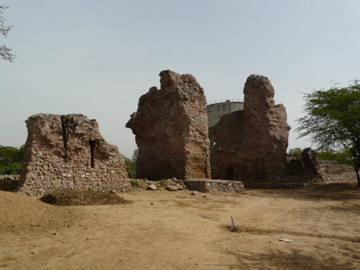
Le fort de Siri, dans la ville de Delhi, fut construit sous le règne d'Alauddin Khalji, deuxième souverain de la dynastie des Khalji, du sultanat de Delhi, pour défendre la ville contre les assauts des Mongols. Ce fut la deuxième des sept villes du Delhi médiéval, construite vers 1303, dont il ne subsiste aujourd'hui que des ruines et quelques vestiges, en raison de la qualité de construction inférieure à celle des forts précédemment édifiés en Inde (en photo).
À proximité des ruines du fort de Siri, des auditoriums modernes, le complexe du Village des jeux asiatiques ainsi que des établissements résidentiels et commerciaux occupent aujourd'hui le paysage moderne, entre le Khel Gaon Marg et l'Aurobindo Marg, au cœur du sud de Delhi.
Traduction automatique de « Siri Fort » de la Wikipédia en anglais, CC BY-SA 4.0.
Siri Fort occupe la 2 061e place sur 8 134 au classement de renommée de cet atlas et le 75e rang des 179 que l’atlas recense en Inde. Sa fondation, en 1303, est antérieure à celle de 62 % des monuments datés de l’atlas — l’un des 604 monuments de l’atlas fondés au XIVe siècle. Ses articles Wikipédia ont été ouverts 3 079 fois en 60 jours, plus que 76 % de l’atlas. Dans un rayon de 25 km se dressent 8 autres monuments de l’atlas. Le guide d’excursion le plus proche est Delhi, à 13 km. Voyez comment l’Inde se compare dans les statistiques des châteaux.
Voir sur la carte interactive des châteaux →Questions fréquentes
Où se trouve Siri Fort ?
Siri Fort se trouve en Inde, aux coordonnées 28.5524°, 77.2235°.
De quand date Siri Fort ?
L’atlas retient comme fondation 1303. Des constructions antérieures ont pu occuper le site ; c’est l’année de fondation documentée la plus ancienne.
Quelle est la renommée de Siri Fort ?
Au classement de renommée de cet atlas : 2 061e place sur 8 134 dans le monde, 75e place en Inde. La renommée combine le nombre d’éditions de Wikipédia qui couvrent un monument et leur lectorat.
Quel château est le plus proche de Siri Fort ?
Qila Rai Pithora, à environ 3 km.
D’autres châteaux en Inde
- Akhnoor Fort Inde · XVIIIe siècle
- Jahangir Mahal Inde · XVIIe siècle
- Palais de Marbre (Calcutta) Inde · XIXe siècle
- Ita Fort Inde · XVe siècle
D’autres ruines
- Ghumdan Palace Yémen · VIIIe siècle av. J.-C.
- Palais d'Antiochos Turquie · Ve siècle
- Palais de Lausos Turquie · Ve siècle
- Tour de la Parada Espagne · XVIe siècle