Vesting
Fort Queenscliff
🇦🇺 Australië · 19e eeuw
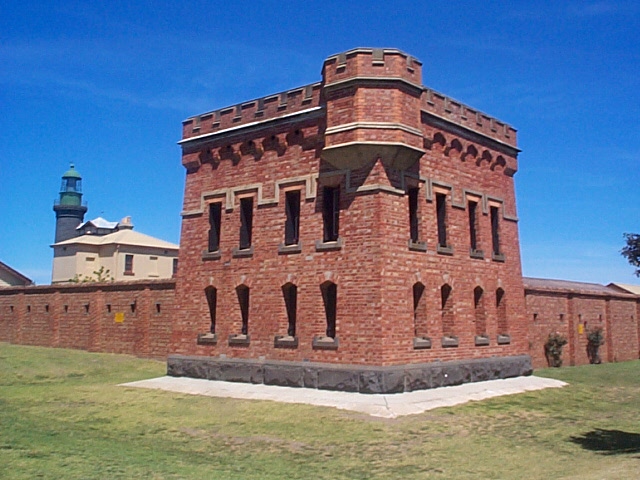
Fort Queenscliff, in Victoria, Australië, dateert uit 1860, toen op Shortland's Bluff een open batterij werd aangelegd ter verdediging van de ingang van Port Phillip. Het fort, dat eind jaren 1870 en in de jaren 1880 een grote uitbreiding onderging, werd het hoofdkwartier van een uitgebreide keten forten rondom Port Phillip Heads. Het garnizoen omvatte vrijwillige artillerie, genietroepen, infanterie en marinemilitie, en het fort werd van 1883 tot 1946 ononderbroken bemand als kustverdedigingsinstallatie. De overige vestingwerken en bewapening rondom de Heads waren in 1891 voltooid, en samen maakten zij Port Phillip tot een van de zwaarst verdedigde havens van het Britse Rijk.
De eerste geallieerde schoten van de Eerste Wereldoorlog werden afgevuurd toen een kanon bij Fort Nepean over de boeg schoot van het Duitse vrachtschip Pfalz, dat probeerde naar zee te ontsnappen. Het bevel om te schieten kwam van Fort Queenscliff. Datzelfde kanon, met een andere loop, vuurde ook het eerste geallieerde schot van de Tweede Wereldoorlog af. Tegen 1946 was kustartillerie verouderd, en het fort werd de thuisbasis van het Army Command and Staff College. Nadat de drie Service Staff Colleges werden samengevoegd tot het Australian Defence College in Canberra, werd het in 2001 de basis van het Soldier Career Management Agency van het leger.
Fort Queenscliff ligt in het Borough of Queenscliffe, zo'n 106 km van Melbourne, aan de westzijde van de ingang van Port Phillip. Het beslaat een gebied van 6,7 hectare op het hoge terrein bekend als Shortland's Bluff en kijkt uit over de scheepvaartroutes naar Melbourne en Geelong. Het fort is een prachtig voorbeeld van de verdedigingswerken die vanaf de koloniale tijd tot aan het einde van de Tweede Wereldoorlog langs de Australische kustlijn bestonden.
Machinaal vertaald uit “Fort Queenscliff” op de Engelstalige Wikipedia, CC BY-SA 4.0.
Fort Queenscliff staat op plaats 6.727 van 8.134 in de bekendheidsranglijst van deze atlas en op plaats 7 van de 14 die de atlas in Australië in kaart brengt. Gebouwd in 1891 — een van de 607 bouwwerken in de atlas die uit de 19e eeuw stammen. Binnen 25 km staan nog 2 andere bouwwerken uit de atlas. Zie hoe dat zich verhoudt in de kastelenstatistiek.
Bekijk op de interactieve kastelenkaart →Veelgestelde vragen
Waar ligt Fort Queenscliff?
Fort Queenscliff ligt in Australië, op -38.27226°, 144.66028°.
Wanneer werd Fort Queenscliff gebouwd?
De atlas dateert de stichting op 1891. Er kunnen eerdere bouwwerken hebben gestaan; dit is het oudste gedocumenteerde bouwjaar.
Hoe bekend is Fort Queenscliff?
In de bekendheidsranglijst van deze atlas: plaats 6.727 van 8.134 wereldwijd, plaats 7 in Australië. Bekendheid combineert het aantal Wikipedia-taalversies met het aantal lezers.
Welk kasteel ligt het dichtst bij Fort Queenscliff?
Fort Nepean, ongeveer 3 km verderop.
Meer kastelen in Australië
- Fort Macquarie Australië · 19e eeuw
- Fort Lytton Australië
- Fort Banks Australië · 20e eeuw
- Fort Cowan Cowan Australië · 20e eeuw
Meer vestingen
- Sqala of Kasbah Marokko · 18e eeuw
- Fort Gouraya Algerije
- Fort Wint Filipijnen · 20e eeuw
- Fort Tabarka Tunesië · 16e eeuw